SBASAU7C December 2024 – July 2025 ADC3548 , ADC3549
PRODUCTION DATA
- 1
- 1 Features
- 2 Applications
- 3 Description
- 4 Device Comparison
- 5 Pin Configuration and Functions
-
6 Specifications
- 6.1 Absolute Maximum Ratings
- 6.2 ESD Ratings
- 6.3 Recommended Operating Conditions
- 6.4 Thermal Information
- 6.5 Electrical Characteristics - Power Consumption
- 6.6 Electrical Characteristics - DC Specifications
- 6.7 Electrical Characteristics - AC Specifications (ADC3548 - 250 MSPS)
- 6.8 Electrical Characteristics - AC Specifications (ADC3549 - 500 MSPS)
- 6.9 Timing Requirements
- 6.10 Typical Characteristics - ADC3548 (250MSPS)
- 6.11 Typical Characteristics - ADC3549 (500MSPS)
- 7 Parameter Measurement Information
- 8 Detailed Description
- 9 Application and Implementation
- 10Device and Documentation Support
- 11Revision History
- 12Mechanical, Packaging, and Orderable Information
Package Options
Mechanical Data (Package|Pins)
- RTD|64
Thermal pad, mechanical data (Package|Pins)
- RTD|64
Orderable Information
8.3.2 Sampling Clock
The sampling clock input is designed to be driven differentially with external AC coupling and termination. The ADC provides internal common mode voltage biasing as shown in Figure 8-8.
 Figure 8-8 Sampling Clock Input
Circuitry
Figure 8-8 Sampling Clock Input
CircuitryThe internal sampling clock path was designed for low residual phase noise contribution. The sampling clock circuitry requires a dedicated, low noise power supply for best phase noise and jitter performance. The internal residual clock phase noise is also sensitive to clock amplitude.
The internal residual clock noise consists of two components - phase noise and amplitude noise as shown in Table 8-1. The phase noise scales with input frequency and sampling rate (20*log(fIN/FS)) while the amplitude noise does not scale.
| Frequency Offset (MHz) | Phase Noise (dBc/Hz) | Amplitude Noise (dBc/Hz) |
|---|---|---|
| 0.001 | -130 | -129 |
| 0.01 | -140 | -139 |
| 0.1 | -150 | -149 |
| 1 | -160 | -159 |
| 3 | -165 | -164 |
| 10 | -165 | -164 |
Figure 8-9 and Figure 8-10 show the phase and amplitude noise at three different input frequencies.
 Figure 8-9 Phase Noise
Examples
Figure 8-9 Phase Noise
Examples Figure 8-10 Amplitude Noise
Examples
Figure 8-10 Amplitude Noise
ExamplesThe internal clock noise is also dependent on the external clock amplitude. Figure 8-11 to Figure 8-14 show the expected AC performance for different input frequencies across clock amplitude.

| FS = 500MSPS | FIN = 100MHz | AIN = -1dBFS |
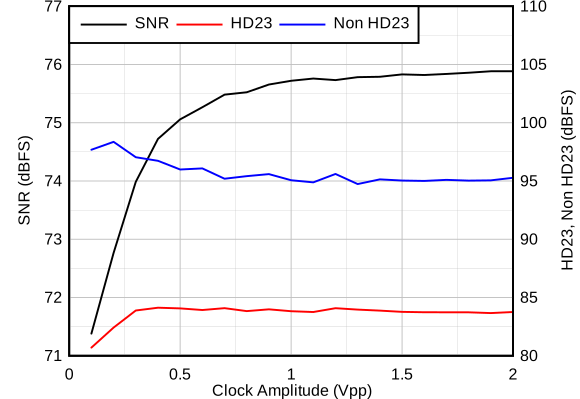
| FS = 250MSPS | FIN = 100MHz | AIN = -1dBFS |

| FS = 500MSPS | FIN = 400MHz | AIN = -1dBFS |
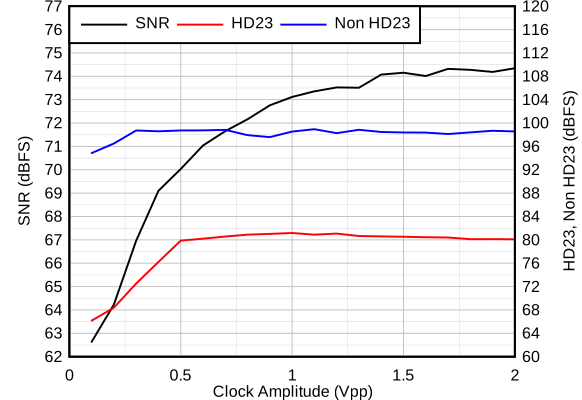
| FS = 250MSPS | FIN = 240MHz | AIN = -1dBFS |