SNAS843C December 2024 – July 2025 CDC6C
PRODUCTION DATA
- 1
- 1 Features
- 2 Applications
- 3 Description
- 4 Device Comparison
- 5 Pin Configuration and Functions
- 6 Specifications
- 7 Parameter Measurement Information
- 8 Detailed Description
- 9 Application and Implementation
- 10Device and Documentation Support
- 11Revision History
- 12Mechanical, Packaging, and Orderable Information
Package Options
Refer to the PDF data sheet for device specific package drawings
Mechanical Data (Package|Pins)
- DLX|4
- DLF|4
- DLE|4
- DLY|4
Thermal pad, mechanical data (Package|Pins)
Orderable Information
3 Description
Texas Instruments' high-precision Bulk-Acoustic Wave (BAW) micro-resonator technology is integrated directly into a package allowing for low jitter clock circuitry. BAW is fully designed and manufactured at TI factories like other silicon-based fabrication processes.
The CDC6Cx device is a low jitter, low power, fixed-frequency oscillator which incorporates the BAW as the resonator source. The device is factory-programmed per specific frequency and function pin. With a frequency control logic and output frequency divider, the CDC6Cx is capable of producing any frequency within the specified range providing a single device family for all frequency needs.
The high-performance clocking, mechanical stability, lower power consumption, and small package options for this device are designed for reference clock and core clocks in Industrial, Telecom, Data and Enterprise Network and Personal Electronics end equipments.
| PART NUMBER | OUTPUT TYPE | PACKAGE(1) | FREQUENCY STABILITY(2) | PACKAGE SIZE3 |
|---|---|---|---|---|
| CDC6Cx | LVCMOS |
VSON (DLE-4) |
±25ppm | 3.20mm × 2.50mm |
| VSON (DLF-4) | ±25ppm | 2.50mm × 2.00mm | ||
|
VSON (DLX-4) |
±25ppm | 2.00mm × 1.60mm | ||
| VSON (DLY-4) | ±50ppm ±25ppm(4) |
1.60mm × 1.20mm |
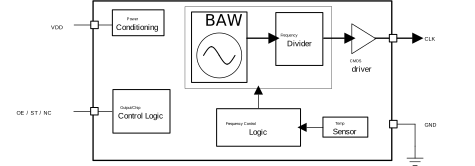 CDC6Cx
Simplified Block Diagram
CDC6Cx
Simplified Block Diagram