SLVSHC7B December 2023 – September 2025 DRV8334
PRODUCTION DATA
- 1
- 1 Features
- 2 Applications
- 3 Description
- 4 Pin Configuration and Functions
- 5 Specification
-
6 Detailed Description
- 6.1 Overview
- 6.2 Functional Block Diagram
- 6.3
Feature Description
- 6.3.1 Three BLDC Gate Drivers
- 6.3.2 Low-Side Current Sense Amplifiers
- 6.3.3 Gate Driver Shutdown
- 6.3.4
Gate Driver Protective Circuits
- 6.3.4.1 PVDD Supply Undervoltage Warning (PVDD_UVW)
- 6.3.4.2 PVDD Supply Undervoltage Lockout (PVDD_UV)
- 6.3.4.3 PVDD Supply Overvoltage Fault (PVDD_OV)
- 6.3.4.4 GVDD Undervoltage Lockout (GVDD_UV)
- 6.3.4.5 GVDD Overvoltage Fault (GVDD_OV)
- 6.3.4.6 BST Undervoltage Lockout (BST_UV)
- 6.3.4.7 BST Overvoltage Fault (BST_OV)
- 6.3.4.8 VCP Undervoltage Fault (CP_OV)
- 6.3.4.9 VCP Overvoltage Fault (CP_OV)
- 6.3.4.10 VDRAIN Undervoltage Fault (VDRAIN_UV)
- 6.3.4.11 VDRAIN Overvoltage Fault (VDRAIN_OV)
- 6.3.4.12 MOSFET VGS Monitoring Protection
- 6.3.4.13 MOSFET VDS Overcurrent Protection (VDS_OCP)
- 6.3.4.14 VSENSE Overcurrent Protection (SEN_OCP)
- 6.3.4.15 Phase Comparators
- 6.3.4.16 Thermal Shutdown (OTSD)
- 6.3.4.17 Thermal Warning (OTW)
- 6.3.4.18 OTP CRC
- 6.3.4.19 SPI Watchdog Timer
- 6.3.4.20 Phase Diagnostic
- 6.4 Device Functional Modes
- 6.5 Programming
- 7 Register Maps
- 8 Application and Implementation
- 9 Device and Documentation Support
- 10Revision History
- 11Mechanical, Packaging, and Orderable Information
Package Options
Mechanical Data (Package|Pins)
Thermal pad, mechanical data (Package|Pins)
- PHP|48
Orderable Information
6.3.4.12 MOSFET VGS Monitoring Protection
The DRV8334 utilizes integrated gate to source voltage (VGS) monitors to monitor the state of the external MOSFETs. When the output state of the MOSFETs is commanded OFF (INxx = low), the monitor provides that the output stays turned off. If at any point the VGS voltage exceeds the VGS threshold for a duration longer than tvgs_dg, the nFAULT pin is driven low and the VGS_XX flag is set for the corresponding output channel. When the output state of the MOSFETs is commanded ON (INxx = high), the monitor verifies that the output turns on and the MOSFETs are driven with sufficient VGS to be strongly enhanced. If at any point the VGS drops below the VGS threshold for a duration longer than tvgs_dg, the nFAULT pin is driven low and the VGS_XX flag is set for the corresponding output channel. The VGS monitor blanking time can be adjusted through the VGS_BLK register field. TI recommends to set this value based on the expected switching time for the external MOSFETs. The VGS monitor deglitch time can be adjusted through the VGS_DEG register field. The deglitch timer does not start until after the VGS blanking time has elapsed following a rising/falling PWM signal. TI recommends to set this value based on the system noise level and acceptable fault tolerance timing.
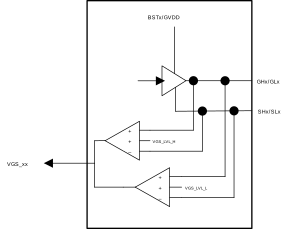 Figure 6-16 DRV8334
VGS Monitors
Figure 6-16 DRV8334
VGS Monitors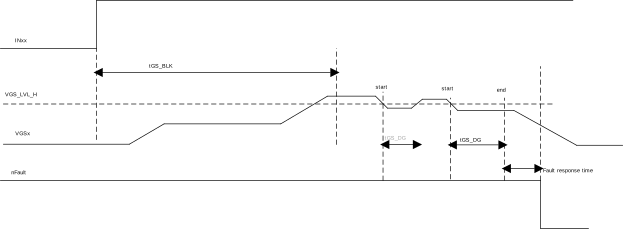 Figure 6-17 DRV8334
VGS Monitor Timing (Output High)
Figure 6-17 DRV8334
VGS Monitor Timing (Output High) Figure 6-18 DRV8334
VGS Monitor Timing (Output Low)
Figure 6-18 DRV8334
VGS Monitor Timing (Output Low)