SLVSI02 May 2025 DRV8376-Q1
PRODUCTION DATA
- 1
- 1 Features
- 2 Applications
- 3 Description
- 4 Device Comparison Table
- 5 Pin Configuration and Functions
- 6 Specifications
-
7 Detailed Description
- 7.1 Overview
- 7.2 Functional Block Diagram
- 7.3
Feature Description
- 7.3.1 Output Stage
- 7.3.2 Control Modes
- 7.3.3 Device Interface Modes
- 7.3.4 AVDD and GVDD Linear Voltage Regulator
- 7.3.5 Charge Pump
- 7.3.6 Slew Rate Control
- 7.3.7 Cross Conduction (Dead Time)
- 7.3.8 Propagation Delay
- 7.3.9 Pin Diagrams
- 7.3.10 Current Sense Amplifiers
- 7.3.11 Active Demagnetization
- 7.3.12 Cycle-by-Cycle Current Limit
- 7.3.13
Protections
- 7.3.13.1 VM Supply Undervoltage Lockout (RESET)
- 7.3.13.2 AVDD Undervoltage Protection (AVDD_UV)
- 7.3.13.3 GVDD Undervoltage Lockout (GVDD_UV)
- 7.3.13.4 VCP Charge Pump Undervoltage Lockout (CPUV)
- 7.3.13.5 Overvoltage Protections (OV)
- 7.3.13.6 Overcurrent Protection (OCP)
- 7.3.13.7 Thermal Warning (OTW)
- 7.3.13.8 Thermal Shutdown (OTS)
- 7.4 Device Functional Modes
- 7.5 SPI Communication
- 8 Register Map
- 9 Application and Implementation
- 10Device and Documentation Support
- 11Revision History
- 12Mechanical, Packaging, and Orderable Information
Package Options
Mechanical Data (Package|Pins)
- NLG|28
Thermal pad, mechanical data (Package|Pins)
- NLG|28
Orderable Information
7.3.12 Cycle-by-Cycle Current Limit
The current-limit circuitry utilizes the current sense amplifier output of the three phases compared with the voltage at ILIMIT pin. Figure 7-28 shows the implementation of current limit circuitry, the output of current sense amplifiers are combined with star connected resistive network. This measured voltage VMEAS is compared with the external reference voltage VLIM on ILIMIT pin to realize the current limit implementation. The relation between current sensed on three phases (IOUTx) and VMEAS threshold is given as:
where
- VVREFis the current sense amplifier supply
- IOUTX is current flowing into the low-side MOSFET
- CSA_GAIN is the current sense amplifier gain
The current limit threshold can be adjusted by configuring the voltage at ILIMIT pin. Current limit varies linearly between 0A to 4A, as the voltage at ILIMIT pin varies from VREF/2 to VMEAS. A voltage more than VVREF can be applied to disable ILIMIT.
Current limit comparator output is blanked for a blanking time, on every rising edge of high side and low side switch control input (INHx and INLx) and the DRV8376 output state depends on the INHx and INLx status during blanking time. The blanking time is configured through ILIM_BLANK_SEL in SPI device and the blanking time is fixed to 5.5us for slew rate of 50 and 1.8us for all other slew rates in hardware variant.
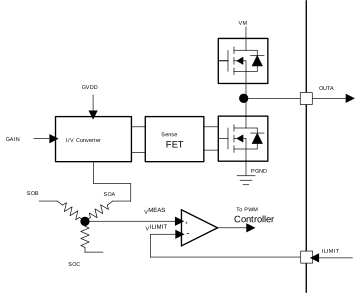 Figure 7-28 Current Limit Implementation
When then the current limit activates, the high-side FET of each half bride is disabled until the rising edge of the high side (INHx) of that half bridge as shown in Figure 7-29. The low-side FETs can operate in brake mode or Coast (high-Z) mode by configuring the ILIM_MODE bit