SNIS237A December 2024 – April 2025 TMP118
PRODUCTION DATA
- 1
- 1 Features
- 2 Applications
- 3 Description
- 4 Device Comparison
- 5 Pin Configuration and Functions
- 6 Specifications
- 7 Detailed Description
-
8 Device Registers
- 8.1
Register Map
- 8.1.1 Temp_Result Register (address = 00h) [reset = 0000h]
- 8.1.2 Configuration Register (address = 01h) [reset = 60B0h]
- 8.1.3 TLow_Limit Register (address = 02h) [reset = 2580h]
- 8.1.4 THigh_Limit Register (address = 03h) [reset = 2800h]
- 8.1.5 Device ID Register (Address = 0Bh) [reset = 1180h]
- 8.1.6 Unique_ID0 Register (Address = 0Ch) [reset = xxxxh]
- 8.1.7 Unique_ID1 Register (Address = 0Dh) [reset = xxxxh]
- 8.1.8 Unique_ID2 Register (Address = 0Eh) [reset = xxxxh]
- 8.1
Register Map
- 9 Application and Implementation
- 10Device and Documentation Support
- 11Revision History
- 12Mechanical, Packaging, and Orderable Information
Package Options
Refer to the PDF data sheet for device specific package drawings
Mechanical Data (Package|Pins)
- YMS|4
Thermal pad, mechanical data (Package|Pins)
Orderable Information
7.3.3 Temperature Comparator and Hysteresis
The TMP118 has a temperature comparator feature that uses the THigh_Limit register for high temperature comparator threshold and the TLow_Limit register for low temperature comparator threshold. The low temperature comparator threshold is used to program the comparator hysteresis. The comparator thresholds are programmed in the TMP118 in a 16-bit two's complement format and with a resolution of 7.8125m°C. The Alert_Flag bit in the Configuration register is asserted when the temperature result equals or exceeds the THigh_Limit for a consecutive number of conversions as set by the Fault bits in the Configuration Register, which can be programmed to 1, 2, 4, or 6 consecutive conversions. The Alert_Flag clears when the temperature result drops below the TLow_Limit for the same consecutive number of conversions. The difference between the two limits acts as a hysteresis on the comparator output, and the fault counter prevents false alerts as a result of environmental temperature fluctuations. The Alert_Flag can be programmed to active low or active high by configuring the Polarity bit in the Configuration Register.
As shown in Figure 7-5, the alert status becomes active when the temperature equals or exceeds the value in THigh_Limit for Fault number of consecutive conversions. The alert status remains active until the temperature falls below the TLow_Limit for the same number of consecutive conversions. The Alert_Flag can also be cleared by issuing the General Call Reset command.
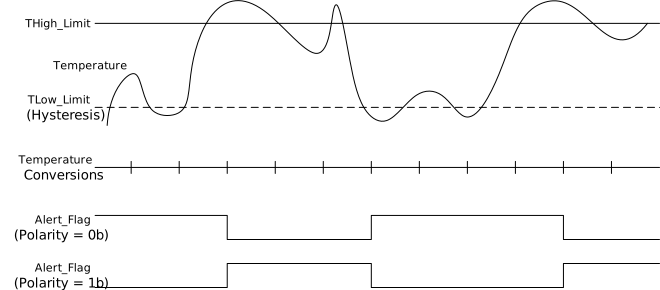 Figure 7-5 Alert_Flag Behavior