SLOSEG3 October 2025 TRF1305A2
PRODUCTION DATA
- 1
- 1 Features
- 2 Applications
- 3 Description
- 4 Device Comparison Table
- 5 Pin Configuration and Functions
-
6 Specifications
- 6.1 Absolute Maximum Ratings
- 6.2 ESD Ratings
- 6.3 Recommended Operating Conditions
- 6.4 Thermal Information
- 6.5 Electrical Characteristics - AC Specifications in D2D Configuration
- 6.6 Electrical Characteristics - AC Specifications in S2D Configuration
- 6.7 Electrical Characteristics - DC and Timing Specifications
- 6.8 Typical Characteristics: D2D Configuration
- 6.9 Typical Characteristics: S2D Configuration
- 7 Detailed Description
- 8 Application and Implementation
- 9 Device and Documentation Support
- 10Revision History
- 11Mechanical, Packaging, and Orderable Information
Package Options
Refer to the PDF data sheet for device specific package drawings
Mechanical Data (Package|Pins)
- RYP|16
Thermal pad, mechanical data (Package|Pins)
Orderable Information
8.1.1.1 Single-Ended Input
In the single-ended input configuration, one of the amplifier input pins is driven from a source while the other input is terminated with an external resistor. Figure 8-1 shows a dc-coupled, single-ended input configuration driven from and matched to a 50Ω source. Figure 8-1 shows how the non-driven INM pin is terminated with an external resistor to match to a source with the same 50Ω impedance at the INP pin.
CSH in Figure 8-1 is typically open. The performance curves shown in Section 6.9 are with input de-embedded up to device input pin, and output de-embedded up to device output pins. Therefore, Sss11 shown in Section 6.9 represents the input return loss at the amplifier input. The input return loss (Sss11) at CSH is improved by installing CSH with a value of 0.3pF. Figure 8-3 shows this improvement without impacting the frequency flatness within the amplifier bandwidth in Figure 8-2. Using CSH does not impact on noise figure and linearity.
 Figure 8-1 DC-Coupled, Single-Ended Input
Matched to a 50Ω Source
Figure 8-1 DC-Coupled, Single-Ended Input
Matched to a 50Ω Source
| At TA = 25℃, VS = 5V, input de-embedded up to CSH |
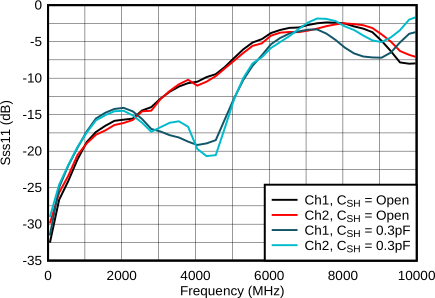
| At TA = 25℃, VS = 5V, input de-embedded up to CSH |
Figure 8-4 shows how to configure the design in Figure 8-1 for single-ended, ac-coupled input by adding ac-coupling capacitors in series at the input and output.
 Figure 8-4 AC-Coupled, Single-Ended Input
Matched to a 50Ω Source
Figure 8-4 AC-Coupled, Single-Ended Input
Matched to a 50Ω Source