SLUSF25A September 2025 – November 2025 UCC27834 , UCC27884
PRODUCTION DATA
- 1
- 1 Features
- 2 Applications
- 3 Description
- 4 Pin Configuration and Functions
- 5 Specifications
- 6 Detailed Description
-
7 Application and Implementation
- 7.1 Application Information
- 7.2
Typical Application
- 7.2.1 Design Requirements
- 7.2.2
Detailed Design Procedure
- 7.2.2.1 Selecting HI and LI Low Pass Filter Components (RHI, RLI, CHI, CLI)
- 7.2.2.2 Selecting Bootstrap Capacitor (CBOOT)
- 7.2.2.3 Selecting VDD Bypass Capacitor (CVDD)
- 7.2.2.4 Selecting Bootstrap Resistor (RBOOT)
- 7.2.2.5 Selecting Gate Resistor RON/ROFF
- 7.2.2.6 Selecting Bootstrap Diode
- 7.2.2.7 Estimate the UCC278X4 Power Losses
- 7.2.3 Application Curves
- 7.3 Power Supply Recommendations
- 7.4 Layout
- 8 Device and Documentation Support
- 9 Revision History
- 10Mechanical, Packaging, and Orderable Information
6.3.1 Input Stages and Interlock
The two inputs (HI and LI) operate independently. The independence allows for full control of two outputs compared to the gate drivers that have a single input. The UCC27834 device has input interlock or cross-conduction protection. Whenever both the inputs are high, the internal logic turns both the outputs (HO and LO) off. Once the device is in this mode, when one of the inputs goes low, the outputs follow the input logic. There is no other fixed time deglitch filter implemented in the device and therefore propagation delay and delay matching are not sacrificed. In other words, there is no built-in dead-time due to the interlock feature.
The inputs are TTL-logic compatible. The device can also work with CMOS type control signals at the inputs as long as the signals meet the turn-on and turn-off threshold specifications of the device. Because the inputs are independent of supply voltage, the inputs can be connected to outputs of either digital controller or analog controller. The inputs can accept wide slew rate signals and can withstand a wide input voltage range to increase the robustness and flexibility. A small RC filter at the inputs of the driver can further improve system robustness in noise prone applications. The inputs have internal pull down resistors with typical value of 150kΩ. Thus, when the inputs are floating, the outputs are held low.
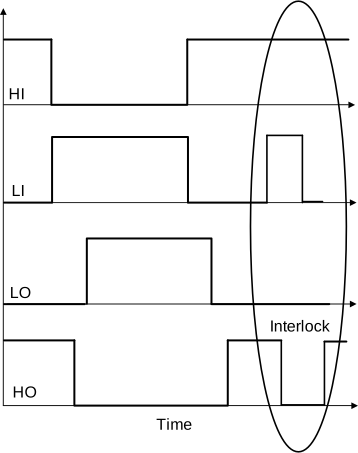 Figure 6-2 Interlock or Input
Shoot-Through Protection (UCC27834)
Figure 6-2 Interlock or Input
Shoot-Through Protection (UCC27834) Figure 6-3 No Interlock or Input
Shoot-Through Protection (UCC27884)
Figure 6-3 No Interlock or Input
Shoot-Through Protection (UCC27884)