SLUSBV4C June 2018 – June 2025 BQ40Z80
PRODUCTION DATA
- 1
- 1 Features
- 2 Applications
- 3 Description
- 4 Pin Configuration and Functions
- 5 Specifications
-
6 Detailed Description
- 6.1 Overview
- 6.2 Functional Block Diagram
- 6.3
Feature Description
- 6.3.1 Primary (1st Level) Safety Features
- 6.3.2 Secondary (2nd Level) Safety Features
- 6.3.3 Charge Control Features
- 6.3.4 Gas Gauging
- 6.3.5 Multifunction Pins
- 6.3.6 Configuration
- 6.3.7 Battery Parameter Measurements
- 6.3.8 Lifetime Data Logging Features
- 6.3.9 Authentication
- 6.3.10 Tamper Protection
- 6.3.11 LED Display
- 6.3.12 IATA Support
- 6.3.13 Voltage
- 6.3.14 Current
- 6.3.15 Temperature
- 6.3.16 Communications
- 6.4 Device Functional Modes
-
7 Applications and Implementation
- 7.1 Application Information Disclaimer
- 7.2 Application Information
- 7.3 Typical Applications
- 7.4 Power Supply Recommendations
- 7.5 Layout
- 8 Device and Documentation Support
- 9 Revision History
- 10Mechanical, Packaging, and Orderable Information
Package Options
Mechanical Data (Package|Pins)
- RSM|32
Thermal pad, mechanical data (Package|Pins)
- RSM|32
Orderable Information
7.5.1 Layout Guidelines
A battery fuel gauge circuit board is a challenging environment due to the fundamental incompatibility of high-current traces and ultra-low current semiconductor devices. The best way to protect against unwanted trace-to-trace coupling is with a component placement, where the high-current section is on the opposite side of the board from the electronic devices. Component placement is shown in Figure 7-3. This component placement is not possible in many situations due to mechanical constraints. Make every attempt to route high-current traces away from signal traces which enter the BQ40Z80 directly. IC references and registers can be disturbed and in rare cases damaged due to magnetic and capacitive coupling from the high-current path.
During surge current and ESD events, the high-current traces appear inductive and can couple unwanted noise into sensitive nodes of the gas gauge electronics, as shown in Figure 7-4.
 Figure 7-3 Separating High- and Low-Current Sections Provides an Advantage in Noise Immunity
 Figure 7-4 Avoid Close Spacing Between High-Current and Low-Level Signal Lines
Kelvin voltage sensing is important to accurately measure current and top and bottom cell voltages. Place all filter components as close as possible to the device. Route the traces from the sense resistor in parallel to the filter circuit. Adding a ground plane around the filter network can add additional noise immunity. Figure 7-5 and Figure 7-6 demonstrate correct kelvin current sensing.
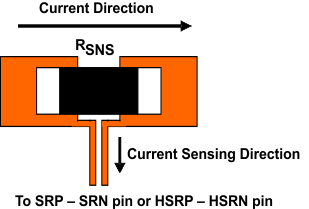 Figure 7-5 Sensing Resistor PCB Layout
 Figure 7-6 Sense Resistor, Ground Shield, and Filter Circuit Layout