SLDS274A September 2024 – March 2025 DRV81242-Q1
PRODUCTION DATA
- 1
- 1 Features
- 2 Applications
- 3 Description
- 4 Device Comparison
- 5 Pin Configuration and Functions
- 6 Specifications
-
7 Detailed Description
- 7.1 Overview
- 7.2 Functional Block Diagram
- 7.3
Feature Description
- 7.3.1 Control Pins
- 7.3.2 Power Supply
- 7.3.3 Power Stage
- 7.3.4
Protection and Diagnostics
- 7.3.4.1 Undervoltage on VM
- 7.3.4.2 Overcurrent Protection
- 7.3.4.3 Over Temperature Protection
- 7.3.4.4 Over Temperature Warning
- 7.3.4.5 Over Temperature and Overcurrent Protection in Limp Home Mode
- 7.3.4.6 Reverse Polarity Protection
- 7.3.4.7 Over Voltage Protection
- 7.3.4.8 Output Status Monitor
- 7.3.4.9 Open Load Detection in ON State
- 7.3.5
SPI Communication
- 7.3.5.1 SPI Signal Description
- 7.3.5.2 Daisy Chain Capability
- 7.3.5.3 SPI Protocol
- 7.3.5.4
SPI Registers
- 7.3.5.4.1 Standard Diagnosis Register
- 7.3.5.4.2 Output control register
- 7.3.5.4.3 Bulb Inrush Mode Register
- 7.3.5.4.4 Input 0 Mapping Register
- 7.3.5.4.5 Input 1 Mapping Register
- 7.3.5.4.6 Input Status Monitor Register
- 7.3.5.4.7 Open Load Current Control Register
- 7.3.5.4.8 Output Status Monitor Register
- 7.3.5.4.9 Open Load at ON Register
- 7.3.5.4.10 EN_OLON Register
- 7.3.5.4.11 Configuration Register
- 7.3.5.4.12 Output Clear Latch Register
- 7.3.5.4.13 FPWM Register
- 7.3.5.4.14 PWM0 Configuration Register
- 7.3.5.4.15 PWM1 Configuration Register
- 7.3.5.4.16 PWM_OUT Register
- 7.3.5.4.17 MAP_PWM Register
- 7.3.5.4.18 Configuration 2 Register
- 8 Application and Implementation
- 9 Device and Documentation Support
- 10Revision History
- 11Mechanical, Packaging, and Orderable Information
Package Options
Mechanical Data (Package|Pins)
- PWP|24
Thermal pad, mechanical data (Package|Pins)
- PWP|24
Orderable Information
7.3.5.3 SPI Protocol
The relationship between SDI and SDO content during SPI communication is shown in Figure 7-27. SDI line represents the frame sent from the microcontroller and SDO line is the answer provided by the device.
 Figure 7-27 Relationship Between SDI and
SDO During SPI Communication
Figure 7-27 Relationship Between SDI and
SDO During SPI CommunicationThe SPI protocol provides the answer to a command frame only with the next transmission triggered by the microcontroller. Although the biggest majority of commands and frames implemented in the device can be decoded without the knowledge of what happened before, considering what the microcontroller sent in the previous transmission to decode the response frame completely is advisable. The sequence of commands to read and write the content of a register looks as follows:
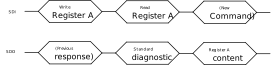 Figure 7-28 Register content sent back to
microcontroller
Figure 7-28 Register content sent back to
microcontrollerThere are 3 special situations where the frame sent back to the microcontroller is not related directly to the previous received frame:
- In case an error in transmission happened during the previous frame (for instance, the clock pulses were not multiple of 8 with a minimum of 16 bits), shown below.
- When the logic supply comes out of Power-On reset condition or after a Software Reset, as shown below.
- In case of command syntax errors
- write command starting with 11b instead of 10b
- read command starting with 00b instead of 01b
- read or write commands on registers which are reserved or not used
 Figure 7-29 Response After a Error in
Transmission
Figure 7-29 Response After a Error in
Transmission Figure 7-30 Response After Coming Out Of
Power-On Reset at VDD
Figure 7-30 Response After Coming Out Of
Power-On Reset at VDD Figure 7-31 Response After a Command
Syntax Error
Figure 7-31 Response After a Command
Syntax ErrorA summary of all possible SPI commands is presented below, including the answer that the device sends back at the next transmission.
|
Requested Operation |
Frame sent to SDI pin |
Frame received from SDO pin with the next command |
| Read Standard Diagnosis | 0xxxxxxxxxxxxx01b (xxxxxxxxxxxxb = don 't care) |
0dddddddddddddddb (Standard Diagnosis) |
| Write 10 bit register | 10pppprrrrrrrrrrb where: ppppb = register address ADDR0, rrrrrrrrrrb = new register content | 0dddddddddddddddb (Standard Diagnosis) |
| Read 10 bit registers | 01ppppxxxxxxxx10b where: ppppb = register address ADDR0, xxxxxxxxb = don't care | 10pppprrrrrrrrrrb where: ppppb = register address ADDR0c, rrrrrrrrrrb = register content |
| Write 8 bit register | 10ppppqqrrrrrrrrb where: ppppb = register address ADDR0, qqb = register address ADDR1, rrrrrrrrb = new register content | 0dddddddddddddddb (Standard Diagnosis) |
| Read 8 bit registers | 01ppppqqxxxxxx10b where: ppppb = register address ADDR0, qqb = register address ADDR1, xxxxxxb = don't care | 10ppppqqrrrrrrrrb where: ppppb = register address ADDR0c, qqb = register address ADDR1, rrrrrrrrb = register content |
“p” = address bits for ADDR0 field, “q” = address bit for ADDR1 field, “r” = register content, “d” = diagnostic bit