SLVSI22 August 2025 DRV8844A
PRODUCTION DATA
- 1
- 1 Features
- 2 Applications
- 3 Description
- 4 Pin Configuration and Functions
- 5 Specifications
- 6 Detailed Description
- 7 Application and Implementation
- 8 Device and Documentation Support
- 9 Revision History
- 10Mechanical, Packaging, and Orderable Information
Package Options
Mechanical Data (Package|Pins)
- DGQ|28
Thermal pad, mechanical data (Package|Pins)
- DGQ|28
Orderable Information
6.3.3 Bridge Control
The INx input pins directly control the state (high or low) of the OUTx outputs; the ENx input pins enable or disable the OUTx driver. Table 6-1 shows the logic.
| INx | ENx | OUTx |
|---|---|---|
| X | 0 | Z |
| 0 | 1 | L |
| 1 | 1 | H |
The inputs can also be used for PWM control of, for example, the speed of a DC motor. When controlling a winding with PWM, when the drive current is interrupted, the inductive nature of the motor requires that the current must continue to flow. This is called recirculation current. To handle this recirculation current, the H-bridge can operate in two different states, fast decay or slow decay. In fast decay mode, the H-bridge is disabled and recirculation current flows through the body diodes; in slow decay, the motor winding is shorted.
To PWM using fast decay, the PWM signal is applied to the ENx pin; to use slow decay, the PWM signal is applied to the INx pin. Table 6-2 is an example of driving a DC motor using OUT1 and OUT2 as an H-bridge:
| IN1 | EN1 | IN2 | EN2 | FUNCTION |
|---|---|---|---|---|
| PWM | 1 | 0 | 1 | Forward PWM, slow decay |
| 0 | 1 | PWM | 1 | Reverse PWM, slow decay |
| 1 | PWM | 0 | PWM | Forward PWM, fast decay |
| 0 | PWM | 1 | PWM | Reverse PWM, fast decay |
Figure 6-2 shows the current paths in different drive and decay modes:
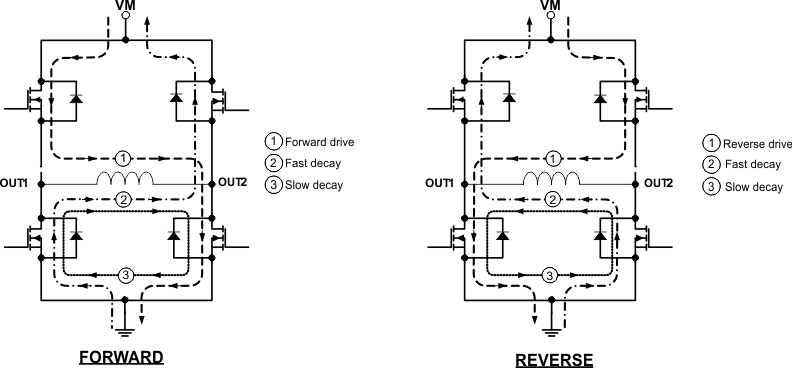 Figure 6-2 Current Paths