SNAS918 May 2025 LMK5C23208A
PRODUCTION DATA
- 1
- 1 Features
- 2 Applications
- 3 Description
- 4 Device Comparison
- 5 Pin Configuration and Functions
- 6 Specifications
- 7 Parameter Measurement Information
-
8 Detailed Description
- 8.1 Overview
- 8.2 Functional Block Diagram
- 8.3
Feature Description
- 8.3.1 Oscillator Input (XO)
- 8.3.2 Reference Inputs
- 8.3.3 Clock Input Interfacing and Termination
- 8.3.4 Reference Input Mux Selection
- 8.3.5 Hitless Switching
- 8.3.6 Gapped Clock Support on Reference Inputs
- 8.3.7 Input Clock and PLL Monitoring, Status, and Interrupts
- 8.3.8
PLL Relationships
- 8.3.8.1 PLL Frequency Relationships
- 8.3.8.2 Analog PLLs (APLL1, APLL2)
- 8.3.8.3 APLL Reference Paths
- 8.3.8.4 APLL Feedback Divider Paths
- 8.3.8.5 APLL Loop Filters (LF1, LF2)
- 8.3.8.6 APLL Voltage-Controlled Oscillators (VCO1, VCO2)
- 8.3.8.7 APLL VCO Clock Distribution Paths
- 8.3.8.8 DPLL Reference (R) Divider Paths
- 8.3.8.9 DPLL Time-to-Digital Converter (TDC)
- 8.3.8.10 DPLL Loop Filter (DLF)
- 8.3.8.11 DPLL Feedback (FB) Divider Path
- 8.3.9 Output Clock Distribution
- 8.3.10 Output Source Muxes
- 8.3.11 Output Channel Muxes
- 8.3.12 Output Dividers (OD)
- 8.3.13 SYSREF/1PPS Output
- 8.3.14 Output Delay
- 8.3.15 Clock Output Drivers
- 8.3.16 Clock Output Interfacing and Termination
- 8.3.17 Glitchless Output Clock Start-Up
- 8.3.18 Output Auto-Mute During LOL
- 8.3.19 Output Synchronization (SYNC)
- 8.3.20 Zero-Delay Mode (ZDM)
- 8.3.21 DPLL Programmable Phase Delay
- 8.3.22 Time Elapsed Counter (TEC)
- 8.4 Device Functional Modes
- 8.5 Programming
-
9 Application and Implementation
- 9.1 Application Information
- 9.2 Typical Application
- 9.3 Best Design Practices
- 9.4 Power Supply Recommendations
- 9.5 Layout
- 10Device and Documentation Support
- 11Revision History
- 12Mechanical, Packaging, and Orderable Information
Package Options
Mechanical Data (Package|Pins)
- RGC|64
Thermal pad, mechanical data (Package|Pins)
- RGC|64
Orderable Information
8.2.2.1 Independent DPLL Operation
During independent DPLL operation, each DPLL can select a reference input (INx) as preferred. Each DPLLs can share the same reference or each can select a different reference. At start-up, each APLL locks to the XO input after initialization and operates in free-run mode. When a valid DPLL reference input is detected, each DPLL begins lock acquisition on based on the reference priority settings. The TDC in the DPLL compares the phase between the selected reference input clock and the FB divider clock from the respective VCO, generating a digital correction word corresponding to the phase error. The correction word is filtered by the digital loop filter (DLF), and the DLF output adjusts the APLL N divider numerator to pull the VCO frequency into lock with the reference input.
Since each DPLL can work independently in this mode, the DPLLs can lock or unlock without impacting other channels.
When selecting an XO input frequency, TI recommends to avoid ratios falling near integer or half integer boundaries to minimize spurious noise. The best practice is to select an XO input frequency that results in an APLL fractional N divider ratio (NUM/DEN) between the range of 0.125 to 0.45 and 0.55 to 0.875. Choosing a higher frequency XO is better for jitter performance, especially for the BAW APLL and APLL2 outputs. Cascade the BAW APLL output into APLL2 or APLL1 when the XO frequency or phase noise performance is poor.
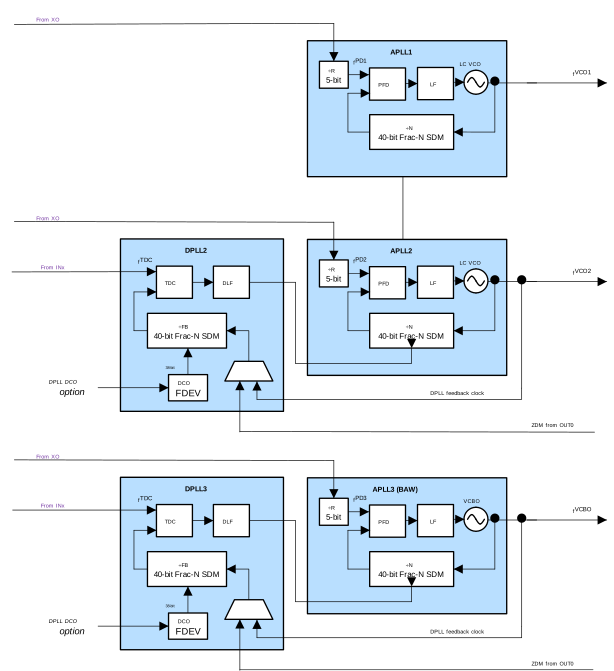 Figure 8-3 DPLL
Independent Mode
Figure 8-3 DPLL
Independent Mode