SBOS350B December 2006 – December 2024 OPA4830
PRODUCTION DATA
- 1
- 1 Features
- 2 Applications
- 3 Description
- 4 Related Products
- 5 Pin Configuration and Functions
-
6 Specifications
- 6.1 Absolute Maximum Ratings
- 6.2 ESD Ratings
- 6.3 Recommended Operating Conditions
- 6.4 Thermal Information
- 6.5 Electrical Characteristics VS = ±5V
- 6.6 Electrical Characteristics VS = 5V
- 6.7 Electrical Characteristics VS = 3V
- 6.8 Typical Characteristics: VS = ±5V
- 6.9 Typical Characteristics: VS = ±5V, Differential Configuration
- 6.10 Typical Characteristics: VS = 5V
- 6.11 Typical Characteristics: VS = 5V, Differential Configuration
- 6.12 Typical Characteristics: VS = 3V
- 6.13 Typical Characteristics: VS = 3V, Differential Configuration
- 7 Parameter Measurement Information
-
8 Application and Implementation
- 8.1
Application Information
- 8.1.1 Wideband Voltage-Feedback Operation
- 8.1.2 DC Level-Shifting
- 8.1.3 AC-Coupled Output Video Line Driver
- 8.1.4 Noninverting Amplifier With Reduced Peaking
- 8.1.5 Single-Supply Active Filter
- 8.1.6 Differential Interface Applications
- 8.1.7 DC-Coupled Single-to-Differential Conversion
- 8.1.8 Low-Power, Differential I/O, 4th-Order Active Filter
- 8.1.9 Dual-Channel, Differential ADC Driver
- 8.1.10 Video Line Driving
- 8.1.11 4-Channel DAC Transimpedance Amplifier
- 8.1.12 Operating Suggestions: Optimizing Resistor Values
- 8.1.13 Bandwidth vs Gain: Noninverting Operation
- 8.1.14 Inverting Amplifier Operation
- 8.1.15 Output Current and Voltages
- 8.1.16 Driving Capacitive Loads
- 8.1.17 Distortion Performance
- 8.1.18 Noise Performance
- 8.1.19 DC Accuracy and Offset Control
- 8.2 Power Supply Recommendations
- 8.3 Layout
- 8.1
Application Information
- 9 Device and Documentation Support
- 10Revision History
- 11Mechanical, Packaging, and Orderable Information
Package Options
Refer to the PDF data sheet for device specific package drawings
Mechanical Data (Package|Pins)
- PW|14
Thermal pad, mechanical data (Package|Pins)
Orderable Information
8.1.18 Noise Performance
High slew rate, unity-gain stable, voltage-feedback op amps usually achieve the slew rate at the expense of a higher input noise voltage. The 9.2nV/√ Hz input voltage noise for the OPA4830 however, is much lower than comparable amplifiers. The input-referred voltage noise and the two input-referred current noise terms (2.8pA/√ Hz) combine to give low output noise under a wide variety of operating conditions. Figure 8-18 shows the op amp noise analysis model with all the noise terms included. In this model, all noise terms are taken to be noise voltage or current density terms in either nV/√ Hz or pA/√ Hz.
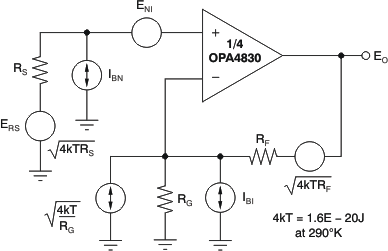 Figure 8-18 Noise Analysis Model
The total output spot noise voltage can be computed as the square root of the sum of all squared output noise voltage contributors. Equation 10 shows the general form for the output noise voltage using the terms shown in Figure 8-18:

Dividing this expression by the noise gain [ NG = (1 + RF/RG) ] gives the equivalent input-referred spot noise voltage at the noninverting input; this result is shown in Equation 11:

Evaluating these two equations for the circuit and component values shown in Figure 8-1 gives a total output spot noise voltage of 19.3nV/√ Hz and a total equivalent input spot noise voltage of 9.65nV/√ Hz. This value is including the noise added by the resistors. This total input-referred spot noise voltage is not much higher than the 9.2nV/√ Hz specification for the op amp voltage noise alone.