SBOSAL6A June 2025 – September 2025 XTR200
PRODUCTION DATA
- 1
- 1 Features
- 2 Applications
- 3 Description
- 4 Pin Configurations and Functions
- 5 Specifications
- 6 Detailed Description
- 7 Application and Implementation
- 8 Device and Documentation Support
- 9 Revision History
- 10Mechanical, Packaging, and Orderable Information
Package Options
Refer to the PDF data sheet for device specific package drawings
Mechanical Data (Package|Pins)
- DQC|10
Thermal pad, mechanical data (Package|Pins)
Orderable Information
7.2.2 Additional Applications
The XTR200 is useful in a variety of applications beyond voltage and current transmission. The wide supply and output current ranges, high output impedance, and excellent integration make the device well suited for sensor excitation as well as current monitoring in server power supply applications.
Current Sources for RTD Measurements
Resistance temperature detectors, or RTDs, are sensors which measure temperature through a change in resistance. RTDs are typically biased using a constant current source and then the temperature-dependent voltage across the sensor can be measured. Figure 7-2 illustrates a 2-wire ratiometric RTD measurement system employing the XTR200 as a current source. The excitation current produced by the XTR200, IEXC, flows through the RTD as well as a reference resistor, RREF, which produces the reference voltage for the ADC.
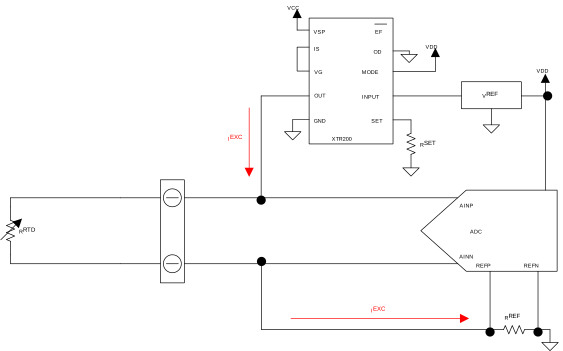 Figure 7-10 XTR200 Used as an Excitation
Current Source in a 2-Wire, Ratiometric, RTD Measurement
Figure 7-10 XTR200 Used as an Excitation
Current Source in a 2-Wire, Ratiometric, RTD MeasurementA 3-wire RTD measurement, for lead resistance cancellation, is shown in Figure 7-11. Using a single input voltage source for the two XTR200s, and matching the RSET resistors maintains good matching between the two excitation currents.
 Figure 7-11 XTR200s Used as Matched
Current Sources in a 3-Wire RTD Measurement for Lead Resistance
Cancellation
Figure 7-11 XTR200s Used as Matched
Current Sources in a 3-Wire RTD Measurement for Lead Resistance
CancellationAdjustable Bias Current Source for IEPE Sensors
Some sensors, such as integrated-electronics piezoelectric (IEPE) accelerometers are powered from a DC constant current source from 2mA to 20mA and with a typical compliance voltage of 24V. Figure 7-12 shows the XTR200 combined with a low-cost DAC to form an adjustable 2-20mA current source for IEPE sensors. The XTR200's error flag pin can be used to indicate open-circuit fault conditions.
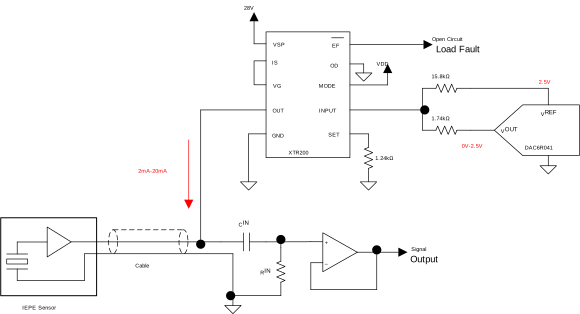 Figure 7-12 Adjustable Current Source for
IEPE/ICP Sensor Excitation
Figure 7-12 Adjustable Current Source for
IEPE/ICP Sensor ExcitationCurrent Source Biasing of Bridge Sensors
Although bridge sensors are commonly specified by volts of excitation, using a current source to excite a bridge can improve the sensor's linearity. However, low impedance bridges can require several milliamps of excitation current for adequate sensitivity which is more than can be provided by the integrated current sources of ADCs. In Figure 7-13 the XTR200 delivers 7.18mA to a 350Ω bridge, producing 2.51V across the bridge for a ratiometric measurement using an ADS1220 ADC.
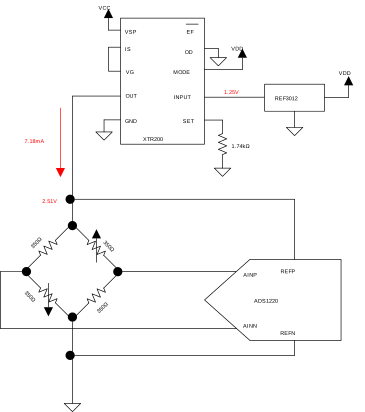 Figure 7-13 Current Source for Bridge
Sensor Excitation
Figure 7-13 Current Source for Bridge
Sensor ExcitationCurrent Monitor (Imon) Output for Modular Hardware System-Common Redundant Power Supplies (M-CRPS)
The M-CRPS specification requires that server power supplies have a current monitor (Imon) output for the 12V bus. The Imon output produces a scaled down replica of the current flowing on the 12V bus with a ratio of either 10μA/A or 0-2mA indicating 0-200% of rated output current. Figure 7-14 shows an example implementation of the Imon function using an INA241A5 current shunt monitor amplifier and an XTR200. The INA241A5 outputs a voltage of 0V to 2V, corresponding to 0-100A flowing through the 100μΩ shunt resistor. An optional low-pass filter composed of RFILT and CFILT are shown on the output of the INA241A5 to allow for bandwidth limiting.
 Figure 7-14 Simplified Diagram of Current
Monitor (Imon) Output for the M-CRPS Specification
Figure 7-14 Simplified Diagram of Current
Monitor (Imon) Output for the M-CRPS SpecificationThe XTR200 converts the 0V to 2V output of the INA241A5 to an output current with a transfer function determined by the 2, 20kΩ RSET resistors. If the gate of the NMOS is low, the XTR200 outputs 10μA per Amp of current flowing on the 12V bus. If the gate of the NMOS is high, then the 2, 20kΩ resistors are connected in parallel and the transfer function is 0-2mA corresponding to 0-200% of rated output current.
Diode D1 and op amp U3 form a clamping circuit which clamps the output voltage to 3.3V when the voltage drop across diode D2 is accounted for. Diode D2 prevents reverse current flow in systems with multiple Imon signals connected in parallel. D2 must be a low-leakage diode to meet the requirement of <500nA leakage at 85°C.
Q1, Q2, R2, and R3 implement "presence" functionality required for backwards compatibility with older power supplies. The standards document suggests a low-leakage PJFET for Q1, such as the MMBFJ177L.