SBOK097B April 2025 – June 2025 TMP9R01-SEP
7 SET Results
Transient characterization data was captured while exposing the units to different levels of radiation. The cross-section plots were captured to provide information of the trend of how the device performs under radiation. During the exposure time, all I2C registers were continuously read. A device reset was taken before every read. The data collected in the registers and the alert pin signal was used to understand the complete functionally of the device and support the SET results presented in this report. Data captured in this report is labeled with reset or without resets.
TMP9R01 device supports reset using the two-wire general-call address 00h (0000 0000b). The TMP9R01 device acknowledges the general-call address and responds to the second byte. If the second byte is 06h (0000 0110b), the TMP9R01 device executes a software reset. This software reset restores the power-on reset state to all TMP9R01 registers and aborts any conversion in progress. The TMP9R01 device takes no action in response to other values in the second byte.
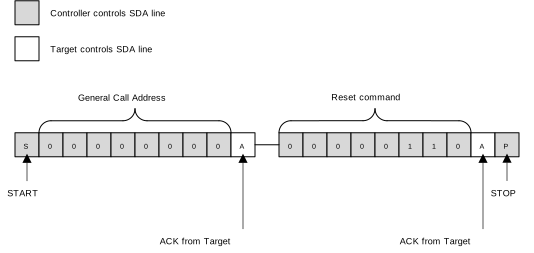 Figure 7-1 Reset Software Procedure
Data was read and captured every 50ms. With resets, the max time for the device to recover temperature is 50ms and no temperature value was seen to be stuck longer than 50ms during the exposure. The max time for the TMP461 to read all registers is shown in the following equation:
Where 36 is the number of clock cycles per communication cycle.
Without resetting the device, there is a large chance the device performs poorly. TMP9R01 is a digital I2C device and transient/upset events were defined in the following way:
- A remote or local temperature output with an error larger than 1.5C was recorded as a transient. Temperature delta was between the temperature readings during exposure and before. Data was read through I2C SCL and SDA lines and recorded through excel. Local and remote temperature is read through two bytes: high and low byte. The high byte represents the whole portion of the temperature result while the low byte represents the fractional portion of the temperature results. The amount of changed bits and location impact the overall accuracy of the device. The changes in the configuration registers can also affect the accuracy of the temperature result. The bits within the following registers impact temperature accuracy as shown in Table 7-1:
|
Pointer (HEX) |
Register Description |
Potential Accuracy Errors |
Event Type |
|---|---|---|---|
|
R 00h |
Local temperature Register (high byte) |
Reading Incorrect Measurement |
SET |
|
R 15h |
Local temperature Register (low byte) |
Reading Incorrect Measurement |
SET |
|
R 01h |
Remote Temperature Register (high byte) |
Reading Incorrect Measurement |
SET |
|
R 10h |
Remote Temperature Register (low byte) |
Reading Incorrect Measurement |
SET |
|
R 03h W 09h |
Configuration Register |
Changing the range from [-40C, 127C] to [-60C, 191C] |
SEFI |
|
RW 11h |
Remote Temperature Offset Register (high byte) |
An unwanted temperature offset is set |
SET |
|
RW 12h |
Remote Temperature Offset Register (low byte) |
An unwanted temperature offset was set |
SET |
|
RW 16h |
Channel Enable Register |
Disabled the temperature conversion of remote and
local temperature sensors leading to inaccurate readings |
SEFI |
|
RW 23h |
η-Factor Correction Register |
An unwanted n-Factor calibration was set |
SET |
 Figure 7-2 12-bit Q4 Format
- A SEFI was recorded when the alert/therm signal was tripped. The device was programmed with default settings to where the alert stays off. If the alert is tripped, the number of assurances is recorded. Operation of the ALERT (pin 7) and THERM (pin 4) interrupts is shown in Figure 7-3. Operation of the THERM (pin 4) and THERM2 (pin 7) interrupts is shown in Figure 7-4.
 Figure 7-3 Alert and Therm Interrupt Operation
 Figure 7-4 Therm and Therm2 Interrupt Operation
- Any bit that was changed within any of the I2C registers outside of the temperature reading registers was recorded as an upset. These events test if any of the configuration settings was changed during exposure. All events are SEU events. No MBU events were present.
The bits within the following registers impact the alert/therm signal as shown in Table 7-2.
| Pointer (HEX) | Register Description | Potential Alert/Therm Errors | Event Type |
|---|---|---|---|
R 02h | Status Register | Mismatch in Status of the Alert Signal | SEU |
R 03h W 09h | Configuration Register | Unwanted mask of the alert signal and changing the mode from alert to therm | SEFI |
R 05h W 0Bh | Local Temperature High Limit Register | Incorrect limit setting | SEFI |
R 06h W 0Ch | Local Temperature Low Limit Register | Incorrect limit setting | SEFI |
R 07h W 0Dh | Remote Temperature High Limit Register (high byte) | Incorrect limit setting | SEFI |
RW 13h | Remote Temperature High Limit Register (low byte) | Incorrect limit setting | SEFI |
R 08h W 0Eh | Remote Temperature Low Limit Register (high byte) | Incorrect limit setting | SEFI |
RW 14h | Remote Temperature Low Limit Register (low byte) | Incorrect limit setting | SEFI |
RW 19h | Remote Temperature THERM Limit Register | Incorrect limit setting | SEFI |
RW 20h | Local Temperature THERM Limit Register | Incorrect limit setting | SEFI |
RW 21h | THERM Hysteresis Register | Incorrect hysteresis setting | SEFI |
RW 22h | Consecutive ALERT Register | Unwanted number of out-of-limit temperature measurements required for ALERT to be asserted | SEFI |
A device reset was taken before every temperature read. All data captured in the report was taken with a temperature reset. Data was read and captured every 50ms. With resets, the max time for the device to recover temperature is 50ms and no temperature value was seen to be stuck longer than 50ms during the exposure. Without resetting the device, there is a large chance the device performs poorly. We have tested the results with and without resets and found that with resets the device preforms better.
The following table captures SET data with TMP9R01 in extended mode. Extended mode extends the temperature range to reach the range of -64C to 191C adding more bits to the temperature registers. The data below highlights the benefits of reseting the device before every temperature read.
| LetEFF (MeV) | # Events (Reset) | # Events (No Reset) |
|---|---|---|
| 8.7 | 24 | 22 |
| 48 | 26 | 324 |
| 56.36 | 33 | 643 |