SLASEE9C September 2017 – May 2025 TPA3221
PRODUCTION DATA
- 1
- 1 Features
- 2 Applications
- 3 Description
- 4 Device Comparison Table
- 5 Pin Configuration and Functions
-
6 Specifications
- 6.1 Absolute Maximum Ratings
- 6.2 ESD Ratings
- 6.3 Recommended Operating Conditions
- 6.4 Thermal Information
- 6.5 Electrical Characteristics
- 6.6 Audio Characteristics (BTL)
- 6.7 Audio Characteristics (PBTL)
- Typical Characteristics, BTL Configuration, AD-mode
- Typical Characteristics, PBTL Configuration, AD-mode
- 7 Parameter Measurement Information
-
8 Detailed Description
- 8.1 Overview
- 8.2 Functional Block Diagrams
- 8.3 Feature Description
- 8.4
Device Functional Modes
- 8.4.1 Powering Up
- 8.4.2 Powering Down
- 8.4.3 Device Reset
- 8.4.4 Device Soft Mute
- 8.4.5
Device Protection System
- 8.4.5.1 Overload and Short Circuit Current Protection
- 8.4.5.2 Signal Clipping and Pulse Injector
- 8.4.5.3 DC Speaker Protection
- 8.4.5.4 Pin-to-Pin Short Circuit Protection (PPSC)
- 8.4.5.5 Overtemperature Protection OTW and OTE
- 8.4.5.6 Undervoltage Protection (UVP) and Power-on Reset (POR)
- 8.4.5.7 Fault Handling
-
9 Application and Implementation
- 9.1 Application Information
- 9.2 Typical Applications
- 9.3 Power Supply Recommendations
- 9.4 Layout
- 10Device and Documentation Support
- 11Revision History
- 12Mechanical, Packaging, and Orderable Information
8.4 Device Functional Modes
TPA3221 can be configured in either a stereo BTL (Bridge Tied Load) mode, mono BTL mode (only one output BTL channel active), or in a mono PBTL (Parallel Bridge Tied Load) mode. In PBTL mode the two output BTL channels are parallelled with double output current available. The parallelling of the two BTL outputs can be made either before the output LC filter, or after the output LC filter. For PBTL mode the audio performance in general be higher when parallelling before the output LC filter, but parallelling after the LC output filter can be preferred in some systems.
See Table 5-2 for mode configuration setup.
 Figure 8-17 Stereo BTL
 Figure 8-19 Mono PBTL, Pre LC Filter
 Figure 8-18 Mono BTL
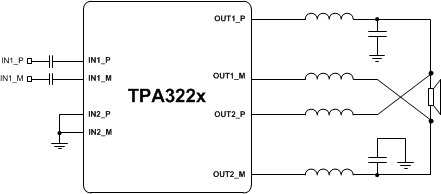 Figure 8-20 Mono PBTL, Post LC Filter