SLLA662 March 2025 MCF8315A , MCF8315C , MCF8315C-Q1 , MCF8315D , MCF8316A , MCF8316C-Q1 , MCF8316D , MCF8329A , MCT8315A , MCT8316A , MCT8329A
2.1 TARGET_ID
TARGET_ID is a 7-bit value representing the target address of the MCx83xx device. The TARGET_ID default value is 0x01. The MCx83xx family supports only the 7-bit addressing mode.
- TARGET_ID Configuration:
For field oriented control (FOC) devices, TARGET_ID can be configured in
DEVICE_CONFIG1 register by setting the ‘I2C_TARGET_ADDR’. For trapezoidal
control devices (MCT83xx), TARGET_ID can be configured in PIN_CONFIG2 register
by setting the ‘I2C_TARGET_ADDR’.Note: TARGET_ID change does not take effect at runtime and device continues to communicate with the address burned in EEPROM at the time of power-up. After changing the TARGET_ID, the EEPROM needs to be programmed with the updated TARGET_ID and device needs to be power cycled.
- TARGET_ID Detection: If
primary device fails to communicate with default or preprogrammed TARGET_ID, a
search can be implemented to find TARGET_ID. Figure 2-1 explains the TARGET_ID detection steps.
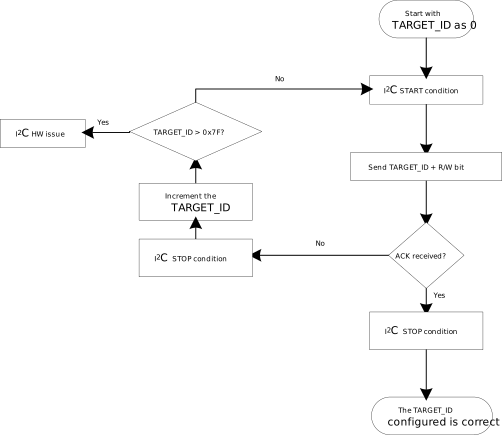 Figure 2-1 TARGET_ID Detection
Flow Chart
Figure 2-1 TARGET_ID Detection
Flow Chart
Address not found can occur due to following possible reasons:
- SCL, SDA connections are not
proper.
- Make sure signals from SCL/SDA pins are routed to the device and all connections are made including necessary pull-up resistors for both pins.
- Make sure no other communication or other peripheral is using the same pins. The SCL/SDA pins must be permanently configured for I2C communication.
- MCx83xx is not powered up.
- Make sure that there is no excessive capacitive loading on SCL and SDA lines. This can be verified by monitoring the SCL and SDA lines on an oscilloscope during communication.