TIDUDI9A January 2018 – May 2025 ISOM8610
- 1
- Description
- Resources
- Features
- Applications
- 6
- 1System Description
- 2System Overview
- 3Hardware, Software, Testing Requirements, and Test Results
- 4Design Files
- 5Software Files
- 6Related Documentation
- 7About the Author
- 8Revision History
2.3.2 Broken Wire Detection
Broken wire detection is explained for a single-channel configuration. This means that only one channel of a ISO121x device is used. Only one additional opto-emulator switch is needed. The rest of the circuit stays the same. As shown in Figure 2-6, the opto-emulator switch must be placed in between the FGND pin of the respective ISO121x channel and the field ground input.
For the broken wire detection to work, when the wire is intact, a small current is available to charge CIN even when the input state is '0'. This assumption is made because the IEC61131-2 allows for Type 1, 2, and 3 inputs in '0' state currents of up to a few mA (see Figure 2-7).
This is only valid for powered field devices and not passive inputs like a simple, standalone mechanical switch. Furthermore, the output of the sourcing device must have a pullup resistor to its supply.
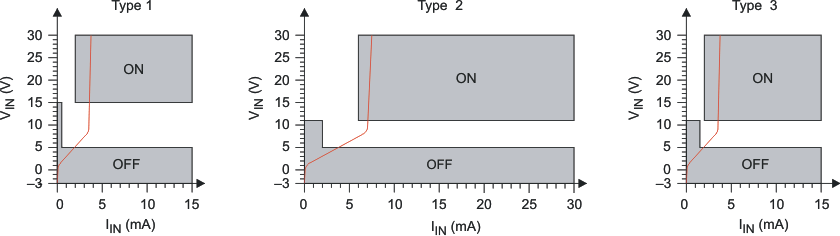 Figure 2-7 Switching Characteristics for IEC 61131-2 Type 1, 2, and 3 Proximity Switches
The broken wire detection sequence works as follows:
- In normal operation, the field ground pin FGND of the input channel is connected to the actual field ground through the opto-emulator switch.
- The opto-emulator switch is opened by switching its control line low.
- The control line is switched high again to close the optical switch.
- Afterwards, the output state of the ISO121x channel is read. If a wire is connected, the output state of the channel will be '1'. This is the case for input states '1' and '0. However, if the wire is broken, the output state of the respective channel is '0' constantly.
For more information on these different cases, see Section 2.3.2.1 to Section 2.3.2.3. Therein, Break FGND is the control state of the optical switch (0 V means the switch is off, 3.3 V means the switch is turned on), IN is the input signal from the field device, CIN is the voltage at the input capacitor, and OUT is the output state of the ISO121x. The respective times are given in brackets (tx).