TIDUDI9A January 2018 – May 2025 ISOM8610
- 1
- Description
- Resources
- Features
- Applications
- 6
- 1System Description
- 2System Overview
- 3Hardware, Software, Testing Requirements, and Test Results
- 4Design Files
- 5Software Files
- 6Related Documentation
- 7About the Author
- 8Revision History
2.3.3 Readout of Digital Outputs
To readout the 16 digital output signals, there are two options:
- Parallel readout of output signals at connectors J5 (channels 1–8) and J8 (channels 9–16)
- Serial readout of output signals from parallel-in serial-out registers U1 and U2
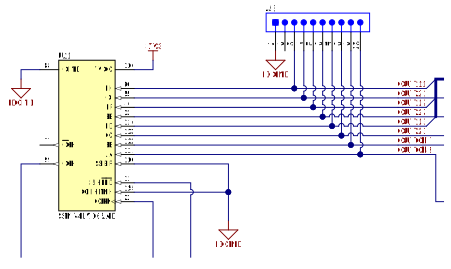 Figure 2-11 Schematic of Parallel and
Serial Readout Options for Output Signals
Figure 2-11 Schematic of Parallel and
Serial Readout Options for Output SignalsFor serial readout, all eight output signals per group are connected to the parallel-in serial-out register SN74LV165A. The output QH of register U1 is connected to input pin SER of register U2. To readout the register, the SPI of the LaunchPad is used. For this, the LaunchPad SPI is connected to the SN74LV165A registers as follows:
The SPI_nCS signal of the LaunchPad is inverted using a logic gate SN74LVC1GU04 with function Y = A.
→ SPI_nCS logic '0' / low = logic '1' / high at SH/ LD pin of SN74LV165A
| LAUNCHPAD | U1 (CHANNELS 1–8) | U2 (CHANNELS 9–16) |
|---|---|---|
| SPI_MOSI | Not used | Not used |
| SPI_MISO | Not connected | QH |
| SPI_nCS | SH/ LD | SH/ LD |
| SPI_CLK | CLK | CLK |
| QH | SER |
The readout of the 16 output states works as follows:
- SPI_nCS is high → both SN74LV165A continuously load input states
- SPI_nCS pulled low → both SN74LV165A store current status of their respective eight inputs
- SPI_CLK is clocked 16 times → output QH of register U2 first gives out outputs states of inputs H–A (channel 9–16) of U2, second gives out output states H–A (channel 1–8) of U1.