SBOSAM2 August 2025 INA701
PRODUCTION DATA
- 1
- 1 Features
- 2 Applications
- 3 Description
- 4 Pin Configuration and Functions
- 5 Specifications
-
6 Detailed Description
- 6.1 Overview
- 6.2 Functional Block Diagram
- 6.3 Feature Description
- 6.4 Device Functional Modes
- 6.5 Programming
- 6.6 Register Maps
- 7 Application and Implementation
- 8 Power Supply Recommendations
- 9 Layout
- 10Device and Documentation Support
- 11Revision History
- 12Mechanical, Packaging, and Orderable Information
Package Options
Refer to the PDF data sheet for device specific package drawings
Mechanical Data (Package|Pins)
- YWF|8
Thermal pad, mechanical data (Package|Pins)
Orderable Information
6.3.3 Versatile Measurement Capability
While the INA701 operates from a 2.7V to 5.5V supply, the device can measure voltage and current on rails as high as 40V. The current is measured by sensing the voltage drop across an internal shunt resistor positioned between the IN+ and IN– pins. The input stage of the INA701 is designed such that the input common-mode voltage can be higher than the device supply voltage, VS. The supported common-mode voltage range of –0.3V to +40V at the input pins is designed for both high-side and low-side current measurements. There are no special considerations for power-supply sequencing because the common-mode input range and device supply voltage are independent of each other; therefore, the bus voltage can be present with the supply voltage off, and vice-versa without damaging the device.
The device also measures the bus supply voltage through the IN– pin and temperature through the integrated temperature sensor. The differential shunt voltage is measured between the IN+ and IN– pins, while the bus voltage is measured with respect to device ground. Monitored bus voltages can range from 0V to 40V, while monitored temperatures can range from –40°C to +125°C.
Shunt voltage, bus voltage, and temperature measurements are multiplexed internally to a single ADC as shown in Figure 6-6.
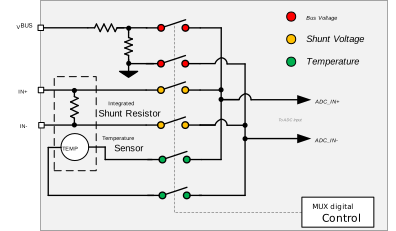 Figure 6-6 High-Voltage Input Multiplexer