SNAS834 November 2024 LMK5C22212A
ADVANCE INFORMATION
- 1
- 1 Features
- 2 Applications
- 3 Description
- 4 Pin Configuration and Functions
- 5 Specifications
- 6 Parameter Measurement Information
-
7 Detailed Description
- 7.1 Overview
- 7.2 Functional Block Diagram
- 7.3
Feature Description
- 7.3.1 Oscillator Input (XO)
- 7.3.2 Reference Inputs
- 7.3.3 Clock Input Interfacing and Termination
- 7.3.4 Reference Input Mux Selection
- 7.3.5 Hitless Switching
- 7.3.6 Gapped Clock Support on Reference Inputs
- 7.3.7 Input Clock and PLL Monitoring, Status, and Interrupts
- 7.3.8
PLL Relationships
- 7.3.8.1 PLL Frequency Relationships
- 7.3.8.2 Analog PLLs (APLL1, APLL2)
- 7.3.8.3 APLL Reference Paths
- 7.3.8.4 APLL Feedback Divider Paths
- 7.3.8.5 APLL Loop Filters (LF1, LF2)
- 7.3.8.6 APLL Voltage-Controlled Oscillators (VCO1, VCO2)
- 7.3.8.7 APLL VCO Clock Distribution Paths
- 7.3.8.8 DPLL Reference (R) Divider Paths
- 7.3.8.9 DPLL Time-to-Digital Converter (TDC)
- 7.3.8.10 DPLL Loop Filter (DLF)
- 7.3.8.11 DPLL Feedback (FB) Divider Path
- 7.3.9 Output Clock Distribution
- 7.3.10 Output Source Muxes
- 7.3.11 Output Channel Muxes
- 7.3.12 Output Dividers (OD)
- 7.3.13 Output Delay
- 7.3.14 Clock Outputs
- 7.3.15 Output Auto-Mute During LOL
- 7.3.16 Glitchless Output Clock Start-Up
- 7.3.17 Clock Output Interfacing and Termination
- 7.3.18 Output Synchronization (SYNC)
- 7.3.19 Zero-Delay Mode (ZDM)
- 7.3.20 DPLL Programmable Phase Delay
- 7.3.21 Time Elapsed Counter (TEC)
- 7.4
Device Functional Modes
- 7.4.1 DPLL Operating States
- 7.4.2 Digitally-Controlled Oscillator (DCO) Frequency and Phase Adjustment
- 7.4.3 APLL Frequency Control
- 7.4.4 Device Start-Up
- 7.4.5 Programming
-
8 Application and Implementation
- 8.1 Application Information
- 8.2 Typical Application
- 8.3 Best Design Practices
- 8.4 Power Supply Recommendations
- 8.5 Layout
- 9 Device and Documentation Support
- 10Revision History
- 11Mechanical, Packaging, and Orderable Information
Package Options
Mechanical Data (Package|Pins)
- RGC|64
Thermal pad, mechanical data (Package|Pins)
- RGC|64
Orderable Information
7.3.21 Time Elapsed Counter (TEC)
The Time Elapsed Counter (TEC) allows the user to make a precise time measurement between two (or more) events. The events can be either a rising or falling edge of a GPIO pin or a falling edge of the SPI SCS pin. Any GPIO pin can be programmed for TEC input. Rising or falling polarity can be selected using the GPIO polarity invert register. After each TEC event, the counter values is captured and the application can read back a 40-bit value. The elapsed time is calculated based on the difference in the read back values. The accuracy of the measurement is better than 7.5ns with a total measurement time over 59 minutes depending on exact configuration. Reading back at least the LSB of the TEC_CNTR is necessary to re-arm the TEC counter capture.
The TEC counter is clocked at a frequency based on APLL1 VCO frequency ÷8 or PLL2 VCO frequency ÷ 20. A time measurement is performed using the following steps.
- Reset the TEC counter value. Recommended to reduce chance of counter roll-over between TEC capture events, but optional. If the reset is not done, the user needs to detect roll-over of counter register which complicate Equation 11 for elapsed time calculation.
- Trigger TEC capture event and read back the TEC registers containing the stored counter value.
- Trigger the TEC capture event a second time and read back the TEC registers containing the stored counter value.
- Use Equation 11 to calculate the elapsed time. The worst-case error is twice the TEC counter clock period. Table 7-10 lists some common TEC clock frequencies/periods and roll-over times.
The TEC_CNTR register is split across five registers.
| PLL SOURCE | VCO FREQUENCY | TEC CLOCK FREQUENCY | TEC CLOCK PERIOD (t) | ROLL-OVER TIME |
|---|---|---|---|---|
| PLL1 | 2457.6MHz | 307.2MHz | ≅3.225ns | ≅59.6 minutes |
| PLL2 | 5950MHz | 297.5MHz | ≅3.361ns | ≅61.6 minutes |
| PLL2 | 5898.24MHz | 294.912MHz | ≅3.391ns | ≅62.1 minutes |
| PLL2 | 5625MHz | 281.25MHz | ≅3.556ns | ≅65.1 minutes |
| PLL2 | 5600MHz | 280MHz | ≅3.571ns | ≅65.4 minutes |

Figure 7-34 illustrates the states of the Time Elapsed Counter function.
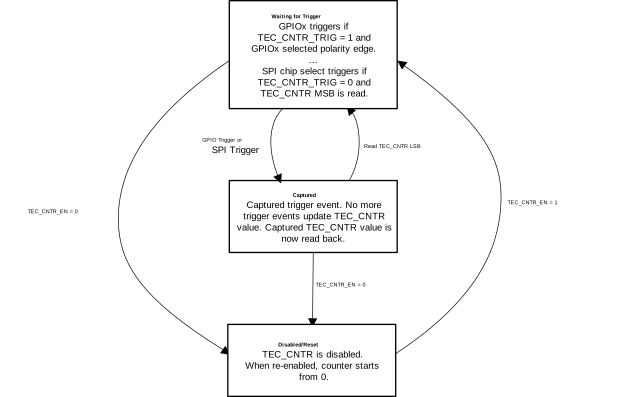
Figure 7-34 State Diagram of TEC