SNAS834 November 2024 LMK5C22212A
ADVANCE INFORMATION
- 1
- 1 Features
- 2 Applications
- 3 Description
- 4 Pin Configuration and Functions
- 5 Specifications
- 6 Parameter Measurement Information
-
7 Detailed Description
- 7.1 Overview
- 7.2 Functional Block Diagram
- 7.3
Feature Description
- 7.3.1 Oscillator Input (XO)
- 7.3.2 Reference Inputs
- 7.3.3 Clock Input Interfacing and Termination
- 7.3.4 Reference Input Mux Selection
- 7.3.5 Hitless Switching
- 7.3.6 Gapped Clock Support on Reference Inputs
- 7.3.7 Input Clock and PLL Monitoring, Status, and Interrupts
- 7.3.8
PLL Relationships
- 7.3.8.1 PLL Frequency Relationships
- 7.3.8.2 Analog PLLs (APLL1, APLL2)
- 7.3.8.3 APLL Reference Paths
- 7.3.8.4 APLL Feedback Divider Paths
- 7.3.8.5 APLL Loop Filters (LF1, LF2)
- 7.3.8.6 APLL Voltage-Controlled Oscillators (VCO1, VCO2)
- 7.3.8.7 APLL VCO Clock Distribution Paths
- 7.3.8.8 DPLL Reference (R) Divider Paths
- 7.3.8.9 DPLL Time-to-Digital Converter (TDC)
- 7.3.8.10 DPLL Loop Filter (DLF)
- 7.3.8.11 DPLL Feedback (FB) Divider Path
- 7.3.9 Output Clock Distribution
- 7.3.10 Output Source Muxes
- 7.3.11 Output Channel Muxes
- 7.3.12 Output Dividers (OD)
- 7.3.13 Output Delay
- 7.3.14 Clock Outputs
- 7.3.15 Output Auto-Mute During LOL
- 7.3.16 Glitchless Output Clock Start-Up
- 7.3.17 Clock Output Interfacing and Termination
- 7.3.18 Output Synchronization (SYNC)
- 7.3.19 Zero-Delay Mode (ZDM)
- 7.3.20 DPLL Programmable Phase Delay
- 7.3.21 Time Elapsed Counter (TEC)
- 7.4
Device Functional Modes
- 7.4.1 DPLL Operating States
- 7.4.2 Digitally-Controlled Oscillator (DCO) Frequency and Phase Adjustment
- 7.4.3 APLL Frequency Control
- 7.4.4 Device Start-Up
- 7.4.5 Programming
-
8 Application and Implementation
- 8.1 Application Information
- 8.2 Typical Application
- 8.3 Best Design Practices
- 8.4 Power Supply Recommendations
- 8.5 Layout
- 9 Device and Documentation Support
- 10Revision History
- 11Mechanical, Packaging, and Orderable Information
Package Options
Mechanical Data (Package|Pins)
- RGC|64
Thermal pad, mechanical data (Package|Pins)
- RGC|64
Orderable Information
7.2.2.2 Cascaded DPLL Operation
Figure 7-4 shows an example where DPLL1 is in cascaded mode from APLL1. APLL2 and APLL1 lock the VCO frequency to the external XO input and operate in free-run mode when a valid reference input is not present. In this example, DPLL2 is the main DPLL, and DPLL1 is a cascaded DPLL.
Once a valid DPLL reference input is detected, the main DPLL begins lock acquisition. The DPLL TDC compares the phase of the selected reference input clock with the FB divider clock from the respective VCO and generates a digital correction word corresponding to the phase error. The correction word is filtered by the DLF, and the DLF output adjusts the APLL N divider SDM to pull the VCO frequency into lock with the reference input.
Cascading of DPLLs provides clean, low jitter output clocks synchronized with the main DPLL. Note in cascaded DPLL mode, the best jitter performance and frequency stability is achieved after DPLLs are locked.
When configured with DPLL2 in cascaded mode from APLL1, the DPLL1 lock status does not necessarily impact DPLL2 lock status. If APLL1 is in free-run mode or holdover mode, and the VCBO frequency offset ppm value is still a valid reference for DPLL2, then cascaded DPLL2 and APLL2 are able to maintain lock status, while APLL2 outputs track the same frequency offset as APLL1. When all enabled DPLLs and APLLs are locked, all enabled outputs are synchronized to the reference selected by the main DPLL.
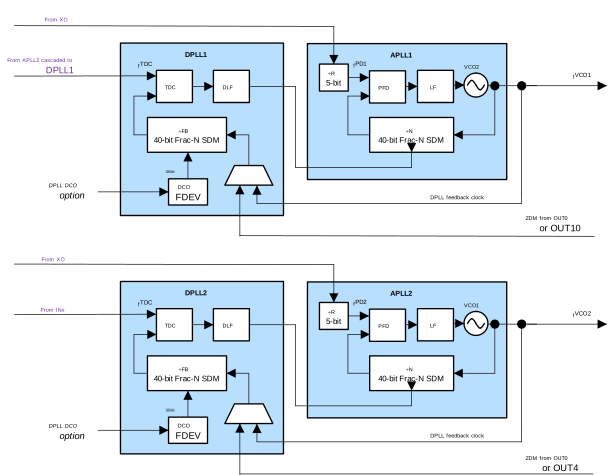 Figure 7-4 DPLL Cascaded
Mode
Figure 7-4 DPLL Cascaded
Mode