SNAS834 November 2024 LMK5C22212A
ADVANCE INFORMATION
- 1
- 1 Features
- 2 Applications
- 3 Description
- 4 Pin Configuration and Functions
- 5 Specifications
- 6 Parameter Measurement Information
-
7 Detailed Description
- 7.1 Overview
- 7.2 Functional Block Diagram
- 7.3
Feature Description
- 7.3.1 Oscillator Input (XO)
- 7.3.2 Reference Inputs
- 7.3.3 Clock Input Interfacing and Termination
- 7.3.4 Reference Input Mux Selection
- 7.3.5 Hitless Switching
- 7.3.6 Gapped Clock Support on Reference Inputs
- 7.3.7 Input Clock and PLL Monitoring, Status, and Interrupts
- 7.3.8
PLL Relationships
- 7.3.8.1 PLL Frequency Relationships
- 7.3.8.2 Analog PLLs (APLL1, APLL2)
- 7.3.8.3 APLL Reference Paths
- 7.3.8.4 APLL Feedback Divider Paths
- 7.3.8.5 APLL Loop Filters (LF1, LF2)
- 7.3.8.6 APLL Voltage-Controlled Oscillators (VCO1, VCO2)
- 7.3.8.7 APLL VCO Clock Distribution Paths
- 7.3.8.8 DPLL Reference (R) Divider Paths
- 7.3.8.9 DPLL Time-to-Digital Converter (TDC)
- 7.3.8.10 DPLL Loop Filter (DLF)
- 7.3.8.11 DPLL Feedback (FB) Divider Path
- 7.3.9 Output Clock Distribution
- 7.3.10 Output Source Muxes
- 7.3.11 Output Channel Muxes
- 7.3.12 Output Dividers (OD)
- 7.3.13 Output Delay
- 7.3.14 Clock Outputs
- 7.3.15 Output Auto-Mute During LOL
- 7.3.16 Glitchless Output Clock Start-Up
- 7.3.17 Clock Output Interfacing and Termination
- 7.3.18 Output Synchronization (SYNC)
- 7.3.19 Zero-Delay Mode (ZDM)
- 7.3.20 DPLL Programmable Phase Delay
- 7.3.21 Time Elapsed Counter (TEC)
- 7.4
Device Functional Modes
- 7.4.1 DPLL Operating States
- 7.4.2 Digitally-Controlled Oscillator (DCO) Frequency and Phase Adjustment
- 7.4.3 APLL Frequency Control
- 7.4.4 Device Start-Up
- 7.4.5 Programming
-
8 Application and Implementation
- 8.1 Application Information
- 8.2 Typical Application
- 8.3 Best Design Practices
- 8.4 Power Supply Recommendations
- 8.5 Layout
- 9 Device and Documentation Support
- 10Revision History
- 11Mechanical, Packaging, and Orderable Information
Package Options
Mechanical Data (Package|Pins)
- RGC|64
Thermal pad, mechanical data (Package|Pins)
- RGC|64
Orderable Information
7.3.7.3 PLL Lock Detectors
The loss-of-lock (LOL) status is available for each APLL and DPLL. The APLLs are monitored for loss-of-frequency lock only. The DPLL can be monitored for both loss-of-frequency lock (LOFL) and loss-of-phase lock (LOPL). The DPLL lock threshold and loss-of-lock threshold are programmable for both LOPL and LOFL detectors. If the BAW APLL loss-of-frequency lock is selected, then paired DPLL is monitored for LOPL only. The paired DPLL must be enabled for the digital monitoring of the BAW APLL VCBO lock detect.
The DPLL frequency lock detector clears the LOFL flag when the DPLL frequency error relative to the selected reference input is less than the lock ppm threshold. Otherwise, the lock detector sets the LOFL flag when the DPLL frequency error is greater than the unlock ppm threshold. The ppm delta between the lock and unlock thresholds provides hysteresis to prevent the LOFL flag from toggling when the DPLL frequency error is crossing these thresholds.
The BAW APLL frequency digital lock detector clears the LOFL flag when the VCBO frequency error relative to the XO reference input is less than the lock ppm threshold. Otherwise, the lock detector sets the LOFL flag when the VCBO frequency error is greater than the unlock ppm threshold. Make sure to take the ppm frequency tolerance of the XO input reference into account when setting the VCBO frequency lock and unlock thresholds. The ppm delta between the lock and unlock thresholds provides hysteresis to prevent the LOFL flag from toggling when the VCBO frequency error is crossing these thresholds.
A measurement accuracy (ppm) and averaging factor are used in computing the frequency lock detector register settings. A higher measurement accuracy (smaller ppm) or higher averaging factor increases the measurement delay to set or clear the LOFL flag. Higher averaging can be useful when locking to an input with high wander or when the PLL is configured with a narrow loop bandwidth. Note that higher averaging reduces the maximum frequency ppm thresholds that can be configured.
The DPLL phase lock detector clears the LOPL flag when the phase error of the DPLL is less than the phase lock threshold. Otherwise, the lock detector sets the LOPL flag when the phase error is greater than the phase unlock threshold.
Users can observe the APLL and DPLL lock detector flags through the status pins and the status bits.
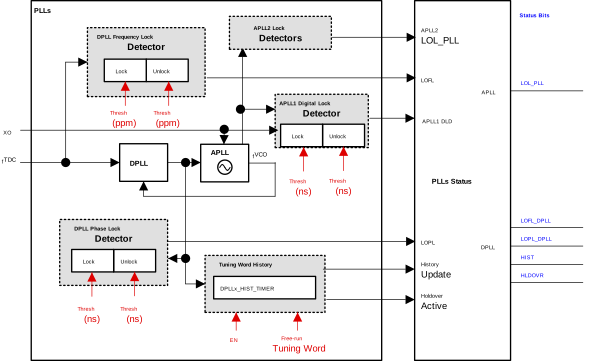 Figure 7-20 PLL Lock Detectors and History
Monitor
Figure 7-20 PLL Lock Detectors and History
Monitor