SNAS834 November   2024 LMK5C22212A

ADVANCE INFORMATION  

  1.   1
  2. Features
  3. Applications
  4. Description
  5. Pin Configuration and Functions
  6. Specifications
    1. 5.1 Absolute Maximum Ratings
    2. 5.2 ESD Ratings
    3. 5.3 Recommended Operating Conditions
    4. 5.4 Thermal Information
    5. 5.5 Electrical Characteristics
    6. 5.6 Timing Diagrams
    7. 5.7 Typical Characteristics
  7. Parameter Measurement Information
    1. 6.1 Differential Voltage Measurement Terminology
    2. 6.2 Output Clock Test Configurations
  8. Detailed Description
    1. 7.1 Overview
    2. 7.2 Functional Block Diagram
      1. 7.2.1 PLL Architecture Overview
      2. 7.2.2 DPLL
        1. 7.2.2.1 Independent DPLL Operation
        2. 7.2.2.2 Cascaded DPLL Operation
        3. 7.2.2.3 APLL Cascaded With DPLL
      3. 7.2.3 APLL-Only Mode
    3. 7.3 Feature Description
      1. 7.3.1  Oscillator Input (XO)
      2. 7.3.2  Reference Inputs
      3. 7.3.3  Clock Input Interfacing and Termination
      4. 7.3.4  Reference Input Mux Selection
        1. 7.3.4.1 Automatic Input Selection
        2. 7.3.4.2 Manual Input Selection
      5. 7.3.5  Hitless Switching
        1. 7.3.5.1 Hitless Switching With Phase Cancellation
        2. 7.3.5.2 Hitless Switching With Phase Slew Control
      6. 7.3.6  Gapped Clock Support on Reference Inputs
      7. 7.3.7  Input Clock and PLL Monitoring, Status, and Interrupts
        1. 7.3.7.1 XO Input Monitoring
        2. 7.3.7.2 Reference Input Monitoring
          1. 7.3.7.2.1 Reference Validation Timer
          2. 7.3.7.2.2 Frequency Monitoring
          3. 7.3.7.2.3 Missing Pulse Monitor (Late Detect)
          4. 7.3.7.2.4 Runt Pulse Monitor (Early Detect)
          5. 7.3.7.2.5 Phase Valid Monitor for 1-PPS Inputs
        3. 7.3.7.3 PLL Lock Detectors
        4. 7.3.7.4 Tuning Word History
        5. 7.3.7.5 Status Outputs
        6. 7.3.7.6 Interrupt
      8. 7.3.8  PLL Relationships
        1. 7.3.8.1  PLL Frequency Relationships
          1. 7.3.8.1.1 APLL Phase Frequency Detector (PFD) and Charge Pump
          2. 7.3.8.1.2 APLL VCO Frequency
          3. 7.3.8.1.3 DPLL TDC Frequency
          4. 7.3.8.1.4 DPLL VCO Frequency
          5. 7.3.8.1.5 Clock Output Frequency
        2. 7.3.8.2  Analog PLLs (APLL1, APLL2)
        3. 7.3.8.3  APLL Reference Paths
          1. 7.3.8.3.1 APLL XO Doubler
          2. 7.3.8.3.2 APLL XO Reference (R) Divider
        4. 7.3.8.4  APLL Feedback Divider Paths
          1. 7.3.8.4.1 APLL N Divider With Sigma-Delta Modulator (SDM)
        5. 7.3.8.5  APLL Loop Filters (LF1, LF2)
        6. 7.3.8.6  APLL Voltage-Controlled Oscillators (VCO1, VCO2)
          1. 7.3.8.6.1 VCO Calibration
        7. 7.3.8.7  APLL VCO Clock Distribution Paths
        8. 7.3.8.8  DPLL Reference (R) Divider Paths
        9. 7.3.8.9  DPLL Time-to-Digital Converter (TDC)
        10. 7.3.8.10 DPLL Loop Filter (DLF)
        11. 7.3.8.11 DPLL Feedback (FB) Divider Path
      9. 7.3.9  Output Clock Distribution
      10. 7.3.10 Output Source Muxes
      11. 7.3.11 Output Channel Muxes
      12. 7.3.12 Output Dividers (OD)
      13. 7.3.13 Output Delay
      14. 7.3.14 Clock Outputs
        1. 7.3.14.1 Differential Output
        2. 7.3.14.2 LVCMOS Output
        3. 7.3.14.3 SYSREF/1PPS Output
      15. 7.3.15 Output Auto-Mute During LOL
      16. 7.3.16 Glitchless Output Clock Start-Up
      17. 7.3.17 Clock Output Interfacing and Termination
      18. 7.3.18 Output Synchronization (SYNC)
      19. 7.3.19 Zero-Delay Mode (ZDM)
      20. 7.3.20 DPLL Programmable Phase Delay
      21. 7.3.21 Time Elapsed Counter (TEC)
        1. 7.3.21.1 Configuring TEC Functionality
        2. 7.3.21.2 SPI as a Trigger Source
        3. 7.3.21.3 GPIO Pin as a TEC Trigger Source
          1. 7.3.21.3.1 An Example: Making a Time Elapsed Measurement Using TEC and GPIO1 as Trigger
        4. 7.3.21.4 Other TEC Behavior
    4. 7.4 Device Functional Modes
      1. 7.4.1 DPLL Operating States
        1. 7.4.1.1 Free-Run
        2. 7.4.1.2 Lock Acquisition
        3. 7.4.1.3 DPLL Locked
        4. 7.4.1.4 Holdover
      2. 7.4.2 Digitally-Controlled Oscillator (DCO) Frequency and Phase Adjustment
        1. 7.4.2.1 DPLL DCO Control
        2. 7.4.2.2 DPLL DCO Relative Adjustment Frequency Step Size
        3. 7.4.2.3 APLL DCO Frequency Step Size
      3. 7.4.3 APLL Frequency Control
      4. 7.4.4 Device Start-Up
        1. 7.4.4.1 Device Power-On Reset (POR)
        2. 7.4.4.2 PLL Start-Up Sequence
        3. 7.4.4.3 Start-Up Options for Register Configuration
        4. 7.4.4.4 GPIO1 and SCS_ADD Functionalities
        5. 7.4.4.5 ROM Page Selection
        6. 7.4.4.6 EEPROM Overlay
      5. 7.4.5 Programming
        1. 7.4.5.1 Memory Overview
        2. 7.4.5.2 Interface and Control
          1. 7.4.5.2.1 Programming Through TICS Pro
          2. 7.4.5.2.2 SPI Serial Interface
          3. 7.4.5.2.3 I2C Serial Interface
        3. 7.4.5.3 General Register Programming Sequence
        4. 7.4.5.4 Steps to Program the EEPROM
          1. 7.4.5.4.1 Overview of the SRAM Programming Methods
          2. 7.4.5.4.2 EEPROM Programming With the Register Commit Method
          3. 7.4.5.4.3 EEPROM Programming With the Direct Writes Method or Mixed Method
          4. 7.4.5.4.4 Five MSBs of the I2C Address and the EEPROM Revision Number
  9. Application and Implementation
    1. 8.1 Application Information
      1. 8.1.1 Device Start-Up Sequence
      2. 8.1.2 Power Down (PD#) Pin
      3. 8.1.3 Strap Pins for Start-Up
      4. 8.1.4 Pin States
      5. 8.1.5 ROM and EEPROM
      6. 8.1.6 Power Rail Sequencing, Power Supply Ramp Rate, and Mixing Supply Domains
        1. 8.1.6.1 Power-On Reset (POR) Circuit
        2. 8.1.6.2 Power Up From a Single-Supply Rail
        3. 8.1.6.3 Power Up From Split-Supply Rails
        4. 8.1.6.4 Non-Monotonic or Slow Power-Up Supply Ramp
      7. 8.1.7 Slow or Delayed XO Start-Up
    2. 8.2 Typical Application
      1. 8.2.1 Design Requirements
      2. 8.2.2 Detailed Design Procedure
      3. 8.2.3 Application Curves
    3. 8.3 Best Design Practices
    4. 8.4 Power Supply Recommendations
      1. 8.4.1 Power Supply Bypassing
    5. 8.5 Layout
      1. 8.5.1 Layout Guidelines
      2. 8.5.2 Layout Example
      3. 8.5.3 Thermal Reliability
  10. Device and Documentation Support
    1. 9.1 Documentation Support
      1. 9.1.1 Related Documentation
    2. 9.2 Receiving Notification of Documentation Updates
    3. 9.3 Support Resources
    4. 9.4 Trademarks
    5. 9.5 Glossary
    6. 9.6 Electrostatic Discharge Caution
  11. 10Revision History
  12. 11Mechanical, Packaging, and Orderable Information

Package Options

Mechanical Data (Package|Pins)
Thermal pad, mechanical data (Package|Pins)
Orderable Information

Reference Inputs

The reference inputs (IN0 and IN1) can accept differential or single-ended clocks. Each input has programmable input type, termination, and DC-coupled or AC-coupled input biasing configurations as shown in Figure 7-9. Each input buffer drives the reference input mux of the DPLL block. The DPLL input mux can select from any of the reference inputs. The DPLL can switch between inputs with different frequencies if the frequencies can be divided-down to a common frequency by DPLL R dividers. The reference input paths also drive the various detector blocks for reference input monitoring and validation. DC-path switch can bypass internal AC-coupling capacitors to make low frequency input work robustly.
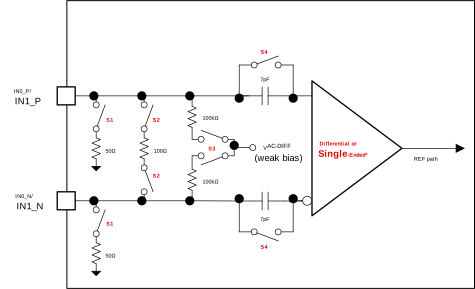
LMK5C22212A Reference Input BufferFigure 7-9 Reference Input Buffer

Table 7-2 lists the reference input buffer configurations for common clock interface types.

Table 7-2 Reference Input Buffer Modes
REFx_ITYPE,
R68/R67
INPUT TYPEINTERNAL REGISTER AND SWITCH SETTINGS
HYSTERESIS,
R68[5]
AC CAPACITOR BYPASS,
R68[4], S4(1)
SINGLE-ENDED SELECT,
R68[3]
SINGLE-ENDED TERM.,
R68[2], S1(2)
DIFFERENTIAL TERM.,
R68[1], S2(2)
WEAK BIAS (1.3V)
R68[0], S3(3)
0x00Differential,
ext. DC-coupled,
ext. term.
000000
0x01Differential,
ext. AC-coupled,
ext. term.
000001
0x02Differential,
ext. DC-coupled,
int. 100Ω diff. term.,
LVDS/HSDS
000010
0x03Differential,
ext. AC-coupled,
int. 100Ω diff. term.,
LVDS/HSDS
000011
0x04Differential,
ext. DC-coupled,
int. 50Ω to GND
HCSL
000100
0x05Differential,
ext. AC-coupled,
int. 50Ω to GND,
HCSL
000101
0x08Single-ended,
ext. DC-coupled,
int. AC-coupled
70mV threshold,
LVCMOS
001000
0x0CSingle-ended,
ext. DC-coupled,
int. AC-coupled,
int. 50Ω to GND,
70mV threshold
001100
0x18Single-ended,
ext. DC-coupled,
int. DC-coupled
150mV hysteresis,
LVCMOS
011000
0x28Single-ended,
ext. DC-coupled,
int. AC-coupled
210mV hysteresis,
LVCMOS
101000
0x38Single-ended,
ext. DC-coupled,
int. DC-coupled
0mV hysteresis,
LVCMOS
111000
S4: 0 = Differential input amplitude detector can be used for all input types except LVCMOS or single-ended.
S1, S2: 0 = External termination is assumed.
S3: 0 = External input bias or DC-coupling is assumed.