SBOS263H October   2002  – December 2024 OPA830

PRODUCTION DATA  

  1.   1
  2. Features
  3. Applications
  4. Description
  5. Device Comparison Table
  6. Pin Configurations
  7. Specifications
    1. 6.1  Absolute Maximum Ratings
    2. 6.2  ESD Ratings
    3. 6.3  Recommended Operating Conditions
    4. 6.4  Thermal Information
    5. 6.5  Electrical Characteristics for D Package VS = ±5V
    6. 6.6  Electrical Characteristics for D Package VS = 5V
    7. 6.7  Electrical Characteristics for D Package VS = 3V
    8. 6.8  Electrical Characteristics for DBV Package VS = ±5V
    9. 6.9  Electrical Characteristics for DBV Package VS = 5V
    10. 6.10 Electrical Characteristics for DBV Package VS = 3V
    11. 6.11 Typical Characteristics: VS = ±5V
    12. 6.12 Typical Characteristics: VS = ±5V, Differential Configuration
    13. 6.13 Typical Characteristics: VS = 5V
    14. 6.14 Typical Characteristics: VS = 5V, Differential Configuration
    15. 6.15 Typical Characteristics: VS = 3V
    16. 6.16 Typical Characteristics: VS = 3V, Differential Configuration
  8. Parameter Measurement Information
  9. Application and Implementation
    1. 8.1 Application Information
      1. 8.1.1  Wideband Voltage-Feedback Operation
      2. 8.1.2  DC Level-Shifting
      3. 8.1.3  Optimizing Resistor Values
      4. 8.1.4  Bandwidth Versus Gain: Noninverting Operation
      5. 8.1.5  Inverting Amplifier Operation
      6. 8.1.6  Output Current and Voltages
      7. 8.1.7  Driving Capacitive Loads
      8. 8.1.8  Distortion Performance
      9. 8.1.9  Noise Performance
      10. 8.1.10 DC Accuracy and Offset Control
      11. 8.1.11 Thermal Analysis
    2. 8.2 Typical Applications
      1. 8.2.1 Single-Supply ADC Interface
      2. 8.2.2 AC-Coupled Output Video Line Driver
      3. 8.2.3 Noninverting Amplifier With Reduced Peaking
      4. 8.2.4 Single-Supply Active Filter
    3. 8.3 Layout
      1. 8.3.1 Layout Guidelines
        1. 8.3.1.1 Input and ESD Protection
  10. Device and Documentation Support
    1. 9.1 Device Support
      1. 9.1.1 Development Support
        1. 9.1.1.1 Demonstration Boards
        2. 9.1.1.2 Macromodel and Applications Support
    2. 9.2 Receiving Notification of Documentation Updates
    3. 9.3 Support Resources
    4. 9.4 Trademarks
    5. 9.5 Electrostatic Discharge Caution
    6. 9.6 Glossary
  11. 10Revision History
  12. 11Mechanical, Packaging, and Orderable Information

Package Options

Refer to the PDF data sheet for device specific package drawings

Mechanical Data (Package|Pins)
  • D|8
  • DBV|5
Thermal pad, mechanical data (Package|Pins)
Orderable Information

Typical Characteristics: VS = 5V

at TA = 25°C, G = +2, RF = 750Ω, RL = 150Ω to VS/2, and input VCM = 2.5V (unless otherwise noted); see also Figure 8-1

OPA830 Noninverting Small-Signal
                        Frequency Response
RL = 150Ω VO = 0.2VPP
Figure 6-22 Noninverting Small-Signal Frequency Response
OPA830 Noninverting Large-Signal
                        Frequency Response
RL = 150Ω G = +2V/V
Figure 6-24 Noninverting Large-Signal Frequency Response
OPA830 Noninverting Pulse
                        Response
G = +2V/V
Figure 6-26 Noninverting Pulse Response
OPA830 Harmonic Distortion vs
                        Load Resistance
f = 5MHz VO = 2VPP G = +2V/V
Figure 6-28 Harmonic Distortion vs Load Resistance
OPA830 Harmonic Distortion vs
                        Output Voltage
 
Figure 6-30 Harmonic Distortion vs Output Voltage
OPA830 Harmonic Distortion vs
                        Inverting Gain
f = 5MHz RL = 500Ω VO = 2VPP
Figure 6-32 Harmonic Distortion vs Inverting Gain
OPA830 Input Voltage and Current
                        Noise Density
 
Figure 6-34 Input Voltage and Current Noise Density
OPA830 Recommended RS
                        vs Capacitive Load
 
Figure 6-36 Recommended RS vs Capacitive Load
OPA830 Open-Loop Gain and
                        Phase
 
Figure 6-38 Open-Loop Gain and Phase
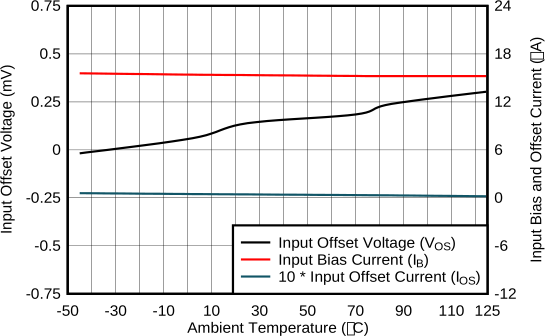
OPA830 Typical DC Drift Over
                        Temperature
 
Figure 6-40 Typical DC Drift Over Temperature
OPA830 CMRR and PSRR vs
                        Frequency
 
Figure 6-42 CMRR and PSRR vs Frequency
OPA830 Inverting Small-Signal
                        Frequency Response
RL = 150Ω VO = 0.2VPP
Figure 6-23 Inverting Small-Signal Frequency Response
OPA830 Inverting Large-Signal
                        Frequency Response
RL = 150Ω G = –1V/V
Figure 6-25 Inverting Large-Signal Frequency Response
OPA830 Inverting Pulse
                        Response
G = –1V/V
Figure 6-27 Inverting Pulse Response
OPA830 Harmonic Distortion vs
                        Frequency
VO = 2VPP G = +2V/V
Figure 6-29 Harmonic Distortion vs Frequency
OPA830 Harmonic Distortion vs Non
                        inverting Gain
f = 5MHz RL = 500Ω VO = 2VPP
Figure 6-31 Harmonic Distortion vs Non inverting Gain
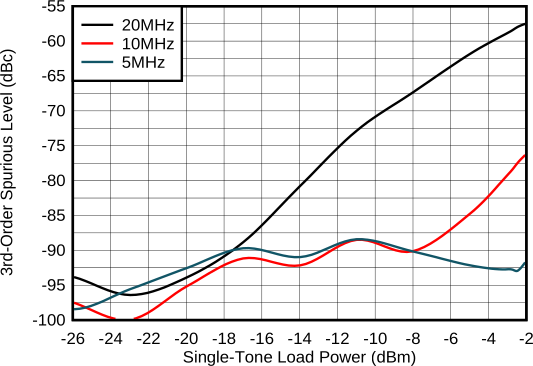
OPA830 Two-Tone, 3rd-Order
                        Intermodulation Spurious
 
Figure 6-33 Two-Tone, 3rd-Order Intermodulation Spurious
OPA830 Closed-Loop Output
                        Impedance vs Frequency
 
Figure 6-35 Closed-Loop Output Impedance vs Frequency
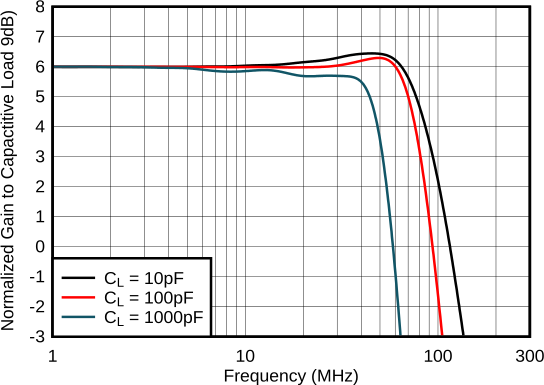
OPA830 Frequency Response vs
                        Capacitive Load
 
Figure 6-37 Frequency Response vs Capacitive Load
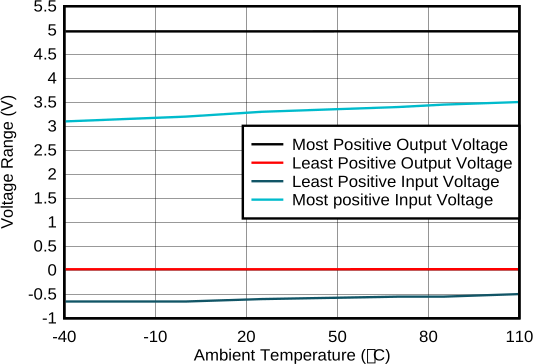
OPA830 Voltage Ranges vs
                        Temperature
 
Figure 6-39 Voltage Ranges vs Temperature
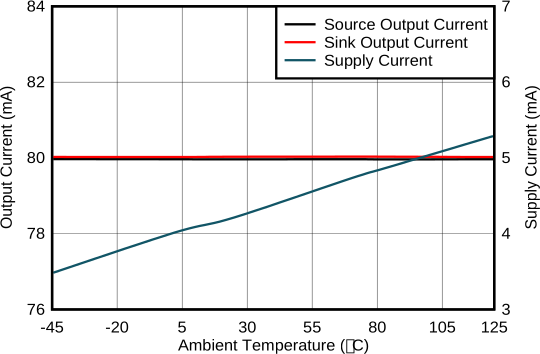
OPA830 Supply and Output Current
                        vs Temperature
 
Figure 6-41 Supply and Output Current vs Temperature
OPA830 Output Voltage Swing vs
                        Output Current
 
Figure 6-43 Output Voltage Swing vs Output Current