SLVSHN0A September 2024 – October 2025 TPS548B23
PRODUCTION DATA
- 1
- 1 Features
- 2 Applications
- 3 Description
- 4 Pin Configuration and Functions
- 5 Specifications
-
6 Detailed Description
- 6.1 Overview
- 6.2 Functional Block Diagram
- 6.3
Feature Description
- 6.3.1 D-CAP4 Control
- 6.3.2 Internal VCC LDO and Using External Bias On the VCC Pin
- 6.3.3 Multifunction Configuration (CFG1-5) Pins
- 6.3.4 Enable
- 6.3.5 Soft Start
- 6.3.6 Power Good
- 6.3.7 Overvoltage and Undervoltage Protection
- 6.3.8 Output Voltage Setting (External Feedback Configuration)
- 6.3.9 Remote Sense
- 6.3.10 Low-side MOSFET Zero-Crossing
- 6.3.11 Current Sense and Positive Overcurrent Protection
- 6.3.12 Low-side MOSFET Negative Current Limit
- 6.3.13 Output Voltage Discharge
- 6.3.14 UVLO Protection
- 6.3.15 Thermal Shutdown
- 6.4 Device Functional Modes
- 7 Application and Implementation
- 8 Device and Documentation Support
- 9 Revision History
- 10Mechanical, Packaging, and Orderable Information
Package Options
Mechanical Data (Package|Pins)
- VAN|19
Thermal pad, mechanical data (Package|Pins)
Orderable Information
6.3.2.1 Powering the Device From a Single Bus
The device works well when powered by a single VIN configuration. In a single VIN configuration, the internal LDO is typically powered by a 5V or 12V bus and generates a 3V output to bias the internal analog circuitry and power MOSFET gate drivers. The VIN input range under this configuration is 4V to 16V for up to 20A load current. Figure 6-1 shows an example for this single VIN configuration.
VIN and EN are the two signals to enable the device. For start-up sequence, any sequence between the VIN and EN signals can power the device up correctly.
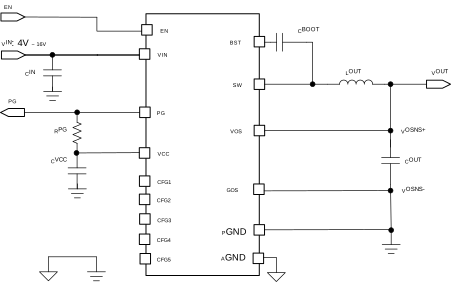 Figure 6-1 Single VIN Configuration for a 12V Bus