SLAAEQ4 July 2025 MSPM0G1106 , MSPM0G1107 , MSPM0G1506 , MSPM0G1507 , MSPM0G1518 , MSPM0G1519 , MSPM0G3106 , MSPM0G3106-Q1 , MSPM0G3107 , MSPM0G3107-Q1 , MSPM0G3506 , MSPM0G3506-Q1 , MSPM0G3507 , MSPM0G3507-Q1 , MSPM0G3518 , MSPM0G3518-Q1 , MSPM0G3519 , MSPM0G3519-Q1
1 Introduction
Controller Area Network (CAN) and Serial Peripheral Interface (SPI) are two widely adopted communication protocols in modern microcontroller units (MCUs). While CAN protocol dominates automotive applications due to the robust error handling and reliability, many low-end microcontrollers and sensors lack CAN support. In contrast, SPI is nearly universal across MCU devices. To bridge this technological gap, SPI-CAN interfaces enable seamless communication between SPI-based devices and CAN networks, allowing low-cost sensors and microcontrollers to integrate with CAN-based systems.
The SPI-CAN bridge functionality is implemented using the MSPM0G3507 device, which acts as an interface between an external SPI controller and a CAN network. When the external SPI controller initiates communication frames, the MSPM0G3507 translates these into CAN protocol instructions and transmits them across the CAN network.
Figure 1-1 illustrates the system architecture, showing the interconnections between the MSPM0G3507 device and the external interfaces. The device communicates with the external controller using 4-wire SPI protocol, while connecting to the CAN bus through a CAN physical layer transceiver (CAN-PHY).
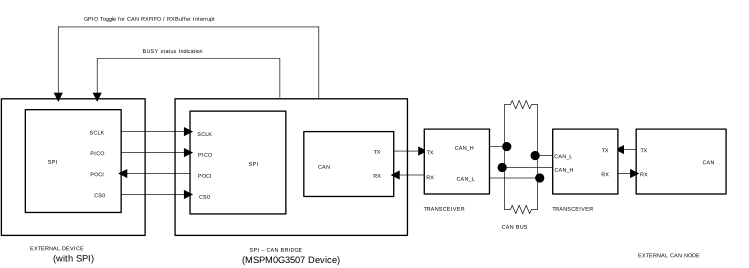 Figure 1-1 Block Diagram of SPI-CAN
Bridge
Figure 1-1 Block Diagram of SPI-CAN
Bridge