SLVS348N July 2001 – January 2025 TPS793
PRODUCTION DATA
- 1
- 1 Features
- 2 Applications
- 3 Description
- 4 Pin Configuration and Functions
- 5 Specifications
- 6 Detailed Description
- 7 Application and Implementation
- 8 Device and Documentation Support
- 9 Revision History
- 10Mechanical, Packaging, and Orderable Information
4 Pin Configuration and Functions
 Figure 4-1 DBV Package,5-Pin SOT-23 Fixed Voltage Version(Top View)
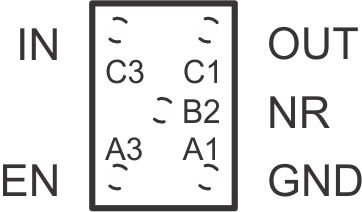 Figure 4-3 YZQ Package,5-Pin DSBGA
(Top View) (Legacy Chip Only)
 Figure 4-2 DBV Package,6-Pin SOT-23 Adjustable Voltage Version(Top View)
Table 4-1 Pin Functions
| PIN | I/O | DESCRIPTION | ||
|---|---|---|---|---|
| NAME | DBV | YZQ | ||
| EN | 3 | A3 | I | Enable pin. Driving the enable pin (EN) high turns on the regulator. Driving this pin low puts the regulator into shutdown mode. EN can be connected to IN if not used. |
| FB | 5 | — | I | Feedback pin. This terminal is the feedback input pin for the adjustable device. Fixed voltage versions in the DBV package do not have this pin. |
| GND | 2 | A1 | — | Regulator ground. |
| IN | 1 | C3 | I | Input to the device. |
| NR/NC | 4 | B2 | — | Noise
Reduction pin (legacy chip only). Connecting an external capacitor
to this pin filters noise generated by the internal bandgap. This
configuration improves power-supply rejection and reduces output
noise for the legacy chip and YZQ package only. No Connect pin (new chip only). This pin is not internally connected. Connect to GND for improved thermal performance or leave floating. For lower noise performance on a fixed device, consider looking at the TPS7A20. |
| OUT | 6 | C1 | O | Output of the regulator. |