SLVSHH3A March 2025 – August 2025 DRV8263-Q1
PRODUCTION DATA
- 1
- 1 Features
- 2 Applications
- 3 Description
- 4 Device Comparison
- 5 Pin Configuration and Functions
- 6 Specifications
-
7 Detailed Description
- 7.1 Overview
- 7.2 Functional Block Diagram
- 7.3
Feature Description
- 7.3.1 External Components
- 7.3.2 Bridge Control
- 7.3.3 Device Configuration
- 7.3.4
Protection and Diagnostics
- 7.3.4.1 Over Current Protection (OCP)
- 7.3.4.2 Over Temperature Warning (OTW) - SPI Variant Only
- 7.3.4.3 Over Temperature Protection (TSD)
- 7.3.4.4 Off-State Diagnostics (OLP)
- 7.3.4.5 On-State Diagnostics (OLA) - SPI Variant Only
- 7.3.4.6 VM Over Voltage Monitor - SPI Variant Only
- 7.3.4.7 VM Under Voltage Monitor
- 7.3.4.8 Power On Reset (POR)
- 7.3.4.9 Powered off Braking (POB)
- 7.3.4.10 Event Priority
- 7.3.5 Device Functional Modes
- 7.3.6 Programming - SPI Variant Only
- 7.3.7 Register Map - SPI Variant Only
- 8 Application and Implementation
- 9 Device and Documentation Support
- 10Revision History
- 11Mechanical, Packaging, and Orderable Information
7.3.6.3.1 Daisy Chain Frame for Multiple Peripherals
The device can be connected in a daisy chain configuration to save GPIO ports when multiple devices are communicating to the same MCU. Figure 7-11 shows the topology with waveforms, where, number of peripherals connected in a daisy chain "n" is set to 3. A maximum of up to 63 devices can be connected in this manner.
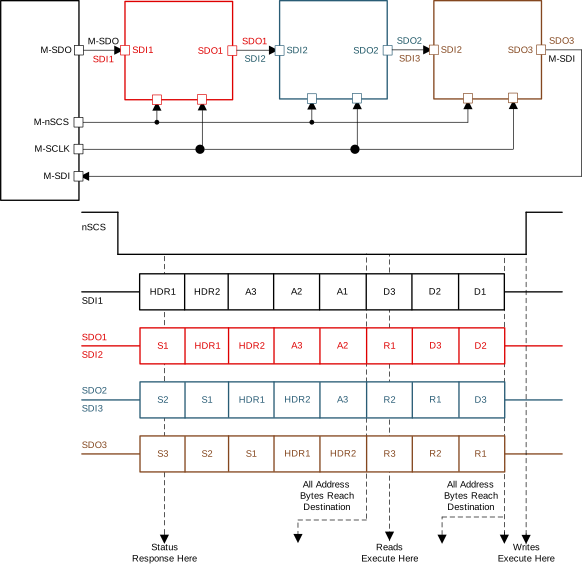 Figure 7-11 Daisy Chain SPI Operation
The SDI sent by the controller in this case is in the following format (see SDI1 in Figure 7-11 ):
- 2 bytes of header (HDR1, HDR2)
- "n" bytes of command byte starting with furthest peripheral in the chain (for this example, this is A3, A2, A1)
- "n" bytes of data byte starting with furthest peripheral in the chain (for this example, this is D3, D2, D1)
- Total of 2 x "n" + 2 bytes
While the data is being transmitted through the chain, the controller receives the data in the following format (see SDO3 in Figure 7-11):
- 3 bytes of status byte starting with furthest peripheral in the chain (for this example, this is S3, S2, S1)
- 2 bytes of header that are transmitted before (HDR1, HDR2)
- 3 bytes of report byte starting with furthest peripheral in the chain (for this example, this is R3, R2, R1)
The Header bytes are special bytes asserted at the beginning of a daisy chain SPI communication. Header bytes must start with 1 and 0 for the two leading bits.
The first header byte (HDR1) contains information of the total number of peripheral devices in the daisy chain. N5 through N0 are 6 bits dedicated to show the number of device in the chain as shown in Figure 7-12. Up to 63 devices can be connected in series per daisy chain connection. Number of peripheral = 0 is not permitted and results in a ERR flag.
The second header byte (HDR2) contains a global CLR FAULT command that clears the fault registers of all the devices on the rising edge of the chip select (nSCS) signal. The 5 trailing bits of the HDR2 register are marked as SPARE (don’t care bits). These can be used by the MCU to determine integrity of the daisy chain connection.
 Figure 7-12 Header bytes
In addition, the device recognizes bytes that start with 1 and 1 for the two leading bits as a "pass" byte. These "pass" bytes are NOT processed by the device, but the "pass" bytes are simply transmitted out on SDO in the following byte.
When data passes through a device, the data determines the position of the data in the chain by counting the number of Status bytes the device receives following by the first Header byte. For example, in this 3 device configuration, device 2 in the chain receives one status byte before receiving the two header bytes.
From the one status byte the data knows that the position is second in the chain, and from HDR1 byte the data knows how many devices are connected in the chain. That way the header byte only loads the relevant address and data byte in the header bytes buffer and bypasses the other bits. This protocol allows for faster communication without adding latency to the system for up to 63 devices in the chain.
The command, data, status and report bytes remain the same as described in the standard frame format.