SLVSHH3A March 2025 – August 2025 DRV8263-Q1
PRODUCTION DATA
- 1
- 1 Features
- 2 Applications
- 3 Description
- 4 Device Comparison
- 5 Pin Configuration and Functions
- 6 Specifications
-
7 Detailed Description
- 7.1 Overview
- 7.2 Functional Block Diagram
- 7.3
Feature Description
- 7.3.1 External Components
- 7.3.2 Bridge Control
- 7.3.3 Device Configuration
- 7.3.4
Protection and Diagnostics
- 7.3.4.1 Over Current Protection (OCP)
- 7.3.4.2 Over Temperature Warning (OTW) - SPI Variant Only
- 7.3.4.3 Over Temperature Protection (TSD)
- 7.3.4.4 Off-State Diagnostics (OLP)
- 7.3.4.5 On-State Diagnostics (OLA) - SPI Variant Only
- 7.3.4.6 VM Over Voltage Monitor - SPI Variant Only
- 7.3.4.7 VM Under Voltage Monitor
- 7.3.4.8 Power On Reset (POR)
- 7.3.4.9 Powered off Braking (POB)
- 7.3.4.10 Event Priority
- 7.3.5 Device Functional Modes
- 7.3.6 Programming - SPI Variant Only
- 7.3.7 Register Map - SPI Variant Only
- 8 Application and Implementation
- 9 Device and Documentation Support
- 10Revision History
- 11Mechanical, Packaging, and Orderable Information
7.3.4.4 Off-State Diagnostics (OLP)
The user can determine the impedance on the OUTx node using off-state diagnostics in the STANDBY state when the power FETs are off. With this diagnostics, detecting the following fault conditions passively in the STANDBY state is possible:
- Output short to VM or GND
- Open load for full-bridge load or low-side load
- Open load for high-side load
Note: Detecting a load short with this
diagnostic is not possible. However, the user can deduce this logically if an
over-current fault (OCP) occurs during ACTIVE operation, but OLP diagnostics do not
report any fault in the STANDBY state. The occurrence of both OCP in the ACTIVE
state and OLP in the STANDBY state implies a terminal short (short on OUT
node).
- The user can configure the following combinations
- Internal pull up resistor (ROLP_PU) on OUTx
- Internal pull down resistor (ROLP_PD) on OUTx
- Comparator reference level
- Comparator input selection (OUT1 or OUT2)
- This combination is determined by the controller inputs (pins only for the HW variant) or equivalent bits in the SPI_IN register for the SPI variant if the SPI_IN register has been unlocked.
- HW variant - When off-state diagnostics are enabled, comparator output (OLP_CMP) is available on nFAULT pin.
- SPI variant - The off-state diagnostics comparator output (OLP_CMP) is available on OLP_CMP bit in STATUS2 register. Additionally, if the SPI_IN register has been locked, this comparator output is also available on the nFAULT pin when off-state diagnostics are enabled.
- The user is expected to toggle through all the combinations and record the comparator output after the output is settled.
- Based on the input combinations and comparator output, the user can determine if there is a fault on the output.
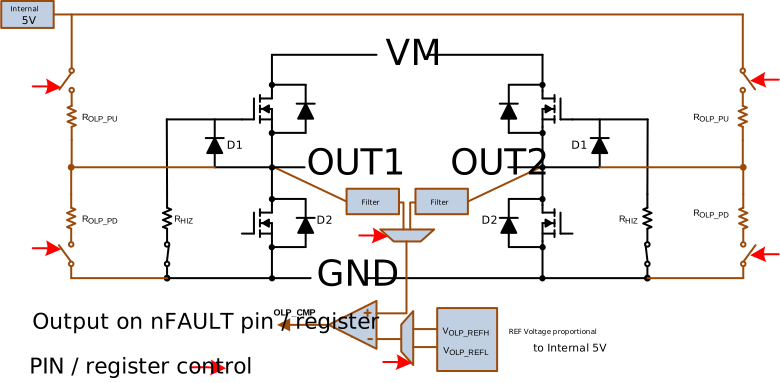 Figure 7-5 Off-State Diagnostics for full-bridge Load (PH/EN or PWM Mode)
The OLP combinations and truth table for a no fault scenario vs. fault scenario for a full-bridge load in PH/EN or PWM modes is shown in Table 7-19.
Table 7-16 Off-State Diagnostics
Table - PH/EN or PWM Mode (full-bridge)
| User Inputs | OLP Set-Up | OLP CMP Output | |||||||||
|---|---|---|---|---|---|---|---|---|---|---|---|
| nSLEEP | DRVOFF | EN/IN1 | PH/IN2 | OUT1 | OUT2 | CMP REF | Output selected | Normal | Open | GND Short | VM Short |
| 1 | 1 | 1 | 0 | ROLP_PU | ROLP_PD | VOLP_REFH | OUT1 | L | H | L | H |
| 1 | 1 | 0 | 1 | ROLP_PU | ROLP_PD | VOLP_REFL | OUT2 | H | L | L | H |
| 1 | 1 | 1 | 1 | ROLP_PD | ROLP_PU | VOLP_REFL | OUT2 | H | H | L | H |
The OLP combinations and truth table for a no fault scenario vs. fault scenario for a low-side load in Independent mode is shown in Table 7-17.
Table 7-17 Off-State Diagnostics
Table for Low-Side Load - Independent Mode
The OLP combinations and truth table for a
no fault scenario vs. fault scenario for a high-side load in Independent mode is shown in Table 7-18.| User Inputs | OLP Set-Up | OLP_CMP Output | ||||||||||
|---|---|---|---|---|---|---|---|---|---|---|---|---|
| DIAG pin | S_DIAG bits | nSLEEP | DRVOFF | EN/IN1 | PH/IN2 | OUT1 | OUT2 | CMP REF | Output selected | Normal | Open | Short to VM |
| LVL2, LVL6 | 01b | 1 | 1 | 1 | don't care | ROLP_PU | Hi-Z | VOLP_REFH | OUT1 | L | H | H |
| LVL3, LVL4 | 11b | 1 | 1 | 1 | don't care | ROLP_PD | Hi-Z | VOLP_REFL | OUT1 | L | L | H |
| LVL2, LVL6 | 01b | 1 | 1 | 0 | 1 | Hi-Z | ROLP_PU | VOLP_REFH | OUT2 | L | H | H |
| LVL3, LVL4 | 11b | 1 | 1 | 0 | 1 | Hi-Z | ROLP_PD | VOLP_REFL | OUT2 | L | L | H |
Table 7-18 Off-State Diagnostics
Table for High-Side Load - Independent Mode
| User Inputs | OLP Set-Up | OLP_CMP Output | ||||||||||
|---|---|---|---|---|---|---|---|---|---|---|---|---|
| DIAG pin | S_DIAG bits | nSLEEP | DRVOFF | EN/IN1 | PH/IN2 | OUT1 | OUT2 | CMP REF | Output selected | Normal | Open | Short to GND |
| LVL2, LVL6 | 01b | 1 | 1 | 1 | don't care | ROLP_PU | Hi-Z | VOLP_REFH | OUT1 | H | H | L |
| LVL3, LVL4 | 11b | 1 | 1 | 1 | don't care | ROLP_PD | Hi-Z | VOLP_REFL | OUT1 | H | L | L |
| LVL2, LVL6 | 01b | 1 | 1 | 0 | 1 | Hi-Z | ROLP_PU | VOLP_REFH | OUT2 | H | H | L |
| LVL3, LVL4 | 11b | 1 | 1 | 0 | 1 | Hi-Z | ROLP_PD | VOLP_REFL | OUT2 | H | L | L |