SLVUD67 September 2025 TPS6521505-Q1
5.3 Configuring LDOs
There are several settings that can be programmed for the LDO regulators. These include the output voltages, and under voltage (UV) monitoring among others.
- Figure 5-4 shows the settings to be changed when using the TPS65215-GUI.
- Table 5-6 and Table 5-7 show the register fields to be written when NOT using the TPS65215-GUI.
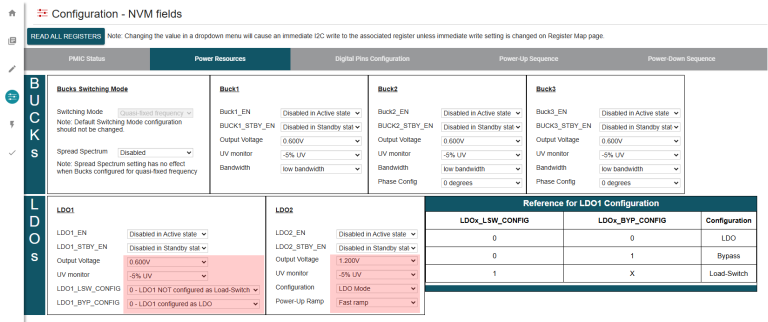 Figure 5-4 LDOs Settings Using the
TPS65215-GUI
Figure 5-4 LDOs Settings Using the
TPS65215-GUITable 5-6 NVM Registers for LDO1
Settings
| Register Address | Bit | Field Name | Settings | |
|---|---|---|---|---|
| Output Voltage | 0x07 | 5-0 | LDO1_VSET | See the register map on the device-specific data sheet. |
| Configuration | 7 | LDO1_LSW_CONFIG | 0h = LDO1 NOT configured as load-switch 1h = LDO1 configured as Load-switch |
|
| 6 | LDO1_BYP_CONFIG | 0h = LDO1 configured as LDO 1h = LDO1 configured as Bypass (only applicable if LDO1_LSW_CONFIG 0x0) |
||
| UV monitoring | 0x1E | 3 | LDO1_UV_THR | 0h = -5% UV 1h = -10% UV |
Table 5-7 NVM Registers for LDO2
Settings
| Register Address | Bit | Field Name | Settings | |
|---|---|---|---|---|
| Output Voltage | 0x05 | 5-0 | LDO2_VSET | See the register map on the device-specific data sheet. |
| Configuration | 6 | LDO2_LSW_CONFIG | 0h = LDO Mode 1h = LSW Mode |
|
| Ramp | 7 | LDO2_SLOW_PU_RAMP | 0h = Fast ramp for power-up 1h = Slow ramp for power-up |
|
| UV Monitoring | 0x1E | 5 | LDO2_UV_THR | 0h = -5% UV 1h = -10% UV |