SLVUDA2 July 2025
2.1 Power Requirements
The INA1H94 operates on a power supply voltage range from ±2V to ±9V dual supply or 4V to 18V single supply. The device can be operated in dual or single supply. The EVM has connections for positive supply (V+), negative supply (V−), and ground (GND) as shown in Figure 2-1. Bypass capacitors are populated on the board (C1, C2, C11, C12) for the device supply. The supply connection can be done either using a standard 4mm banana jack or using the power supply test points, both are not required for operation. If using in single supply, connect both (V−) and GND to ground.
 Figure 2-1 Power Connectors and Test
Points
Figure 2-1 Power Connectors and Test
PointsFigure 2-2 shows the high voltage section on the board is denoted by the silkscreen and the high voltage-rated banana jack connectors (J5, J7). The silkscreen portion is to show where the PCB traces have been optimized for high voltage clearance and design rules to withstand the max voltage rating of ±150V per device rating. All other banana jack connectors are rated for less than 50V.
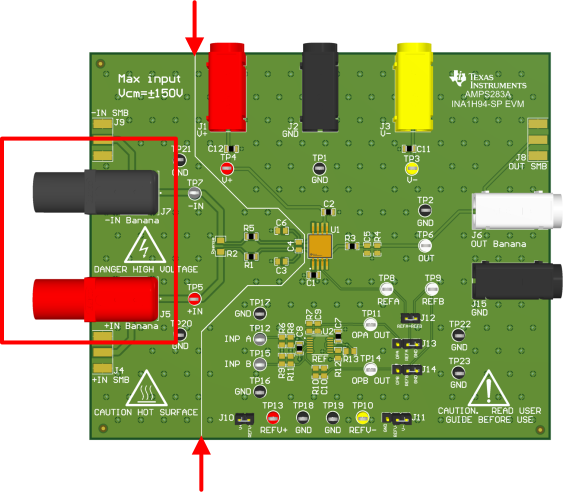 Figure 2-2 High Voltage Section of
Evaluation Board
Figure 2-2 High Voltage Section of
Evaluation BoardWhen using an external reference buffer, the supply voltage for the reference buffer (REFV+ and REFV−) can be either tied to the board supply (V+ and V− or GND) via J10 and J11 or connected externally by the test points TP13 and TP10, both are not required for operation. Location of the test points and headers are indicated in Figure 2-3. If REFV+ and REFV− are driven externally, remove shunts from J10 and J11. Do not connect the board supplies (V+ and V−) and REF supplies (REFV+ and REFV−) together if driving externally. See Table 2-1 for more information.
 Figure 2-3 Reference Power Pin Headers
and Test Points
Figure 2-3 Reference Power Pin Headers
and Test Points| HEADER NAME | FUNCTION | SETTING | DESCRIPTION |
|---|---|---|---|
| J10 | REFV+ | Closed | REFV+ is shorted to V+. Do not apply an external voltage to TP13 |
| Open | REFV+ is floating and must be biased externally with TP13 | ||
| J11 | REFV- | Closed (REFV− to V−) | REFV− is shorted to V−. Do not apply an external voltage to TP10 |
| Closed (REFV− to GND) | REFV− is shorted to GND. Do not apply an external voltage to TP13 | ||
| Open | REFV− is floating and must be biased externally with TP10 |