SPRUHJ1I January 2013 – October 2021 TMS320F2802-Q1 , TMS320F28026-Q1 , TMS320F28026F , TMS320F28027-Q1 , TMS320F28027F , TMS320F28027F-Q1 , TMS320F28052-Q1 , TMS320F28052F , TMS320F28052F-Q1 , TMS320F28052M , TMS320F28052M-Q1 , TMS320F28054-Q1 , TMS320F28054F , TMS320F28054F-Q1 , TMS320F28054M , TMS320F28054M-Q1 , TMS320F2806-Q1 , TMS320F28062-Q1 , TMS320F28062F , TMS320F28062F-Q1 , TMS320F28068F , TMS320F28068M , TMS320F28069-Q1 , TMS320F28069F , TMS320F28069F-Q1 , TMS320F28069M , TMS320F28069M-Q1
- 1 Read This First
-
1 Introduction
- 1.1 An Overview of InstaSPIN-FOC™ and FAST™
- 1.2
An Overview of InstaSPIN-MOTION™ and SpinTAC™
- 1.2.1 InstaSPIN-MOTION™ Key Capabilities and Benefits
- 1.2.2 InstaSPIN-MOTION™ Block Diagrams
- 1.2.3 Application Examples
- 2 Quick Start Kits - TI Provided Software and Hardware
-
3 InstaSPIN™ and MotorWare™
- 3.1 Overview
- 3.2 MotorWare™ Directory Structure
- 3.3 MotorWare™ Object-Oriented Design
- 3.4
InstaSPIN-FOC™ API
- 3.4.1
Controller API Functions – ctrl.c, ctrl.h,
CTRL_obj.h
- 3.4.1.1 CTRL Enumerations and Structures
- 3.4.1.2 CTRL State Control and Error Handling
- 3.4.1.3
CTRL Get Functions
- CTRL_getCount_current ()
- CTRL_getCount_isr ()
- CTRL_getCount_speed ()
- CTRL_getCount_state ()
- CTRL_getCount_traj ()
- CTRL_getCtrlFreq ()
- CTRL_getCtrlPeriod_sec ()
- CTRL_getErrorCode ()
- CTRL_getEstHandle ()
- CTRL_getFlag_enableCtrl ()
- CTRL_getFlag_enableDcBusComp ()
- CTRL_getFlag_enablePowerWarp ()
- CTR CTRL_getFlag_enableOffset ()
- CTRL_getFlag_enableSpeedCtrl ()
- CTRL_getFlag_enableUserMotorParams ()
- CTRL_getGains ()
- CTRL_getIab_filt_pu ()
- CTRL_getIab_filt_addr ()
- CTRL_getIab_in_addr ()
- CTRL_getIab_in_pu ()
- CTRL_getId_in_pu ()
- CTRL_getId_ref_pu ()
- CTRL_getIdq_in_addr ()
- CTRL_getIdq_in_pu ()
- CTRL_getIdq_ref_pu ()
- CTRL_getIdRated_pu ()
- CTRL_getIq_in_pu ()
- CTRL_getIq_ref_pu ()
- CTRL_getKi ()
- CTRL_getKd ()
- CTRL_getKp ()
- CTRL_getLhf ()
- CTRL_getMagCurrent_pu ()
- CTRL_getMaxVsMag_pu ()
- CTRL_getMaximumSpeed_pu ()
- CTRL_getMotorRatedFlux ()
- CTRL_getMotorType ()
- CTRL_getNumCtrlTicksPerCurrentTick ()
- CTRL_getNumCtrlTicksPerSpeedTick ()
- CTRL_getNumCtrlTicksPerTrajTick ()
- CTRL_getNumIsrTicksPerCtrlTick ()
- CTRL_getRefValue_pu ()
- CTRL_getRhf ()
- CTRL_getRoverL ()
- CTRL_getSpd_max_pu ()
- CTRL_getSpd_out_addr ()
- CTRL_getSpd_out_pu ()
- CTRL_getSpd_ref_pu ()
- CTRL_getSpd_int_ref_pu ()
- CTRL_getState ()
- CTRL_getTrajFreq ()
- CTRL_getTrajPeriod_sec ()
- CTRL_getTrajStep ()
- CTRL_getUi ()
- CTRL_getVab_in_pu ()
- CTRL_getVab_out_addr ()
- CTRL_getVab_out_pu ()
- CTRL_getVd_out_addr ()
- CTRL_getVd_out_pu ()
- CTRL_getVdq_out_addr ()
- CTRL_getVdq_out_pu ()
- CTRL_getVersion ()
- CTRL_getVq_out_addr ()
- CTRL_getVq_out_pu ()
- CTRL_getWaitTime ()
- 3.4.1.4 CTRL Counter Functions
- 3.4.1.5
CTRL Set Functions
- CTRL_setCtrlFreq_Hz ()
- CTRL_setCtrlFreq_sec ()
- CTRL_setErrorCode ()
- CTRL_setEstParams ()
- CTRL_setFlag_enableCtrl ()
- CTRL_setFlag_enableDcBusComp ()
- CTRL_setFlag_enablePowerWarp ()
- CTRL_setFlag_enableOffset ()
- calibrationCTRL_setFlag_enableSpeedCtrl ()
- CTRL_setFlag_enableUserMotorParams ()
- CTRL_setGains ()
- CTRL_setIab_in_pu ()
- CTRL_setIab_filt_pu ()
- CTRL_setId_ref_pu ()
- CTRL_setIdq_in_pu ()
- CTRL_setIdq_ref_pu ()
- CTRL_setIdRated_pu ()
- CTRL_setIq_ref_pu ()
- CTRL_setKd ()
- CTRL_setKi ()
- CTRL_setKp ()
- CTRL_setLhf ()
- CTRL_setMagCurrent_pu ()
- CTRL_setMaxVsMag_pu ()
- CTRL_setMaxAccel_pu ()
- CTRL_setMaximumSpeed_pu ()
- CTRL_setParams()
- CTRL_setNumCtrlTicksPerCurrentTick ()
- CTRL_setNumCtrlTicksPerSpeedTick ()
- CTRL_setNumCtrlTicksPerTrajTick ()
- CTRL_setNumIsrTicksPerCtrlTick ()
- CTRL_setRhf ()
- CTRL_setRoverL ()
- CTRL_setSpdMax ()
- CTRL_setSpd_max_pu ()
- CTRL_setSpd_out_pu ()
- CTRL_setSpd_ref_pu ()
- CTRL_setSpd_ref_krpm ()
- CTRL_setState ()
- CTRL_setTrajFreq_Hz ()
- CTRL_setTrajPeriod_sec ()
- CTRL_setUi ()
- CTRL_setupClarke_I ()
- CTRL_setupClarke_V ()
- CTRL_setupEstIdleState ()
- CTRL_setupEstOnLineState ()
- CTRL_setUserMotorParams ()
- CTRL_setVab_in_pu ()
- CTRL_setVab_out_pu ()
- CTRL_setVdq_out_pu ()
- CTRL_setWaitTimes ()
- CTRL_setup ()
- CTRL_setupCtrl ()
- CTRL_setupEst ()
- CTRL_setupTraj ()
- 3.4.1.6 CTRL Run and Compute Functions
- 3.4.2
Estimator API Functions – FAST™ Library – est.h,
est_states.h
- 3.4.2.1 EST Enumerations and Structures
- 3.4.2.2
EST Set Functions
- EST_setRsOnLineId_pu ()
- EST_setAngle_pu ()
- EST_setDcBus_pu ()
- EST_setDir_qFmt ()
- EST_setFe_neg_max_pu ()
- EST_setFe_pos_min_pu ()
- EST_setFlag_enableFluxControl ()
- EST_setFlag_enableForceAngle ()
- EST_setFlag_enableRsOnLine ()
- EST_setFlag_enableRsRecalc ()
- EST_setFlag_estComplete ()
- EST_setFlag_updateRs ()
- EST_setForceAngleDelta_pu ()
- EST_setFreqB0_lp_pu ()
- EST_setFreqBeta_lp_pu ()
- EST_setFullScaleCurrent ()
- EST_setFullScaleFlux ()
- EST_setFullScaleFreq ()
- EST_setFullScaleInductance ()
- EST_setFullScaleResistance ()
- EST_setFullScaleVoltage ()
- EST_setIdle ()
- EST_setIdle_all ()
- EST_setId_ref_pu ()
- EST_setIdRated_pu ()
- EST_setIq_ref_pu ()
- EST_setLs_d_pu ()
- EST_setLs_delta_pu ()
- EST_setLs_dq_pu ()
- EST_setLs_q_pu ()
- EST_setLs_qFmt ()
- EST_setMaxAccel_pu ()
- EST_setMaxAccel_est_pu ()
- EST_setMaxCurrentSlope_pu ()
- EST_setMaxCurrentSlope_PowerWarp_pu ()
- EST_setRr_pu ()
- EST_setRr_qFmt ()
- EST_setRs_delta_pu ()
- EST_setRsOnLine_pu ()
- EST_setRsOnLine_qFmt ()
- EST_setRsOnLineFilterParams ()
- EST_setRsOnLineId_mag_pu ()
- EST_setRs_pu ()
- EST_setRs_qFmt ()
- EST_updateId_ref_pu ()
- 3.4.2.3
EST Get Functions
- EST_get_krpm_to_pu_sf ()
- EST_get_pu_to_krpm_sf ()
- EST_getAngle_pu ()
- EST_getDcBus_pu ()
- EST_ErrorCode_e EST_getErrorCode ()
- EST_getFe ()
- EST_getFe_pu ()
- EST_getFlag_enableForceAngle ()
- EST_getFlag_enableRsOnLine ()
- EST_getFlag_enableRsRecalc ()
- EST_getFlag_estComplete ()
- EST_getFlag_updateRs ()
- EST_getFlux_VpHz ()
- EST_getFlux_Wb ()
- EST_getFlux_pu ()
- EST_getFm ()
- EST_getFm_pu ()
- EST_getForceAngleDelta_pu ()
- EST_getForceAngleStatus ()
- EST_getFreqB0_lp_pu ()
- EST_getFreqBeta_lp_pu ()
- EST_getFslip ()
- 280
- EST_getFslip_pu ()
- EST_getFullScaleCurrent ()
- EST_getFullScaleFlux ()
- EST_getFullScaleFreq ()
- EST_getFullScaleInductance ()
- EST_getFullScaleResistance ()
- EST_getFullScaleVoltage ()
- EST_getIdRated ()
- EST_getIdRated_pu ()
- EST_getIdRated_indEst_pu ()
- EST_getIdRated_ratedFlux_pu ()
- EST_getLr_H ()
- EST_getLr_pu ()
- EST_getLr_qFmt ()
- EST_getLs_d_H ()
- EST_getLs_d_pu ()
- EST_getLs_delta_pu ()
- EST_getLs_dq_pu ()
- EST_getLs_q_H ()
- EST_getLs_q_pu ()
- EST_getLs_qFmt ()
- EST_getLs_max_pu ()
- EST_getLs_min_pu ()
- EST_getLs_coarse_max_pu ()
- EST_getMaxAccel_pu ()
- EST_getMaxAccel_est_pu ()
- EST_getMaxCurrentSlope_pu ()
- EST_getMaxCurrentSlope_PowerWarp_pu ()
- EST_getOneOverDcBus_pu ()
- EST_getRr_Ohm ()
- EST_getRr_pu ()
- EST_getRr_qFmt ()
- EST_getRs_delta_pu ()
- EST_getRs_Ohm ()
- EST_getRs_pu ()
- EST_getRs_qFmt ()
- EST_getRs_qFmt ()
- EST_getRsOnLine_Ohm ()
- EST_getRsOnLine_pu ()
- EST_getRsOnLineId_mag_pu ()
- EST_getRsOnLineId_pu ()
- EST_getSpeed_krpm ()
- EST_getSignOfDirection ()
- EST_getSpeed_krpm ()
- EST_getState ()
- EST_getTorque_lbin ()
- EST_getTorque_Nm ()
- EST_getDir_qFmt ()
- 3.4.2.4 EST Run and Compute Functions
- 3.4.2.5 EST Counter Functions
- 3.4.2.6 EST State Control and Error Handling Functions
- 3.4.3
Hardware Abstraction Layer (HAL) API Functions – hal.c, hal.h, hal_obj.h
- 3.4.3.1 HAL Enumerations and Structures
- 3.4.3.2
HAL – ADC and AFE
- HAL_setupAdcs ()
- HAL_setupAfe ()
- HAL_acqAdcInt ()
- HAL_readAdcData()
- HAL_updateAdcBias ()
- HAL_setBias ()
- HAL_getBias ()
- HAL_cal ()
- HAL_AdcCalConversion ()
- HAL_AdcOffsetSelfCal ()
- HAL_getAdcSocSampleDelay ()
- HAL_setAdcSocSampleDelay ()
- HAL_getCurrentScaleFactor ()
- HAL_setCurrentScaleFactor ()
- HAL_getVoltageScaleFactor ()
- HAL_setVoltageScaleFactor ()
- HAL_getNumCurrentSensors ()
- HAL_setNumCurrentSensors ()
- HAL_getNumVoltageSensors ()
- HAL_setNumVoltageSensors ()
- 377
- HAL_getOffsetBeta_lp_pu ()
- HAL_setOffsetBeta_lp_pu ()
- HAL_setOffsetInitCond ()
- HAL_getOffsetValue ()
- HAL_setOffsetValue ()
- HAL_runOffsetEst ()
- 3.4.3.3 HAL – PWM and PWM-DAC
- 3.4.3.4 HAL – CPU Timers
- 3.4.3.5 HAL – GPIO and LED
- 3.4.3.6
HAL – Miscellaneous
- HAL_init()
- HAL_initIntVectorTable ()
- HAL_setParams ()
- HAL_setupFlash ()
- HAL_setupPie ()
- HAL_setupPll ()
- HAL_setupPeripheralClks ()
- HAL_getOscTrimValue ()
- HAL_OscTempComp ()
- HAL_osc1Comp ()
- HAL_osc2Comp ()
- HAL_setupFaults ()
- HAL_setParams()
- HAL_enableDebugInt ()
- HAL_enableGlobalInts ()
- HAL_disableGlobalInts ()
- HAL_disableWdog ()
- 3.4.4 User Settings – user.c, user.h, userParams.h
- 3.4.5 Miscellaneous Functions
- 3.4.1
Controller API Functions – ctrl.c, ctrl.h,
CTRL_obj.h
- 3.5 InstaSPIN-MOTION™ and the SpinTAC™ API
- 3.6 SpinTAC™ API
-
4 User Parameters (user.h)
- 4.1
Currents and Voltages
- 4.1.1 USER_IQ_FULL_SCALE_FREQ_Hz
- 4.1.2 USER_IQ_FULL_SCALE_VOLTAGE_V
- 4.1.3 USER_ADC_FULL_SCALE_VOLTAGE_V
- 4.1.4 USER_VOLTAGE_SF
- 4.1.5 USER_IQ_FULL_SCALE_CURRENT_A
- 4.1.6 USER_ADC_FULL_SCALE_CURRENT_A
- 4.1.7 USER_CURRENT_SF
- 4.1.8 USER_NUM_CURRENT_SENSORS
- 4.1.9 USER_NUM_VOLTAGE_SENSORS
- 4.1.10 I_A_offset , I_B_offset , I_C_offset
- 4.1.11 V_A_offset , V_B_offset , V_C_offset
- 4.2 Clocks and Timers
- 4.3
Decimation
- 4.3.1 USER_NUM_PWM_TICKS_PER_ISR_TICK
- 4.3.2 USER_NUM_ISR_TICKS_PER_CTRL_TICK
- 4.3.3 USER_NUM_CTRL_TICKS_PER_CURRENT_TICK
- 4.3.4 USER_NUM_CTRL_TICKS_PER_EST_TICK
- 4.3.5 USER_NUM_CTRL_TICKS_PER_SPEED_TICK
- 4.3.6 USER_NUM_CTRL_TICKS_PER_TRAJ_TICK
- 4.3.7 USER_CTRL_FREQ_Hz
- 4.3.8 USER_EST_FREQ_Hz
- 4.3.9 USER_TRAJ_FREQ_Hz
- 4.3.10 USER_CTRL_PERIOD_usec
- 4.3.11 USER_CTRL_PERIOD_sec
- 4.4
Limits
- 4.4.1 USER_MAX_NEGATIVE_ID_REF_CURRENT_A
- 4.4.2 USER_ZEROSPEEDLIMIT
- 4.4.3 USER_FORCE_ANGLE_FREQ_Hz
- 4.4.4 USER_MAX_CURRENT_SLOPE_POWERWARP
- 4.4.5 USER_MAX_ACCEL_Hzps
- 4.4.6 USER_MAX_ACCEL_EST_Hzps
- 4.4.7 USER_MAX_CURRENT_SLOPE
- 4.4.8 USER_IDRATED_FRACTION_FOR_RATED_FLUX
- 4.4.9 USER_IDRATED_FRACTION_FOR_L_IDENT
- 4.4.10 USER_IDRATED_DELTA
- 4.4.11 USER_SPEEDMAX_FRACTION_FOR_L_IDENT
- 4.4.12 USER_FLUX_FRACTION
- 4.4.13 USER_POWERWARP_GAIN
- 4.4.14 USER_R_OVER_L_EST_FREQ_Hz
- 4.5 Poles
- 4.6
User Motor and ID Settings
- 4.6.1 USER_MOTOR_TYPE
- 4.6.2 USER_MOTOR_NUM_POLE_PAIRS
- 4.6.3 USER_MOTOR_Rr
- 4.6.4 USER_MOTOR_Rs
- 4.6.5 USER_MOTOR_Ls_d
- 4.6.6 USER_MOTOR_Ls_q
- 4.6.7 USER_MOTOR_RATED_FLUX
- 4.6.8 USER_MOTOR_MAGNETIZING_CURRENT
- 4.6.9 USER_MOTOR_RES_EST_CURRENT
- 4.6.10 USER_MOTOR_IND_EST_CURRENT
- 4.6.11 USER_MOTOR_MAX_CURRENT
- 4.6.12 USER_MOTOR_FLUX_EST_FREQ_Hz
- 4.6.13 USER_MOTOR_ENCODER_LINES (InstaSPIN-MOTION™ Only)
- 4.6.14 USER_MOTOR_MAX_SPEED_KRPM (InstaSPIN-MOTION™ Only)
- 4.6.15 USER_SYSTEM_INERTIA (InstaSPIN-MOTION™ Only)
- 4.6.16 USER_SYSTEM_FRICTION (InstaSPIN-MOTION™ Only)
- 4.6.17 USER_SYSTEM_BANDWIDTH_SCALE (InstaSPIN-MOTION™ Only)
- 4.7
SpinTAC™ Parameters (spintac_velocity.h and
spintac_position.h)
- 4.7.1
Macro Definitions
- 4.7.1.1 ST_MREV_ROLLOVER (spintac_position.h only)
- 4.7.1.2 ST_EREV_MAXIMUM (spintac_position.h only)
- 4.7.1.3 ST_POS_ERROR_MAXIMUM_MREV (spintac_position.h only)
- 4.7.1.4 ST_ISR_TICKS_PER_SPINTAC_TICK
- 4.7.1.5 ST_SPEED_SAMPLE_TIME
- 4.7.1.6 ST_SPEED_PU_PER_KRPM
- 4.7.1.7 ST_SPEED_KRPM_PER_PU
- 4.7.1.8 ST_MOTOR_INERTIA_PU
- 4.7.1.9 ST_MOTOR_FRICTION_PU
- 4.7.1.10 ST_MIN_ID_SPEED_RPM
- 4.7.1.11 ST_MIN_ID_SPEED_PU
- 4.7.1.12 ST_ID_INCOMPLETE_ERROR
- 4.7.1.13 ST_VARS_DEFAULTS
- 4.7.2 Type Definitions
- 4.7.3
Functions
- 4.7.3.1 ST_init
- 4.7.3.2 ST_setupPosConv
- 4.7.3.3 ST_setupVelCtl (Velocity Control Only)
- 4.7.3.4 ST_setupPosCtl (Position Control Only)
- 4.7.3.5 ST_setupVelMove (Velocity Control Only)
- 4.7.3.6 ST_setupPosMove (Position Control Only)
- 4.7.3.7 ST_setupVelPlan (Velocity Control Only)
- 4.7.3.8 ST_setupPosPlan (Position Control Only)
- 4.7.3.9 ST_setupVelId (Velocity Control Only)
- 4.7.3.10 ST_runPosConv
- 4.7.3.11 ST_runVelCtl (Velocity Control Only)
- 4.7.3.12 ST_runPosCtl (Position Control Only)
- 4.7.3.13 ST_runVelMove (Velocity Control Only)
- 4.7.3.14 ST_runPosMove (Position Control Only)
- 4.7.3.15 ST_runVelPlan (Velocity Control Only)
- 4.7.3.16 ST_runVelPlanTick (Velocity Control Only)
- 4.7.3.17 ST_runPosPlan (Position Control Only)
- 4.7.3.18 ST_runPosPlanTick (Position Control Only)
- 4.7.3.19 ST_runVelId (Velocity Control Only)
- 4.7.1
Macro Definitions
- 4.8 Setting ACIM Motor Parameters in user.h
- 4.1
Currents and Voltages
- 5 Managing Motor Signals
-
6 Motor Identification and State Diagrams
- 6.1 Overview
- 6.2 InstaSPIN™ Motor Identification
- 6.3 Motor Identification Process Overview
- 6.4 Differences between PMSM and ACIM Identification Process
- 6.5 Prerequisites
- 6.6
Full Identification of PMSM Motors
- 6.6.1 CTRL_State_Idle and EST_State_Idle
- 6.6.2 CTRL_State_OffLine and EST_State_Idle (Hardware Offsets Calibrated)
- 6.6.3 CTRL_State_OnLine and EST_State_RoverL
- 6.6.4 CTRL_State_OnLine and EST_State_Rs
- 6.6.5 CTRL_State_OnLine and EST_State_RampUp
- 6.6.6 CTRL_State_OnLine and EST_State_RatedFlux
- 6.6.7 CTRL_State_OnLine and EST_State_Ls
- 6.6.8 CTRL_State_OnLine and EST_State_RampDown
- 6.6.9 CTRL_State_OnLine and EST_State_MotorIdentified
- 6.6.10 CTRL_State_Idle and EST_State_Idle
- 6.7
Full Identification of ACIM Motors
- 6.7.1 CTRL_State_Idle and EST_State_Idle
- 6.7.2 CTRL_State_OffLine and EST_State_Idle
- 6.7.3 CTRL_State_OnLine and EST_State_RoverL
- 6.7.4 CTRL_State_OnLine and EST_State_Rs
- 6.7.5 CTRL_State_OnLine and EST_State_RampUp
- 6.7.6 CTRL_State_OnLine and EST_State_IdRated
- 6.7.7 CTRL_State_OnLine and EST_State_RatedFlux
- 6.7.8 CTRL_State_OnLine and EST_State_RampDown
- 6.7.9 CTRL_State_Idle and EST_State_LockRotor
- 6.7.10 CTRL_State_OnLine and EST_State_Ls
- 6.7.11 CTRL_State_OnLine and EST_State_Rr
- 6.7.12 CTRL_State_OnLine and EST_State_RampDown
- 6.7.13 CTRL_State_OnLine and EST_State_MotorIdentified
- 6.7.14 CTRL_State_Idle and EST_State_Idle
- 6.8
Recalibration of PMSM and ACIM Motor Identification
- 6.8.1 Recalibration of PMSM and ACIM Motors After Full Identification
- 6.8.2 Recalibration of PMSM and ACIM Motors after Using Parameters from user.h
- 6.9 Setting PMSM Motor Parameters in user.h
- 6.10
Troubleshooting Motor Identification
- 6.10.1
Troubleshooting PMSM Motor Identification
- 6.10.1.1 Identifying PMSM Motors When Load Cannot be Detached
- 6.10.1.2 Can Motor Rotate with the Attached Load?
- 6.10.1.3 Run First Three Steps of Identification
- 6.10.1.4 Run Using Motor Parameters from user.h
- 6.10.1.5 Troubleshooting Motor Shaft Stopping During Ramp-Up
- 6.10.1.6 Troubleshooting Motor Shaft for Smoother Ramp
- 6.10.1.7 Troubleshooting Flux Measurement
- 6.10.1.8 Troubleshooting Ls Identification
- 6.10.1.9 Identifying High-Cogging Torque PMSM Motors
- 6.10.2 Troubleshooting ACIM Motor Identification
- 6.10.1
Troubleshooting PMSM Motor Identification
- 7 Inertia Identification
-
8 MCU Considerations
- 8.1 Overview
- 8.2 InstaSPIN-Enabled Devices
- 8.3 ROM and User Memory Overview
- 8.4 Details on CPU Load and Memory Footprint Measurements
- 8.5 Memory Footprint
- 8.6 CPU Load
- 8.7 Digital and Analog Pins
- 9 Real-Time Structure
- 10Managing Startup Time
-
11Tuning Regulators
- 11.1 PI Controllers Introduction
- 11.2 PI Design for Current Controllers
- 11.3 PI Design for Speed Controllers
- 11.4 Calculating PI Gains Based On Stability and Bandwidth
- 11.5 Calculating Speed and Current PI Gains Based on Damping Factor
- 11.6 Considerations When Adding Poles to the Speed Loop
- 11.7 Speed PI Controller Considerations: Current Limits, Clamping and Inertia
- 11.8 Considerations When Designing PI Controllers for FOC Systems
- 11.9 Sampling and Digital Systems Considerations
-
12InstaSPIN-MOTION™ Controllers
- 12.1 Overview
- 12.2 Stability
- 12.3 Software Configuration for the SpinTAC™ Velocity Control
- 12.4 Optimal Performance in Speed Control
- 12.5 Software Configuration for SpinTAC™ Position Control
- 12.6 Optimal Performance in Position Control
-
13Trajectory Planning
- 13.1 InstaSPIN-MOTION™ Profile Generation
- 13.2 Software Configuration for SpinTAC™ Velocity Move
- 13.3 Software Configuration for SpinTAC™ Position Move
- 13.4
InstaSPIN-MOTION™ Sequence Planning
- 13.4.1 SpinTAC™ Velocity Plan Elements
- 13.4.2 SpinTAC™ Velocity Plan Element Limits
- 13.4.3 SpinTAC™ Velocity Plan Example: Washing Machine Agitation
- 13.4.4 SpinTAC™ Velocity Plan Example: Garage Door
- 13.4.5 SpinTAC™ Velocity Plan Example: Washing Machine
- 13.4.6 SpinTAC™ Position Plan Example: Vending Machine
- 13.5
Software Configuration for SpinTAC™ Velocity Plan
- 13.5.1 Include the Header File
- 13.5.2 Define the Size of the Configuration Array
- 13.5.3 Declare the Global Structure
- 13.5.4 Initialize the Configuration Variables
- 13.5.5 Call SpinTAC™ Velocity Plan
- 13.5.6 Call SpinTAC™ Velocity Plan Tick
- 13.5.7 Update SpinTAC™ Velocity Plan with SpinTAC™ Velocity Move Status
- 13.6 Troubleshooting SpinTAC™ Velocity Plan
- 13.7
Software Configuration for SpinTAC™ Position Plan
- 13.7.1 Include the Header File
- 13.7.2 Define the Size of the Configuration Array
- 13.7.3 Declare the Global Structure
- 13.7.4 Initialize the Configuration Variables
- 13.7.5 Call SpinTAC™ Position Plan
- 13.7.6 Call SpinTAC™ Position Plan Tick
- 13.7.7 Update SpinTAC™ Position Plan with SpinTAC™ Position Move Status
- 13.8 Troubleshooting SpinTAC™ Position Plan
- 13.9 Conclusion
-
14Managing Full Load at Startup, Low-Speed, and Speed
Reversal
- 14.1 Overview
- 14.2 Low-Speed Operation with Full Load
- 14.3 Speed Reversal with Full Load
- 14.4 Motor Startup with Full Load
- 14.5 Rapid Acceleration from Standstill With Full Load
- 14.6 Overloading and Motor Overheating
- 14.7 InstaSPIN-MOTION™ and Low-Speed Considerations
-
15Rs Online Recalibration
- 15.1 Overview
- 15.2 Resistance vs. Temperature
- 15.3 Accurate Rs Knowledge Needed at Low Speeds Including Startup
- 15.4 Introduction to Rs Online Recalibration
- 15.5 Rs Online vs. Rs Offline
- 15.6 Enabling Rs Online Recalibration
- 15.7 Disabling Rs Online Recalibration
- 15.8 Modifying Rs Online Parameters
- 15.9 Monitoring Rs Online Resistance Value
- 15.10 Using the Rs Online Feature as a Temperature Sensor
- 15.11 Rs Online Related State Diagrams (CTRL and EST)
- 16PowerWarp™
- 17Shunt Current Measurements
- 18Sensored Systems
6.6.5.2 Ramp-Up Time and Acceleration
The next parameter during the ramp-up state is the period of time while the motor is ramped up (Figure 7-17). This is set by default to 20 seconds as shown in the next code example from user.c file:
pUserParams->estWaitTime[EST_State_RampUp] = (uint_least32_t)(20.0*USER_EST_FREQ_Hz);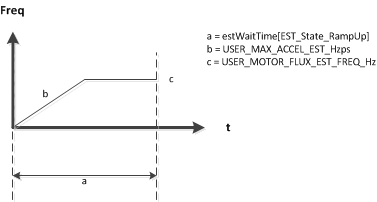 Figure 6-17 Ramp-Up Timing
This time can be changed to any desired value. Figure 7-18, taken using a current probe to measure phase current, shows the ramp up state time.
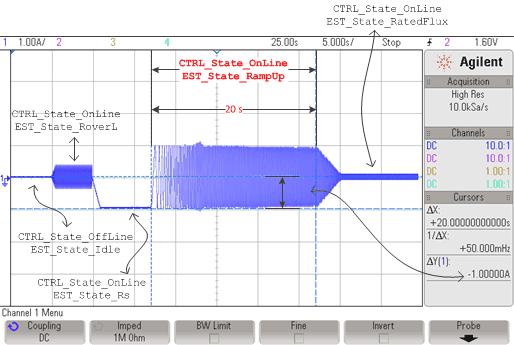 Figure 6-18 Phase Current During RampUp
EST State
Figure 6-18 Phase Current During RampUp
EST StateThe acceleration of this ramp is another parameter set in user.c, which can be changed according to user requirements. In the same example of a high inertia load, this acceleration can be changed. The default value of the ramp-up acceleration is set to 2.0 Hz/s as shown below:
//! \brief Defines maximum acceleration for the estimation speed profiles, Hz/s
#define USER_MAX_ACCEL_EST_Hzps (2.0)