SPVA018 August 2025 LM2904B
- 1
- Abstract
- Trademarks
- 1Introduction
- 2ESD Overview
- 3Types of ESD Cells
- 4How to Determine the ESD Structure of the Device from the Data Sheet
- 5How to Protect The System from In Circuit ESD/EOS Events
- 6How to Test an Op Amp in a System Level Circuit
- 7Summary
- 8References
3.5 CER and ECR NPN Diodes
The CER/ECR NPN ESD protection structure is another common option, particularly for higher voltages. This behaves similarly to a snapback diode, in that the voltage reaches a certain level before dropping back to the threshold voltage. Figure 3-9 shows the general layout.
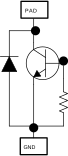 Figure 3-9 CER Diode Structure
The protection structure raises the base potential to lower the NPN trigger voltage. These are preferred when the device is tolerant to a high trigger or clamping voltage. Note that one pad is connected to ground through a diode. The other pad is voltage triggered. This offers ESD protection while taking up a relatively small area, albeit not as small as an SCR structure. These structures are also advantageous because the structures are generally considered to be a latch-up free design unlike SCRs, which are more prone to latch-up.