SN75LVDS32
- Meets or Exceeds the Requirements of ANSI TIA/EIA-644 Standard
- Operates With a Single 3.3-V Supply
- Designed for Signaling Rate of up to 155 Mbps
- Differential Input Thresholds ±100 mV Max
- Low-Voltage TTL (LVTTL) Logic Output Levels
- Open-Circuit Fail Safe
- Characterized For Operation From 0&dg;C to 70°C
The SN75LVDS32 and SN75LVDS9637 are differential line receivers that implement the electrical characteristics of low-voltage differential signaling (LVDS). This signaling technique lowers the output voltage levels of 5-V differential standard levels (such as EIA/TIA-422B) to reduce the power, increase the switching speeds, and allow operation with a 3.3-V supply rail. Any of the four differential receivers provides a valid logical output state with a ±100 mV allow operation with a differential input voltage within the input common-mode voltage range. The input common-mode voltage range allows 1 V of ground potential difference between two LVDS nodes.
The intended application of these devices and signaling technique is both point-to-point and multidrop (one
driver and multiple receivers) data transmission over controlled impedance media of approximately 100  . The
transmission media may be printed-circuit board traces, backplanes, or cables. The ultimate rate and distance
of data transfer is dependent upon the attenuation characteristics of the media and the noise coupling to the
environment.
. The
transmission media may be printed-circuit board traces, backplanes, or cables. The ultimate rate and distance
of data transfer is dependent upon the attenuation characteristics of the media and the noise coupling to the
environment.
The SN75LVDS32 and SN75LVDS9637 are characterized for operation from 0°C to 70°C.
관심 가지실만한 유사 제품
비교 대상 장치와 유사한 기능.
기술 자료
| 상위 문서 | 유형 | 직함 | 형식 옵션 | 최신 영어 버전 다운로드 | 날짜 |
|---|---|---|---|---|---|
| * | 데이터 시트 | High-Speed Differential Line Receivers datasheet (Rev. B) | 2001. 6. 22 | ||
| Application brief | LVDS to Improve EMC in Motor Drives | 2018. 9. 27 | |||
| Application brief | How Far, How Fast Can You Operate LVDS Drivers and Receivers? | 2018. 8. 3 | |||
| Application brief | How to Terminate LVDS Connections with DC and AC Coupling | 2018. 5. 16 | |||
| 애플리케이션 노트 | An Overview of LVDS Technology | 1998. 10. 5 |
설계 및 개발
추가 조건 또는 필수 리소스는 사용 가능한 경우 아래 제목을 클릭하여 세부 정보 페이지를 확인하세요.
SN65LVDS31-32BEVM — LVDS31 및 LVDS32B용 SN65LVDS31-32BEVM 평가 모듈
TI offers a series of low-voltage differential signaling (LVDS) evaluation modules (EVMs) designed for analysis of the electrical characteristics of LVDS drivers and receivers. Four unique EVMs are available to evaluate the different classes of LVDS devices offered by TI.
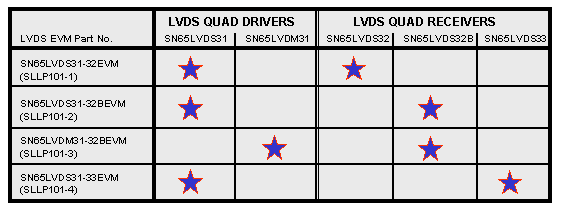
As seen (...)
SN65LVDS31-32EVM — SNx5LVDS31 및 SNx5LVDS32용 SN65LVDS31-32EVM 평가 모듈
The SN65LVDS31-32EVM evaluation moduel (EVM) includes the SV65LVDS31 quad driver and the SN65LVDS32 quad receiver. The SN65LVDS31 device is a TIA/EIA-644 standard-compliant LVDS driver. The SN65LVDS32 device is a TIA/EIA-644 standard-compliant receiver that has a passive open-circuit failsafe (...)
| 패키지 | 핀 | CAD 기호, 풋프린트 및 3D 모델 |
|---|---|---|
| SOIC (D) | 16 | Ultra Librarian |