SNVSCF2 November 2025 LM65680
PRODUCTION DATA
- 1
- 1 Features
- 2 Applications
- 3 Description
- 4 Related Products
- 5 Pin Configuration and Functions
- 6 Specifications
-
7 Detailed Description
- 7.1 Overview
- 7.2 Functional Block Diagram
- 7.3
Feature Descriptions
- 7.3.1 Input Voltage Range (VIN1, VIN2)
- 7.3.2 High-Voltage Bias Supply Subregulator (VCC, BIAS)
- 7.3.3 Precision Enable and Adjustable Input Voltage UVLO (EN/UVLO)
- 7.3.4 Output Voltage Setpoint (FB, BIAS)
- 7.3.5 Switching Frequency (RT)
- 7.3.6 Mode Selection and Clock Synchronization (MODE/SYNC)
- 7.3.7 Device Configuration (CNFG/SYNCOUT)
- 7.3.8 Dual-Random Spread Spectrum (DRSS)
- 7.3.9 High-Side MOSFET Gate Drive (BST)
- 7.3.10 Configurable Soft Start (SS)
- 7.3.11 Protection Features
- 7.3.12 Two-Phase, Single-Output Operation
- 7.4 Device Functional Modes
-
8 Application and Implementation
- 8.1 Application Information
- 8.2
Typical Applications
- 8.2.1
Design 1 – 5V, 8A Synchronous Buck
Regulator With Wide Input Voltage Range and High Efficiency
- 8.2.1.1 Design Requirements
- 8.2.1.2
Detailed Design Procedure
- 8.2.1.2.1 Custom Design With WEBENCH® Tools
- 8.2.1.2.2 Choosing the Switching Frequency
- 8.2.1.2.3 Buck Inductor Selection
- 8.2.1.2.4 Input Capacitor Selection
- 8.2.1.2.5 Output Capacitors
- 8.2.1.2.6 Output Voltage Setpoint
- 8.2.1.2.7 Compensation Components
- 8.2.1.2.8 Setting the Input Voltage UVLO
- 8.2.1.2.9 EMI Mitigation, RDRSS
- 8.2.1.2.10 Bootstrap Capacitor, CBST
- 8.2.1.3 Application Curves
- Design 2 – High Efficiency, 48V to 12V, 400kHz Synchronous Buck Regulator
- 8.2.1
Design 1 – 5V, 8A Synchronous Buck
Regulator With Wide Input Voltage Range and High Efficiency
- 8.3 Best Design Practices
- 8.4 Power Supply Recommendations
- 8.5 Layout
- 9 Device and Documentation Support
- 10Revision History
- 11Mechanical, Packaging, and Orderable Information
Package Options
Mechanical Data (Package|Pins)
- RZY|26
Thermal pad, mechanical data (Package|Pins)
Orderable Information
8.1.1.4 EMI Filter
Switching regulators exhibit a negative input impedance, which is lowest at the minimum input voltage and maximum load. An underdamped LC filter exhibits a high output impedance at the resonant frequency of the filter. For stability, the output impedance of the EMI filter must be less than the absolute value of the converter input impedance.
Based on the EMI filter in Figure 8-1, the design steps are as follows:
- Calculate the required attenuation of the EMI filter at the switching frequency, where CIN represents the existing capacitance at the converter input.
- Select an input filter inductor LIN between 1μH and 10μH. Use a lower value to reduce DC losses in a high-current design.
- Calculate input-side filter capacitance CF.
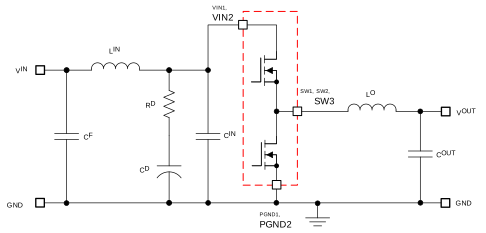 Figure 8-1 Passive
π-Stage EMI Filter for a Buck Regulator
Figure 8-1 Passive
π-Stage EMI Filter for a Buck RegulatorBy calculating the first harmonic current from the Fourier series of the input current waveform and multiplying the result by the input impedance (the impedance is defined by the existing input capacitor CIN), Equation 15 provides the required filter attenuation at the switching frequency.
where
- VMAX is the allowed emission level in dBμV from the applicable conducted EMI standard, for example CISPR 32 Class B.
- CIN is the existing input capacitance of the regulator.
- DMAX is the maximum duty cycle.
- IL(PK) is the peak inductor current.
In terms of EMI filter design, model the current at the input as a square-wave. Use Equation 16 to determine the EMI filter capacitance CF.
Adding an input filter to a switching regulator modifies the control-to-output transfer function. The output impedance of the filter must be sufficiently low such that the input filter does not significantly affect the regulator loop gain. The impedance peaks at the filter resonant frequency. Equation 17 calculates the resonant frequency of the filter.
The purpose of RD is to reduce the peak output impedance of the filter at the resonant frequency. Capacitor CD blocks the DC component of the input voltage to avoid excessive power dissipation in RD. Capacitor CD must have lower impedance than RD at the resonant frequency with a capacitance value greater than that of the input capacitor CIN. This prevents CIN from interfering with the cutoff frequency of the main filter. Add damping when the output impedance of the filter is high at the resonant frequency (Q of the filter formed by LIN and CIN is too high). Use an electrolytic capacitor CD for damping with a value given by Equation 18.
Use Equation 19 to select the damping resistor RD.