SNIS241 September 2025 TMP461-EP
PRODUCTION DATA
- 1
- 1 Features
- 2 Applications
- 3 Description
- 4 Device Information
- 5 Pin Configuration and Functions
- 6 Specifications
- 7 Detailed Description
-
8 Register Map
- 8.1
Register Information
- 8.1.1 Pointer Register
- 8.1.2 Local and Remote Temperature Registers
- 8.1.3 Status Register
- 8.1.4 Configuration Register
- 8.1.5 Conversion Rate Register
- 8.1.6 One-Shot Start Register
- 8.1.7 Channel Enable Register
- 8.1.8 Consecutive ALERT Register
- 8.1.9 η-Factor Correction Register
- 8.1.10 Remote Temperature Offset Register
- 8.1.11 Manufacturer Identification Register
- 8.1
Register Information
- 9 Application and Implementation
- 10Device and Documentation Support
- 11Revision History
- 12Mechanical, Packaging, and Orderable Information
Package Options
Mechanical Data (Package|Pins)
- DGS|10
Thermal pad, mechanical data (Package|Pins)
Orderable Information
7.5.1.2 Bus Definitions
The TMP461-EP device is two-wire- and SMBus-compatible. Figure 7-6 and Figure 7-7 illustrate the timing for various operations on the TMP461-EP device. The bus definitions are as follows:
- Bus Idle:Both SDA and SCL lines remain high.
- Start Data Transfer:A change in the state of the SDA line (from high to low) when the SCL line is high defines a start condition. Each data transfer initiates with a start condition.
- Stop Data Transfer:A change in the state of the SDA line (from low to high) when the SCL line is high defines a stop condition. Each data transfer terminates with a repeated start or stop condition.
- Data Transfer:The number of data bytes transferred between a start and stop condition is not limited and is determined by the controller device. The receiver acknowledges the data transfer.
- Acknowledge:Each receiving device, when addressed, is obliged to generate an acknowledge bit. A device that acknowledges must pull down the SDA line during the acknowledge clock pulse in such a way that the SDA line is stable low during the high period of the acknowledge clock pulse. Take setup and hold times into account. On a controller receive, data transfer termination can be signaled by the controller generating a not-acknowledge on the last byte that is transmitted by the target.
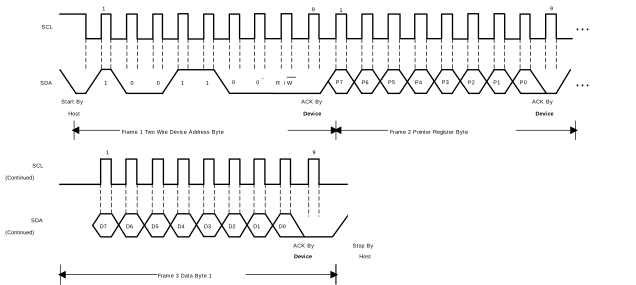
A. Target address 1001100 is shown.
Figure 7-6 Two-Wire Timing Diagram for Write Word Format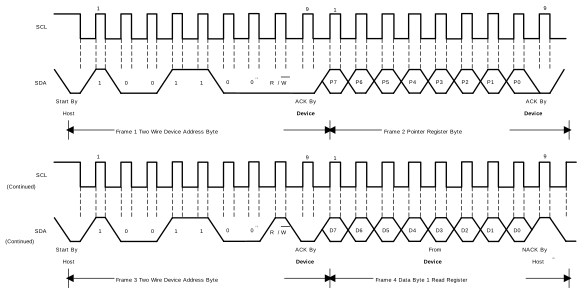
A. Target address 1001100 is shown.
B. The controller must leave SDA high to terminate a single-byte read operation.
Figure 7-7 Two-Wire Timing Diagram for Single-Byte Read Format