SNIS241 September 2025 TMP461-EP
PRODUCTION DATA
- 1
- 1 Features
- 2 Applications
- 3 Description
- 4 Device Information
- 5 Pin Configuration and Functions
- 6 Specifications
- 7 Detailed Description
-
8 Register Map
- 8.1
Register Information
- 8.1.1 Pointer Register
- 8.1.2 Local and Remote Temperature Registers
- 8.1.3 Status Register
- 8.1.4 Configuration Register
- 8.1.5 Conversion Rate Register
- 8.1.6 One-Shot Start Register
- 8.1.7 Channel Enable Register
- 8.1.8 Consecutive ALERT Register
- 8.1.9 η-Factor Correction Register
- 8.1.10 Remote Temperature Offset Register
- 8.1.11 Manufacturer Identification Register
- 8.1
Register Information
- 9 Application and Implementation
- 10Device and Documentation Support
- 11Revision History
- 12Mechanical, Packaging, and Orderable Information
Package Options
Mechanical Data (Package|Pins)
- DGS|10
Thermal pad, mechanical data (Package|Pins)
Orderable Information
9.2 Typical Application
 Figure 9-1 TMP461-EP Basic Connections Using a Discrete Remote Transistor
A. A diode-connected configuration provides better settling time. The transistor-connected configuration provides better series resistance cancellation. NPN transistors must be diode-connected. PNP transistors can either be transistor-connected or diode-connected. For more information on NPN/PNP transistors, see the Remote Temperature Sensor Transistor Selection Guide application note.
B. Rs (optional) must be < 1kΩ in most applications. Selections of Rs depend on specific applications; see the Section 7.3.4
C. CDIFF (optional) must be < 1000pF in most applications. Selections of CDIFF depend on the specific application; see the Section 7.3.4 and Figure 6-6.
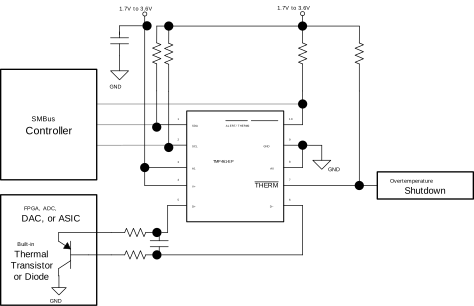 Figure 9-2 TMP461-EP Basic Connections Using a Processor Built-In Remote Transistor