SNIS241 September 2025 TMP461-EP
PRODUCTION DATA
- 1
- 1 Features
- 2 Applications
- 3 Description
- 4 Device Information
- 5 Pin Configuration and Functions
- 6 Specifications
- 7 Detailed Description
-
8 Register Map
- 8.1
Register Information
- 8.1.1 Pointer Register
- 8.1.2 Local and Remote Temperature Registers
- 8.1.3 Status Register
- 8.1.4 Configuration Register
- 8.1.5 Conversion Rate Register
- 8.1.6 One-Shot Start Register
- 8.1.7 Channel Enable Register
- 8.1.8 Consecutive ALERT Register
- 8.1.9 η-Factor Correction Register
- 8.1.10 Remote Temperature Offset Register
- 8.1.11 Manufacturer Identification Register
- 8.1
Register Information
- 9 Application and Implementation
- 10Device and Documentation Support
- 11Revision History
- 12Mechanical, Packaging, and Orderable Information
Package Options
Mechanical Data (Package|Pins)
- DGS|10
Thermal pad, mechanical data (Package|Pins)
Orderable Information
7.3.4 Filtering
Remote junction temperature sensors are typically implemented in a noisy environment. Noise is most often created by fast digital signals that can corrupt measurements. The TMP461-EP device has a built-in, 65kHz filter on the D+ and D– inputs to minimize the effects of noise. However, a bypass capacitor placed differentially across the inputs of the remote temperature sensor is recommended to make the application more robust against unwanted coupled signals. For this capacitor, select a value between 100pF differential and 1nF. Some applications attain better overall accuracy with additional series resistance. However, this increased accuracy is application-specific. When series resistance is added, the total value must not be greater than 1kΩ. If filtering is required, suggested component values are 100pF differential and 50Ω on each input; exact values are application-specific.
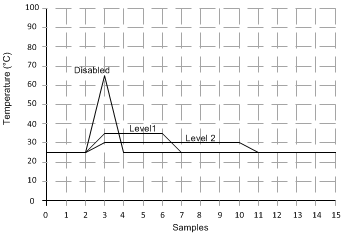
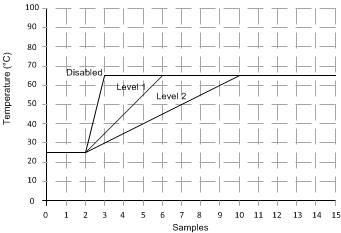
Additionally, a digital filter is available for the remote temperature measurements to reduce the effect of noise further. This filter is programmable and has two levels when enabled. Level 1 performs a moving average of four consecutive samples. Level 1 filtering can be achieved by setting the digital filter control register (read address 24h, write address 24h) to 01h. Level 2 performs a moving average of eight consecutive samples. Level 2 filtering can be achieved by setting the digital filter control register (read address 24h, write address 24h) to 02h. The value stored in the remote temperature result register is the output of the digital filter, and is the value that the ALERT and THERM limits are compared to. The digital filter provides additional immunity to noise and spikes on the ALERT and THERM outputs. The filter responses to impulse and step inputs are shown in Figure 7-2 and Figure 7-3, respectively. The filter can be enabled or disabled by programming the desired levels in the digital filter register; see Table 8-1. The digital filter is disabled by default and on POR.