SNIS241 September   2025 TMP461-EP

PRODUCTION DATA  

  1.   1
  2. Features
  3. Applications
  4. Description
  5. Device Information
  6. Pin Configuration and Functions
  7. Specifications
    1. 6.1 Absolute Maximum Ratings
    2. 6.2 ESD Ratings
    3. 6.3 Recommended Operating Conditions
    4. 6.4 Thermal Information
    5. 6.5 Electrical Characteristics
    6. 6.6 Two-Wire Timing Requirements
    7. 6.7 Timing Diagrams
    8. 6.8 Typical Characteristics
  8. Detailed Description
    1. 7.1 Overview
    2. 7.2 Functional Block Diagram
    3. 7.3 Feature Description
      1. 7.3.1 Temperature Measurement Data
        1. 7.3.1.1 Decoding Temperature Data
      2. 7.3.2 Series Resistance Cancellation
      3. 7.3.3 Differential Input Capacitance
      4. 7.3.4 Filtering
      5. 7.3.5 Sensor Fault
      6. 7.3.6 ALERT and THERM Functions
    4. 7.4 Device Functional Modes
      1. 7.4.1 Shutdown Mode (SD)
    5. 7.5 Programming
      1. 7.5.1 Serial Interface
        1. 7.5.1.1 Bus Overview
        2. 7.5.1.2 Bus Definitions
        3. 7.5.1.3 Serial Bus Address
        4. 7.5.1.4 Read and Write Operations
        5. 7.5.1.5 Timeout Function
        6. 7.5.1.6 High-Speed Mode
      2. 7.5.2 General-Call Reset
  9. Register Map
    1. 8.1 Register Information
      1. 8.1.1  Pointer Register
      2. 8.1.2  Local and Remote Temperature Registers
      3. 8.1.3  Status Register
      4. 8.1.4  Configuration Register
      5. 8.1.5  Conversion Rate Register
      6. 8.1.6  One-Shot Start Register
      7. 8.1.7  Channel Enable Register
      8. 8.1.8  Consecutive ALERT Register
      9. 8.1.9  η-Factor Correction Register
      10. 8.1.10 Remote Temperature Offset Register
      11. 8.1.11 Manufacturer Identification Register
  10. Application and Implementation
    1. 9.1 Application Information
    2. 9.2 Typical Application
      1. 9.2.1 Design Requirements
      2. 9.2.2 Detailed Design Procedure
      3. 9.2.3 Application Curve
    3. 9.3 Power Supply Recommendations
    4. 9.4 Layout
      1. 9.4.1 Layout Guidelines
      2. 9.4.2 Layout Example
  11. 10Device and Documentation Support
    1. 10.1 Receiving Notification of Documentation Updates
    2. 10.2 Related Documentation
    3. 10.3 Support Resources
    4. 10.4 Trademarks
    5. 10.5 Electrostatic Discharge Caution
    6. 10.6 Glossary
  12. 11Revision History
  13. 12Mechanical, Packaging, and Orderable Information

Package Options

Mechanical Data (Package|Pins)
Thermal pad, mechanical data (Package|Pins)
Orderable Information

ALERT and THERM Functions

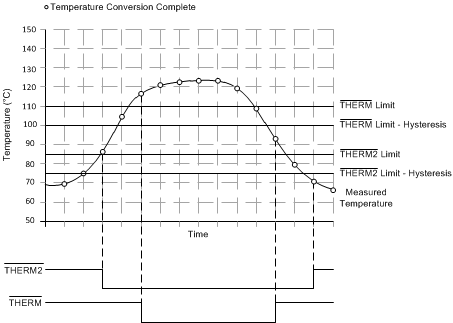
Operation of the ALERT (pin 10) and THERM (pin 7) interrupts is shown in Figure 7-4. Operation of the THERM (pin 7) and THERM2 (pin 10) interrupts is shown in Figure 7-5. The ALERT and THERM pin setting is determined by bit 5 of the configuration register.

The hysteresis value is stored in the THERM hysteresis register and applies to both the THERM and THERM2 interrupts. The value of the CONAL[2:0] bits in the consecutive ALERT register (see Table 8-1) determines the number of limit violations before the ALERT pin is tripped. The default value is 000b and corresponds to one violation, 001b programs two consecutive violations, 011b programs three consecutive violations, and 111b programs four consecutive violations. The CONAL[2:0] bits provide additional filtering for the ALERT pin state.

TMP461-EP ALERT and THERM Interrupt Operation
Figure 7-4 ALERT and THERM Interrupt Operation
TMP461-EP THERM and THERM2 Interrupt Operation
Figure 7-5 THERM and THERM2 Interrupt Operation