SBAU315B July 2018 – March 2025 ADS9224R , ADS9234R
6.4 Spectral Analysis Tool
The spectral analysis tool evaluates the dynamic performance (SNR, THD, SFDR, SINAD, and ENOB) of the ADS9224R SAR ADC. Evaluation is done through single-tone sinusoidal signal FFT analysis using the 7-term Blackman-Harris window setting. The window setting of None can be used to search for noise spurs over frequency in dc inputs.
For dynamic performance evaluation, the external differential source must have better specifications than the ADC. The measured system performance must not be limited by the performance of the signal source. Therefore, the external reference source must meet the source requirements mentioned in Table 6-1.
| Specification Description | Specification Value |
|---|---|
| Signal frequency | Less than fS / 2 |
| External source type | Balanced differential |
| External source common-mode voltage | 0 V or floating |
| Source differential signal (VPP amplitude for –0.5 dBFS) |
±3.875 VP OR 7.75 VPP |
| Maximum noise | 20 µVRMS |
| Minimum SNR | 103.2 dB |
| Maximum THD | –120 dB |
For 2-kHz SNR and ENOB evaluation at a maximum throughput of 3 MSPS, the number of samples must be a minimum of 65536.
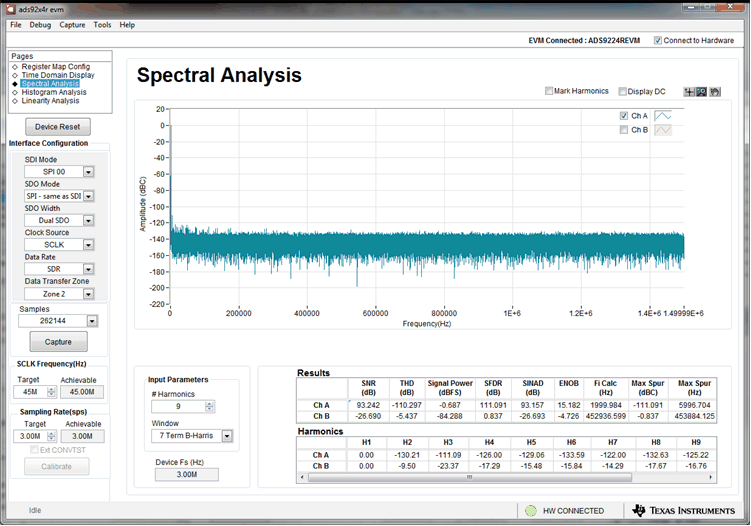 Figure 6-6 Spectral Analysis Tool
Finally, the FFT tool includes windowing options that are required to mitigate the effects of noncoherent sampling (a discussion that is beyond the scope of this document). The 7-Term Blackman Harris window is the default option and has sufficient dynamic range to resolve the frequency components of up to a 24-bit ADC. The None option corresponds to not using a window (or using a rectangular window) and is not recommended.