SBOS998D June 2021 – July 2025 BUF802
PRODUCTION DATA
- 1
- 1 Features
- 2 Applications
- 3 Description
- 4 Pin Configuration and Functions
- 5 Specifications
- 6 Parameter Measurement Information
- 7 Detailed Description
- 8 Application and Implementation
- 9 Device and Documentation Support
- 10Revision History
- 11Mechanical, Packaging, and Orderable Information
Package Options
Refer to the PDF data sheet for device specific package drawings
Mechanical Data (Package|Pins)
- RGT|16
Thermal pad, mechanical data (Package|Pins)
- RGT|16
Orderable Information
8.2.1.2 Detailed Design Procedure
- Input Impedance: The JFET-input stage of the BUF802 offers gigohms of input impedance, and therefore, enables the front-end to be terminated with a 1‑MΩ resistor without affecting performance. A 50‑Ω resistance can also be switched in offering matched termination for high-frequency signals. The BUF802 enables the designer to use both 1‑MΩ and 50‑Ω termination in the same signal chain.
- Noise: The total noise of
the front-end amplifier is the function of the voltage and current noise of the
BUF802, OPA140, and the resistors thermal noise. The
dominant noise source, however, is contributed by the voltage noise of the BUF802 as a result of the noise presence across the complete
bandwidth. Thus, the total RMS noise of the front-end amplifier is approximately
equal to the voltage noise of BUF802 over 1 GHz.
The specified input-referred voltage noise of the BUF802 (see Section 5.5) is 2.3 nV/√Hz. The total input referred RMS noise in a bandwidth of 1 GHz is given by the following equation:
Equation 1. EnRMS = 2.3 nV/√Hz × √(1 GHz × 1.22) = 80 µVRMS.1.22 = Brickwall correction factor. See TI Precision Labs – Op Amps: Noise – Spectral Density for detailed calculations.
Figure 8-3 shows the total input-referred spot noise as a function of frequency. Assuming the oscilloscope has eight divisions on the screen and a highest resolution of 1 mV, the full-scale reading is 8 mVPP or 2.82 mVRMS. Thus, the SNR of the front-end amplifier stage at the highest-resolution setting is:
Equation 2. 20 × log (2.82 mVRMS / 80 µVRMS) = 31 dB. - S11 Optimization: The
front-end amplifier circuit requires a exact 50‑Ω termination to achieve the
required S11 parameter of –15 dB across the frequency. Although mounting an
exact 50‑Ω resistance at the input of the front-end composite loop circuit is
possible, the parasitic capacitance of the BUF802 appears in
parallel to this 50‑Ω resistance, resulting in a net-imperfect termination.
The parasitic input capacitance of BUF802 (IN pin) is 2.4 pF. At 1 GHz, this parasitic capacitance reduces to an impedance of 66.3 Ω. Thus, the net input impedance as seen by the signal at the input is as follows:
Equation 3. 66.3 Ω || 50 Ω = 28.5 ΩThis result is an imperfect termination for the 50‑Ω source, resulting in a poor S11. The addition of a 30‑Ω resistance in series with the input trace, and a 6.8‑nH inductor in series with the onboard 50‑Ω termination help isolate the input parasitic capacitance. This configuration also helps maintain the net input impedance at 50 Ω. Figure 8-4 shows the S11 response of this modified circuit.
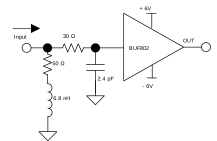 Figure 8-2 Net Input Impedance
 - Uniform Gain Across Frequency: The front-end amplifier circuit is
designed with BUF802 and OPA140
connected in a composite loop. The loop splits the input signal into low- and
high-frequency components, taking both components to the output through two
different circuits (transfer functions) and recombining them to reproduce a net
output signal. The end goal is to achieve a smooth transition between the two
circuits and maintain a flat frequency response from dc until the frequency of
interest.
CL Mode of the BUF802 simplifies this design for achieving a flat frequency response from dc until the frequency of interest (1 GHz in this case). To achieve a flat response, meet the following two conditions:
- High-frequency response pole fHF << low frequency pole fLF
- α/β = G
where α is the input attenuation factor, β is the inverse of the noninverting gain of the precision amplifier and G is the dc gain of the main path of the BUF802. G varies from device-to-device; therefore, trim either α or β to achieve a flat frequency response. In Figure 8-1, trim β using the RPOT.
G is the typical value, (G = 0.971 V/V) from Section 5.5 and α is 1/5 (200 kΩ / (200 kΩ + 800 kΩ)); therefore, trim RPOT so that β ≈ 1/5.
For the β network, use resistors that are an order of magnitude of resistance lower than the resistors used in the α network. Therefore, β resistor values of 80 kΩ and ≈ 20 kΩ are chosen.
fHF is the pole resulting from the 330‑pF series capacitor and the 10‑MΩ resistor on the In_Bias pin. Reduction in value of 10‑MΩ helps with the reduction of overdrive recovery time of the composite loop, but increases the fHF pole frequency.
Equation 4. fHF = 1 / (2 × pi × R × C) = 1 / (2 × 3.14 × 10 MΩ × 330 pF) = 48 HzfLF is the pole resulting from the gain bandwidth of the precision amplifier (OPA140), the auxiliary path bandwidth and other parasitic capacitance of the resistor network.
Equation 5. fLF1 of precision amplifier = GBW × GAUX × β = 440 kHzwhere
- GBW is the gain bandwidth product of the precision amplifier (OPA140) = 11 MHz
- GAUX is the gain from In_Aux to OUT = 0.2 V/V
- 1/β is the external noninverting gain set for the precision amplifier = 5 V/V
The common mode input capacitor of the precision amplifier (CINPA) forms a pole with the Rα2 resulting in pole frequency of:
Equation 6. fLF2 of Rα2 and CINPA of amplifier = 1 / ( 2 × pi × Rα2 × CINPA) = 28.4 kHzSince fLF2 < fLF1, fLF2 is to be considered as the dominant pole for the auxiliary path bandwidth. Based on the above value of fHF and fLF2, the required condition of fHF << fLF2 is met.
CF, connected across the precision amplifier, is required to compensate for the parasitic capacitance and to make the overall poles and zeros cancel each other. Use the following equation to find the value of CF:
Equation 7. CF = CINPA × ((G × Rα2 / Rβ2) – 1)).where
- CINPA is the common-mode input capacitance of the precision amplifier, the OPA140 in this case
- G is the typical value, (G = 0.971 V/V) from Section 5.5
Plugging in the value of these components arrives approximately to CF = 61 pF, rounding off to nearest standard capacitor CF = 56 pF. In the final system, based on the quality of the flat-band response needed, CF is able to be trimmed along with RPOT in the final production flow.