SWRS201C January 2017 – March 2025 CC2640R2F-Q1
PRODUCTION DATA
- 1
- 1 Features
- 2 Applications
- 3 Description
- 4 Functional Block Diagram
- 5 Device Comparison
- 6 Pin Configuration and Functions
-
7 Specifications
- 7.1 Absolute Maximum Ratings
- 7.2 ESD Ratings
- 7.3 Recommended Operating Conditions
- 7.4 Power Consumption Summary
- 7.5 General Characteristics
- 7.6 1Mbps GFSK (Bluetooth Low Energy Technology)—RX
- 7.7 1Mbps GFSK (Bluetooth Low Energy Technology)—TX
- 7.8 24MHz Crystal Oscillator (XOSC_HF)
- 7.9 32.768kHz Crystal Oscillator (XOSC_LF)
- 7.10 48MHz RC Oscillator (RCOSC_HF)
- 7.11 32kHz RC Oscillator (RCOSC_LF)
- 7.12 ADC Characteristics
- 7.13 Temperature Sensor
- 7.14 Battery Monitor
- 7.15 Continuous Time Comparator
- 7.16 Low-Power Clocked Comparator
- 7.17 Programmable Current Source
- 7.18 Synchronous Serial Interface (SSI)
- 7.19 DC Characteristics
- 7.20 Thermal Resistance Characteristics for RGZ Package
- 7.21 Timing Requirements
- 7.22 Switching Characteristics
- 7.23 Typical Characteristics
- 8 Detailed Description
- 9 Application, Implementation, and Layout
- 10Device and Documentation Support
- 11Revision History
- 12Mechanical, Packaging, and Orderable Information
Package Options
Refer to the PDF data sheet for device specific package drawings
Mechanical Data (Package|Pins)
- RGZ|48
Thermal pad, mechanical data (Package|Pins)
Orderable Information
10.1 Device Nomenclature
To designate the stages in the product development cycle, TI assigns prefixes to all part numbers and date-code. Each device has one of three prefixes/identifications: X, P, or null (no prefix) (for example, CC2640R2F-Q1 is in production; therefore, no prefix/identification is assigned).
Device development evolutionary flow:
-
X
Experimental device that is not necessarily representative of the final device's
electrical specifications and may not use production assembly flow.
-
P
Prototype device that is not necessarily the final silicon die and may not necessarily
meet final electrical specifications.
-
null
Production version of the silicon die that is fully qualified.
Production devices have been characterized fully, and the quality and reliability of the device have been demonstrated fully. TI's standard warranty applies.
Predictions show that prototype devices (X or P) have a greater failure rate than the standard production devices. Texas Instruments recommends that these devices not be used in any production system because their expected end-use failure rate still is undefined. Only qualified production devices are to be used.
TI device nomenclature also includes a suffix with the device family name. This suffix indicates the package type (for example, RGZ).
For orderable part numbers of the CC2640R2F-Q1 device package types, see the Package Option Addendum of this document, the TI website (www.ti.com), or contact your TI sales representative.
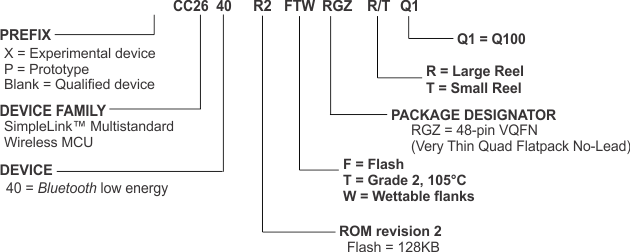 Figure 10-1 Device
Nomenclature
Figure 10-1 Device
Nomenclature