SLASFC6A August   2024  – August 2025 TAS2120

PRODUCTION DATA  

  1.   1
  2. Features
  3. Applications
  4. Description
  5. Pin Configuration and Functions
  6. Specifications
    1. 5.1 Absolute Maximum Ratings
    2. 5.2 ESD Ratings
    3. 5.3 Recommended Operating Conditions
    4. 5.4 Thermal Information
    5. 5.5 Electrical Characteristics
    6. 5.6 Timing Requirements
    7. 5.7 Timing Diagrams
    8. 5.8 Typical Characteristics
  7. Detailed Description
    1. 6.1 Overview
    2. 6.2 Functional Block Diagram
    3. 6.3 Device Functional Modes
      1. 6.3.1 Operational Modes
        1. 6.3.1.1 Hardware Shutdown
        2. 6.3.1.2 Hardware Config Modes
        3. 6.3.1.3 Software Power Modes Control and Software Reset
        4. 6.3.1.4 Efficiency and power saving modes
          1. 6.3.1.4.1 Noise Gate
          2. 6.3.1.4.2 Music Efficiency Mode
          3. 6.3.1.4.3 VDD Y-bridge
          4. 6.3.1.4.4 Class-H Boost
        5. 6.3.1.5 2S Battery Mode
        6. 6.3.1.6 External PVDD Mode
      2. 6.3.2 Faults and Status
        1. 6.3.2.1 Interrupt generation and clearing
    4. 6.4 Feature Description
      1. 6.4.1  PurePath™ Console 3 Software
      2. 6.4.2  Playback Signal Path
        1. 6.4.2.1 Digital Volume Control and Amplifier Output Level
        2. 6.4.2.2 High Pass Filter
        3. 6.4.2.3 Class-D Amplifier
        4. 6.4.2.4 Supply Tracking Limiters with Brown Out Prevention
          1. 6.4.2.4.1 Voltage Limiter and Clipping protection
        5. 6.4.2.5 Tone Generator
      3. 6.4.3  Digital Audio Serial Interface
        1. 6.4.3.1 Digital Loopback
      4. 6.4.4  Internal Boost
      5. 6.4.5  Boost Share
      6. 6.4.6  External Class-H Boost Controller
      7. 6.4.7  Supply Voltage Monitors
      8. 6.4.8  Thermal Protection
      9. 6.4.9  Clocks and PLL
        1. 6.4.9.1 Auto clock based wakeup and clock errors
      10. 6.4.10 Digital IO pins
    5. 6.5 Programming
      1. 6.5.1 I2C Control Interface
      2. 6.5.2 I2C Address Selection
      3. 6.5.3 General I2C Operation
      4. 6.5.4 I2C Single-Byte and Multiple-Byte Transfers
      5. 6.5.5 I2C Single-Byte Write
      6. 6.5.6 I2C Multiple-Byte Write
      7. 6.5.7 I2C Single-Byte Read
      8. 6.5.8 I2C Multiple-Byte Read
  8. Register Maps
    1. 7.1  PAGE 0 Registers
    2. 7.2  PAGE 1 Registers
    3. 7.3  PAGE 2 Registers
    4. 7.4  PAGE 3 Registers
    5. 7.5  PAGE 4 Registers
    6. 7.6  PAGE 5 Registers
    7. 7.7  PAGE 6 Registers
    8. 7.8  PAGE 7 Registers
    9. 7.9  PAGE 8 Registers
    10. 7.10 BOOK100 PAGE9 Registers
  9. Application and Implementation
    1. 8.1 Application Information
    2. 8.2 Typical Application
      1. 8.2.1 Design Requirements
      2. 8.2.2 Detailed Design Procedure
        1. 8.2.2.1 Mono/Stereo Configuration
        2. 8.2.2.2 Boost Converter Passive Devices
        3. 8.2.2.3 EMI Passive Devices
        4. 8.2.2.4 Miscellaneous Passive Devices
      3. 8.2.3 Application Performance Plots
    3. 8.3 What to Do and What Not to Do
    4. 8.4 Power Supply Recommendations
    5. 8.5 Layout
      1. 8.5.1 Layout Guidelines
      2. 8.5.2 Layout Example
  10. Device and Documentation Support
    1. 9.1 Documentation Support
      1. 9.1.1 Related Documentation
    2. 9.2 Receiving Notification of Documentation Updates
    3. 9.3 Support Resources
    4. 9.4 Trademarks
    5. 9.5 Electrostatic Discharge Caution
    6. 9.6 Glossary
  11. 10Revision History
  12. 11Mechanical, Packaging, and Orderable Information

Package Options

Mechanical Data (Package|Pins)
Thermal pad, mechanical data (Package|Pins)
Orderable Information

Description

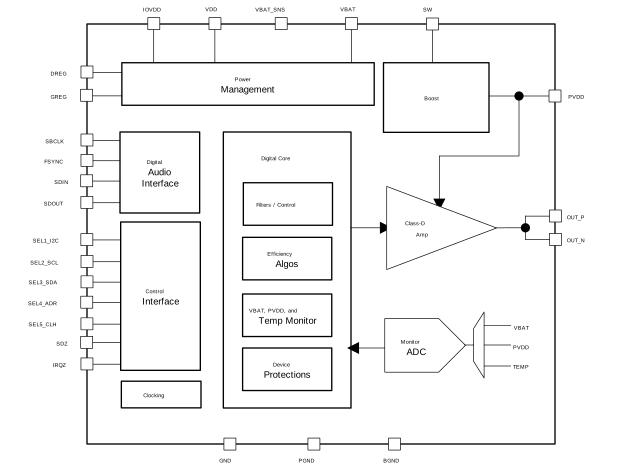
The TAS2120 is a mono, digital input Class-D audio amplifier with an integrated Boost for higher power delivery in battery-operated systems.

TAS2120 is optimized to deliver best battery life for real-use cases of music playback and voice calls. Advanced efficiency optimization features like Y-bridge, and other algorithms enable the device to produce best-in-class efficiency across all power regions of operation. The Class-D amplifier is capable of delivering 8.2W output powerusing integrated Class-H Boost.

TAS2120 device supports look-ahead algorithm based optimum boost voltage levels to match the output of audio signal. This provides all the power needed for peak output while significantly reducing the average power consumption.

Up to four devices can share a common bus via I2S/TDM and I2C interfaces. TAS2120 also supports HW pin based pre-defined controls that can configure the device for desired mode of operation without requiring any I2C controls.
Device Information
PART NUMBERPACKAGE(1)PACKAGE SIZE (2)
TAS2120QFN4mm × 3.5mm
For all available packages, see the orderable addendum at the end of the data sheet.
The package size (length × width) is a nominal value and includes pins, where applicable.
TAS2120 Functional block diagram Functional block diagram