SLAU966 February 2025 MSPM0C1103 , MSPM0C1103-Q1 , MSPM0C1104 , MSPM0C1104-Q1 , MSPM0C1105 , MSPM0C1106 , MSPM0C1106-Q1 , MSPM0G1106 , MSPM0G1107 , MSPM0G1506 , MSPM0G1507 , MSPM0G1518 , MSPM0G1519 , MSPM0G3106 , MSPM0G3106-Q1 , MSPM0G3107 , MSPM0G3107-Q1 , MSPM0G3506 , MSPM0G3506-Q1 , MSPM0G3507 , MSPM0G3507-Q1 , MSPM0G3518 , MSPM0G3518-Q1 , MSPM0G3519 , MSPM0G3519-Q1 , MSPM0H3216 , MSPM0L1105 , MSPM0L1106 , MSPM0L1116 , MSPM0L1117 , MSPM0L1227 , MSPM0L1227-Q1 , MSPM0L1228 , MSPM0L1228-Q1 , MSPM0L1303 , MSPM0L1304 , MSPM0L1304-Q1 , MSPM0L1305 , MSPM0L1305-Q1 , MSPM0L1306 , MSPM0L1306-Q1 , MSPM0L1343 , MSPM0L1344 , MSPM0L1345 , MSPM0L1346 , MSPM0L2228
- 1
- Abstract
- Trademarks
- 1MSPM0 Portfolio Overview
- 2Ecosystem and Migration
- 3Core Architecture Comparison
- 4Digital Peripheral Comparison
- 5Analog Peripheral Comparison
- 6References
3.3 Power Up and Reset Summary and Comparison
Similar to NXP M0 devices, MSPM0 devices have a minimum operating voltage and have modules in place to make sure that the device starts up properly by holding the device or portions of the device in a reset state. Table 3-3 shows a comparison on how this is done between the two families and what modules control the power up process and reset across the families.
| Feature | S32K1xx |
KEA128x |
KM35x | MSPM0 Devices | |
|---|---|---|---|---|---|
| Modules governing power up and resets | Reset Control Module | Reset Control Module | Reset Control Module | Module governing power up and resets | PMCU (Power Management and Clock Unit) |
| Voltage-Level Based Resets | |||||
| POR (Power-On Reset) | Complete device reset. First level voltage release for power up. Lowest voltage level for power down | POR (Power-On Reset) | Complete device reset. First level voltage release for power up. Lowest voltage level for power down. | ||
| BOR (Brownout Reset) with configurable levels | Programmable Threshold for triggering resets | Configurable BOR (Brownout Reset) | Can be configured as a reset or interrupt, with different voltage thresholds. | ||
NXP defines different reset types, while MSPM0 devices have different levels of reset states. For MSPM0 devices, the reset levels have a set order, and when a level is triggered, all subsequent levels are reset until the device is released into RUN mode. Table 3-4 gives a brief description of MSPM0 reset states. Figure 3-1 shows the relationship between all of the MSPM0 reset states.
| S32K1xx, KEA128x, KM35 Reset Domains | MSPM0 Reset States (1) | ||
|---|---|---|---|
| Power reset domain | Typical triggers are POR, BOR (3) | POR | existing content |
| No equivalent | Boot reset (BOOTRST) (2) | existing content | |
| System reset domain | Typical triggers are external pin reset, low voltage detect, WDT reset (3) | System reset (SYSRST) | existing content |
| No equivalent | CPU-only reset (CPURST) | existing content | |
| RTC domain | (3) | existing content | |
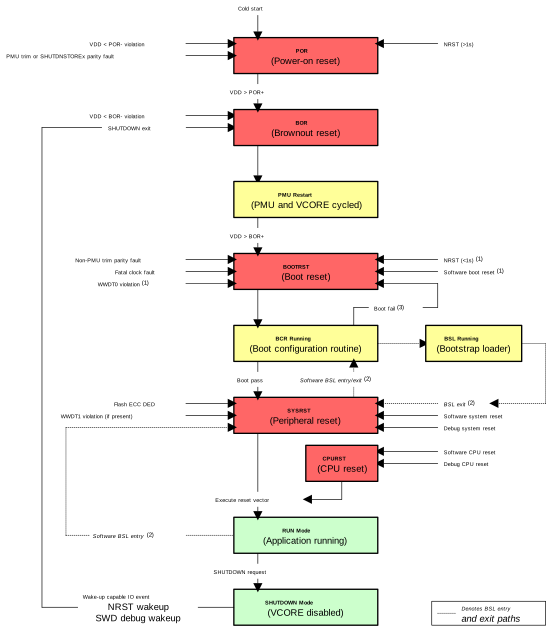 Figure 3-1 MSPM0 Reset Levels