SLVAFD0C May 2022 – August 2025 AM620-Q1 , AM623 , AM625 , AM625-Q1 , TPS65219 , TPS65219-Q1 , TPS65220
7.1 TPS6521901 Powering AM62x
VSYS = 5V | Memory: DDR4 | VDD_CORE = 0.75V
Figure 7-1 shows the TPS6521901 variant powering the AM62x processor on a system with 5V input supply and DDR4 memory. The 5V coming from the pre-regulator is connected to the main input supply for reference system (VSYS) and to the power input of the buck converters (PVIN_Bx). Buck1, Buck2 and Buck3 are used to supply VDD_CORE at 0.75V, 3.3V VDDSHVx IO and DDR IO respectively. Since Buck2 (3.3V PMIC rail) is programmed to ramp up first in the power-up sequence, this can be used as the input supply for some of the LDOs to minimize power dissipation. LDO1, configured as bypass, allows dynamic SD card voltage changes between 3.3V and 1.8V. This voltage change on LDO1 can be triggered setting the VSEL_SD pin high (LDO1=3.3V) or low (LDO1=1.8V). LDO2, is used to supply the VDDR_CORE. LDO3 supports the 1.8V analog domain and LDO4 supports the 2.5V VPP for the DDR4 memory. This power implementation requires an external discrete buck regulator to supply the 1.8V VDDSHV IO domain. This external discrete can be enabled using the GPO1 of the PMIC. TPS6521901 comes preprogrammed to enable GPO1 in the second slot of the power-up sequence. The external discrete must have active discharge and ramp up to an stable output voltage before the PMIC starts powering up the rails in the next slot. The remaining two general purpose pins (GPIO and GPO2) are free digital resources that are disabled by default but can be enabled through I2C after the PMIC completes the power-up sequence (after nRSTOUT is released).
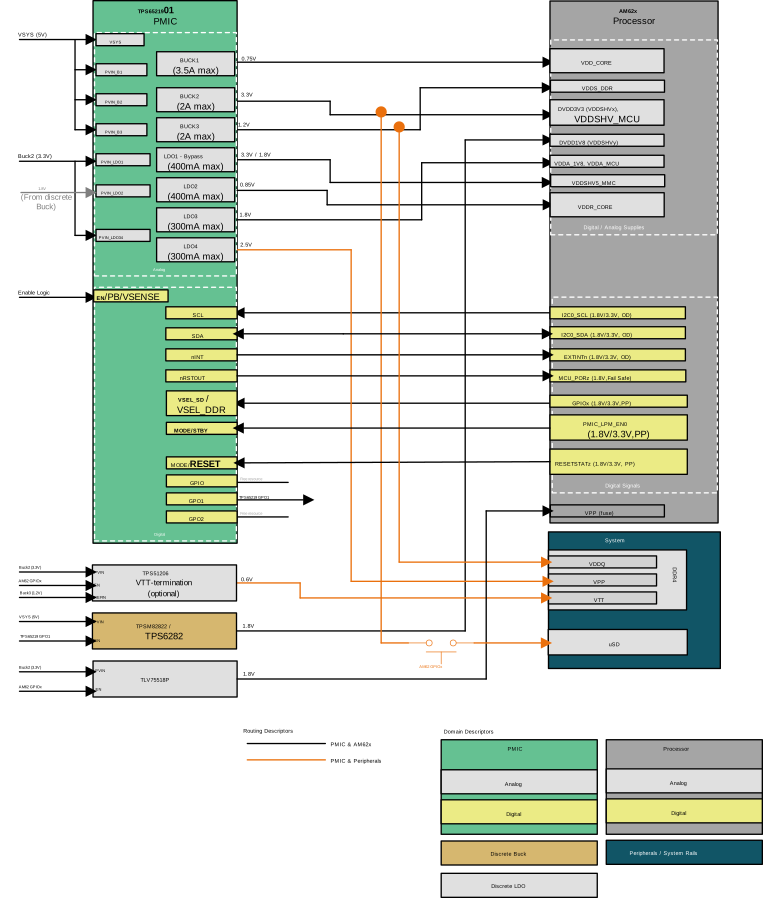 Figure 7-1 TPS6521901 Powering
AM62
Figure 7-1 TPS6521901 Powering
AM62