SPRAD06C March 2022 – March 2025 AM620-Q1 , AM623 , AM625 , AM625-Q1 , AM62L
- 1
- Abstract
- Trademarks
- 1Overview
-
2DDR4 Board Design and Layout Guidance
- 2.1 DDR4 Introduction
- 2.2 DDR4 Device Implementations Supported
- 2.3 DDR4 Interface Schematics
- 2.4 Compatible JEDEC DDR4 Devices
- 2.5 Placement
- 2.6 DDR4 Keepout Region
- 2.7 DBI
- 2.8 VPP
- 2.9 Net Classes
- 2.10 DDR4 Signal Termination
- 2.11 VREF Routing
- 2.12 VTT
- 2.13 POD Interconnect
- 2.14 CK and ADDR_CTRL Topologies and Routing Guidance
- 2.15 Data Group Topologies and Routing Guidance
- 2.16 CK and ADDR_CTRL Routing Specification
- 2.17 Data Group Routing Specification
- 2.18 Bit Swapping
-
3LPDDR4 Board Design and Layout Guidance
- 3.1 LPDDR4 Introduction
- 3.2 LPDDR4 Device Implementations Supported
- 3.3 LPDDR4 Interface Schematics
- 3.4 Compatible JEDEC LPDDR4 Devices
- 3.5 Placement
- 3.6 LPDDR4 Keepout Region
- 3.7 LPDDR4 DBI
- 3.8 Net Classes
- 3.9 LPDDR4 Signal Termination
- 3.10 LPDDR4 VREF Routing
- 3.11 LPDDR4 VTT
- 3.12 CK0 and ADDR_CTRL Topologies
- 3.13 Data Group Topologies
- 3.14 CK0 and ADDR_CTRL Routing Specification
- 3.15 Data Group Routing Specification
- 3.16 Byte and Bit Swapping
- 4LPDDR4 Board Design Simulations
- 5Additional Information: Package Delays
- 6Summary
- 7References
- 8Revision History
2.3.1 DDR4 Implementation Using 16-Bit SDRAM Devices
The DDR4 interface schematics vary, depending upon the width of the DDR4 SDRAM devices used and the width of the EMIF bus implemented. General connectivity is straightforward and consistent between the implementations. 16-bit SDRAM devices look like two 8-bit devices. Figure 2-1 shows the schematic connections for a 16-bit interface using a single x16 SDRAM.
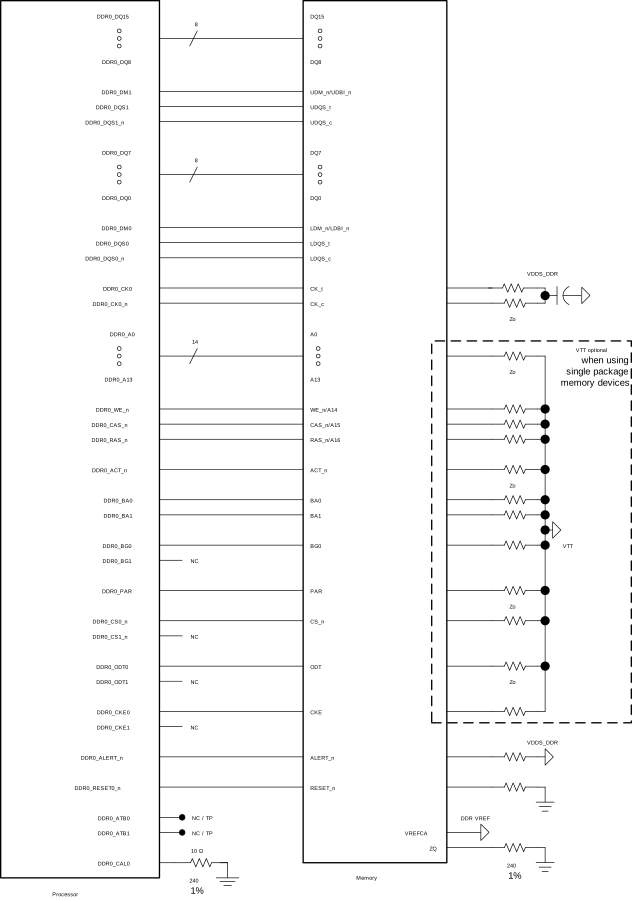 Figure 2-1 16-Bit, Single-Rank DDR4
Implementation Using x16 SDRAM
Figure 2-1 16-Bit, Single-Rank DDR4
Implementation Using x16 SDRAM- When designing with VTT regulator (LDO), which can source and sink current, decoupling capacitors (minimum of one capacitor (1.0uF value) must be used for every two termination resistors) must be used to minimize the effect of VTT supply noise. Refer to the AM64x GP EVM for reference
- Zo value for resistors is 30-47ohm. Resistor value must closely match trace impedance.
- VTT is optional on address and control signals when using single package memory devices, but termination as shown on CK0/CK0_n is always required
- DDR_VREF is supplied by the VTT regulator. When VTT is not used, VREFCA needs to be connected to a voltage divider. Consult the EVM schematic for an example of the voltage divider implementation.
- An external 240Ω ±1% resistor must be connected between the DDR0_CAL0 pin and VSS. The maximum power dissipation for the resistor is 5.2mW. No external voltage must be applied to the DDR0_CAL0 pin. Tolerance of ±1% required throughout life of component or product.
- RESET_n shall have an external 10k pull-down resistor to control RESET low until the DDR controller drives the signal. RESET_n has no length matching requirement.