TIDUF68A February 2024 – March 2025
- 1
- Description
- Resources
- Features
- Applications
- 6
- 1System Description
- 2System Overview
- 3System Design Theory
- 4Hardware, Software, Testing Requirements, and Test Results
- 5Design and Documentation Support
- 6About the Author
- 7Recognition
- 8Revision History
3.6 Interface to Host MCU
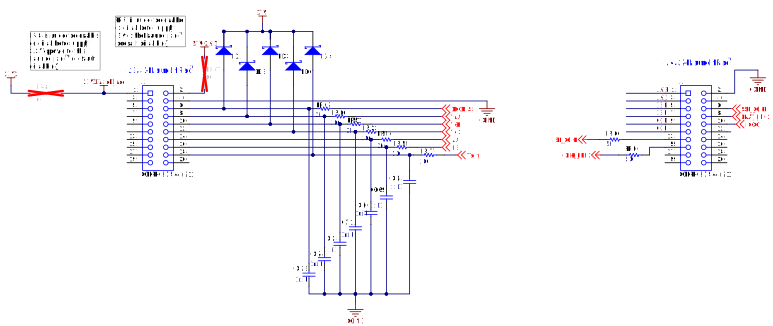 Figure 3-12 Schematic of Host Interface Connectors J1 and J2
The interface-to-host processor, such as the C2000 MCU, is compliant to a 3.3V I/O and provides all the required signals like the complementary PWM signals for phase A, B, and C; a PWM trip and disable signal; as well as accurate phase current, phase voltage, and DC-link voltage feedback to control the three-phase GaN inverter. The analog PCB temperature feedback (temp) further helps to protect the three-phase GaN power stage and adjust the safe operating area (SOA).
Each analog feedback signal is low-pass filtered with an RC filter, for example R57 (20Ω) and C58 (1nF) before connecting to the MCU-integrated ADC. The 1nF capacitor is placed to drive the switched input capacitors of the ADC, which are typically in the range of 5pF to 15pF. The Schottky diodes D2 through D6 clamp the maximum phase voltages to around 3.6V in case the DC bus voltage exceeds the 80V (absolute maximum) value.
The digital interface to the isolated modulator AMC0106M05 consists of a clock signal CLK_PhC with a 50Ω series line termination and a data return signal DAT_PhC. The signal SD_CLK to be generated by the MCU, offers an option to improve the setup and hold timing of the digital interface as described in the Clock Edge Delay Compensation With Isolated Modulators Digital Interface to MCUs application note.
The TIDA-010936 fits upper headers of an 80-pin C2000 MCU LaunchPad, like the LAUNCHXL-F28P65X. Additionally, the TIDA-010936 host interface offers the option to provide the 3.3V rail to power the C2000 LaunchPad. This option provides proper power-up sequencing of the entire system. The details of the pin assignment are outlined in Section 1.1 in Table 1-2, and Table 1-3, respectively.