TIDUFE5 July 2025
- 1
- Description
- Resources
- Features
- Applications
- 6
- 1System Description
- 2System Overview
- 3System Design Theory
- 4Hardware, Testing Requirements, and Test Results
- 5Design and Documentation Support
- 6About the Author
3.2.1 Field Oriented Control of PM Synchronous Motor
To achieve better dynamic performance, a more complex control scheme needs to be applied, to control the PM motor. With the mathematical processing power offered by the microcontrollers, advanced control strategies can be implemented, which use mathematical transformations to decouple the torque generation and the magnetization functions in PM motors. Such de-coupled torque and magnetization control is commonly called rotor flux oriented control, or simply Field Oriented Control (FOC).
In a direct current (DC) Motor, the excitation for the stator and rotor is independently controlled, the produced torque and the flux can be independently tuned as shown in Figure 3-5. The strength of the field excitation (for example, the magnitude of the field excitation current) sets the value of the flux. The current through the rotor windings determines how much torque is produced. The commutator on the rotor plays an interesting part in the torque production. The commutator maintains contact with the brushes, and mechanical design switches windings into the circuit that produce maximum torque when aligned. Mechanical construction manages windings that keep flux from rotor windings perpendicular to stator field at all times.
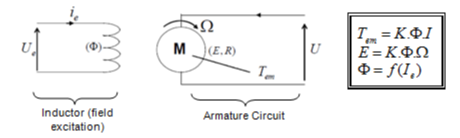 Figure 3-5 Flux and Torque are Independently Controlled
in DC Motor Model
Figure 3-5 Flux and Torque are Independently Controlled
in DC Motor ModelThe goal of the FOC (also called vector control) on synchronous and asynchronous machines is to be able to separately control the torque producing and magnetizing flux components. FOC control allow us to decouple the torque and the magnetizing flux components of stator current. With decoupled control of the magnetization, the torque producing component of the stator flux can now be thought of as independent torque control. Decoupling the torque and flux is necessary to engage several mathematical transforms, and this is where the microcontrollers add the most value. The processing capability provided by the microcontrollers enables these mathematical transformations to be carried out very quickly. This, in turn, implies that the entire algorithm controlling the motor can be executed at a fast rate, enabling higher dynamic performance. In addition to the decoupling, a dynamic model of the motor is now used for the computation of many quantities such as rotor flux angle and rotor speed. This means that the effect is accounted for, and the overall quality of control is better.
According to the electromagnetic laws, the torque produced in the synchronous machine is equal to vector cross product of the two existing magnetic fields as Equation 20 shows.
This expression shows that the torque is maximum if stator and rotor magnetic fields are orthogonal meaning, if the load is maintained at 90 degrees. If this condition is maintained all of the time and if the flux is oriented correctly, reduce the torque ripple and provide a better dynamic response. However, the constraint is to know the rotor position: this can be achieved with a position sensor such as incremental encoder. For low-cost applications where the rotor is not accessible, different rotor position observer strategies are applied to get rid of the position sensor.
In brief, the goal is to maintain the rotor and stator flux in quadrature: the goal is to align the stator flux with the q axis of the rotor flux, for example, orthogonal to the rotor flux. To do this, the stator current component in quadrature with the rotor flux is controlled to generate the commanded torque, and the direct component is set to zero. The direct component of the stator current can be used in some cases for field weakening, which has the effect of opposing the rotor flux, and reducing the back-EMF, which allows for operation at higher speeds.
The Field Orientated Control consists of controlling the stator currents represented by a vector. This control is based on projections which transform a three phase time and speed dependent system into a two coordinate (d and q coordinates) time invariant system. These projections lead to a structure similar to that of a DC machine control. Field-orientated-controlled machines need two constants as input references: the torque component (aligned with the q coordinate) and the flux component (aligned with d coordinate). Because Field Orientated Control is simply based on projections, the control structure handles instantaneous electrical quantities. This makes the control accurate in every working operation (steady state and transient) and independent of the limited bandwidth mathematical model. The FOC thus solves the classic scheme problems, in the following ways:
- The ease of reaching constant reference (torque component and flux component of the stator current)
- The ease of applying direct torque control
because in the (d, q) reference frame the expression of the torque is defined in
Equation 21.Equation 21.
By maintaining the amplitude of the rotor flux (ψR) at a fixed value, a linear relationship between torque and torque component (iSq) if formed. Controlling the torque component of the stator current vector then controls the torque output.