SLAAEH8 October 2024 AFE781H1 , AFE782H1 , AFE881H1 , AFE882H1 , DAC8740H , DAC8741H , DAC8742H
- 1
- Abstract
- Trademarks
- 1Introduction
- 2AFE881H1 HART Modem
-
3HART Testing and Registration
- 3.1 HART History and the FieldComm Group
- 3.2 HART Testing Overview
- 3.3 HART Test Equipment
- 3.4 HART Physical Layer Testing
- 3.5 Data Link Layer Tests
- 3.6 Universal Command Tests
- 3.7 Common-Practice Command Tests
- 3.8 Device Specific Command Tests
- 3.9 HART Protocol Test Submission
- 3.10 HART Registration
- 4Other TI HART Modem Designs
- 5Summary
- 6Acknowledgments
- 7References
2.1 AFE881H1 HART Transmitter
To test HART functionality of the device, a board was constructed for registration as a HART transmitter. Figure 2-2 shows the AFE881H1 HART block diagram transmitter design.
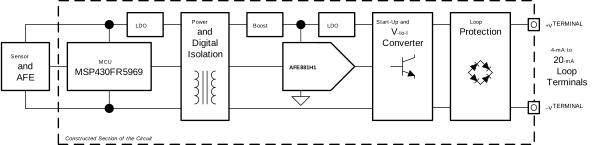 Figure 2-2 2-wire Transmitter Design Using an
AFE881H1 Block Diagram
Figure 2-2 2-wire Transmitter Design Using an
AFE881H1 Block DiagramThe terminals connected to the loop are shown on the right side of the block diagram. This connection to the loop powers the entire transmitter. A bridge rectifier at the input protects against reverse connection to the loop. The rectified loop voltage powers a start-up circuit that provides power to a low-dropout regulator (LDO), that in turn powers the AFE881H1. The LDO powers a fly-back converter acting as a boost and supplies power across an isolation barrier. On the other side of the isolation barrier, another LDO powers the MCU and any sensor connected to the transmitter. The LDOs also power the digital signal isolation on each side of the barrier.
HART communications are translated with the AFE881H1 HART modem. The device receives the HART signal through a capacitive coupled connection to the positive terminal side after the loop protection to the board. The HART signal is transmitted to the loop through the voltage-to-current (V-to-I) stage of the board.
Note that this transmitter board does not have a sensor to transmit data. The loop current is nominally set to 4mA as an output, except for specific HART tests. The main purpose of this board is to test the HART communication functionality of the AFE881H1.