SLAAEH8 October 2024 AFE781H1 , AFE782H1 , AFE881H1 , AFE882H1 , DAC8740H , DAC8741H , DAC8742H
- 1
- Abstract
- Trademarks
- 1Introduction
- 2AFE881H1 HART Modem
-
3HART Testing and Registration
- 3.1 HART History and the FieldComm Group
- 3.2 HART Testing Overview
- 3.3 HART Test Equipment
- 3.4 HART Physical Layer Testing
- 3.5 Data Link Layer Tests
- 3.6 Universal Command Tests
- 3.7 Common-Practice Command Tests
- 3.8 Device Specific Command Tests
- 3.9 HART Protocol Test Submission
- 3.10 HART Registration
- 4Other TI HART Modem Designs
- 5Summary
- 6Acknowledgments
- 7References
1.1 The 4-20mA Loop
Understanding the 4-20mA loop is essential to explaining how HART is implemented in a field transmitter. The 4-20mA loop is a standard signaling method often used in factory automation and control to transmit information on a current loop. A sensor at a remote location measures a process variable and sets the current through the loop to indicate the measurement value. Figure 1-1 shows basic diagram of the loop.
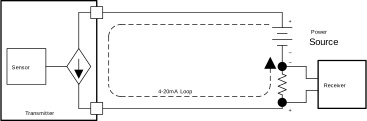 Figure 1-1 Components of the 4-20mA loop
The 4-20mA loop has four basic components. The first component is the loop. Each transmitter operates on a separate loop and a receiver measures the current in the loop across a resistor. The loop is simple, durable, and easy to debug. The loop is robust against electrical noise, making the loop reliable for long-distance transmissions. The 4-20mA loop can be extended to 500 meters or longer. The loop is also cost-effective and already commonly exists in many factory automation and control systems.
Second, the loop has a transmitter with a sensor used in process control. This sensor measures a parameter such as pressure, temperature, flow, or any other input for an industrial process or factory floor. The transmitter converts the measurement into the current value in the loop. For example, a transmitter measures the temperature of an oven from between 100°C to 500°C. In the 4-20mA loop, 4mA is used as the minimum value of the measurement and 20mA is used as the maximum value of the measurement. In that case, 4mA translates to 100°C and 20mA translates to 500°C. All measurements are linearly converted to this current value. In some systems, loop currents under 4mA and currents over 20mA can be used to indicate some error from the transmitter. For transmitters compliant to the NAMUR NE 43 standard, currents below 3.6mA or above 21mA are interpreted as a sensor fault. For designers of these systems, noise, resolution, and linearity are all important parameters for transmitter design.
Next, the loop has a power supply capable of sourcing at least 20mA. If NAMUR fault levels are supported by the transmitter, then higher levels of current are needed to indicate an error. The power supply is often a standard voltage of 24V. However, voltages of 36V, 15V, 12V or other voltage can be seen depending on the system. This power supply sends current through the loop and often also powers the transmitter.
Finally, there is a receiver that measures the current on the loop. The receiver measures the voltage across a series resistance. The current is calculated and converted to the primary variable. A load resistance of typically 250Ω is measured with an ADC to convert the primary variable back to the measured result from the transmitter.